
Climate change and environmental issues are massive topics for your...
 Spanish3 megtekintések·Frissítve Jun 14, 2026·7 oldal
Understanding Climate Change and Global Challenges

1 / 7
1
of 7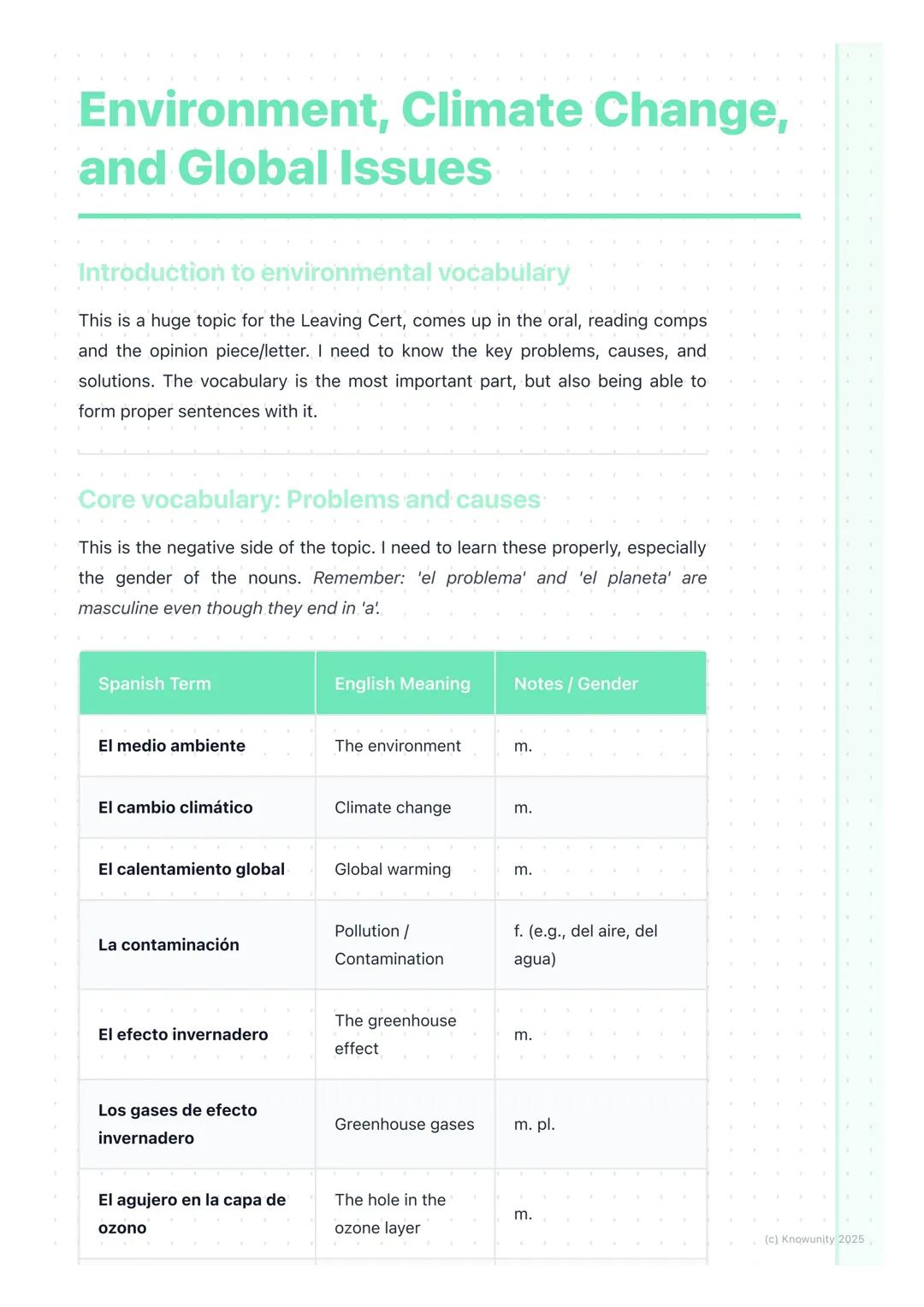
Environment, Climate Change, and Global Issues
Getting your head around environmental Spanish might seem daunting, but loads of these words are cognates - they look similar to English, which makes your life easier. The tricky bit is nailing the pronunciation and gender of nouns.
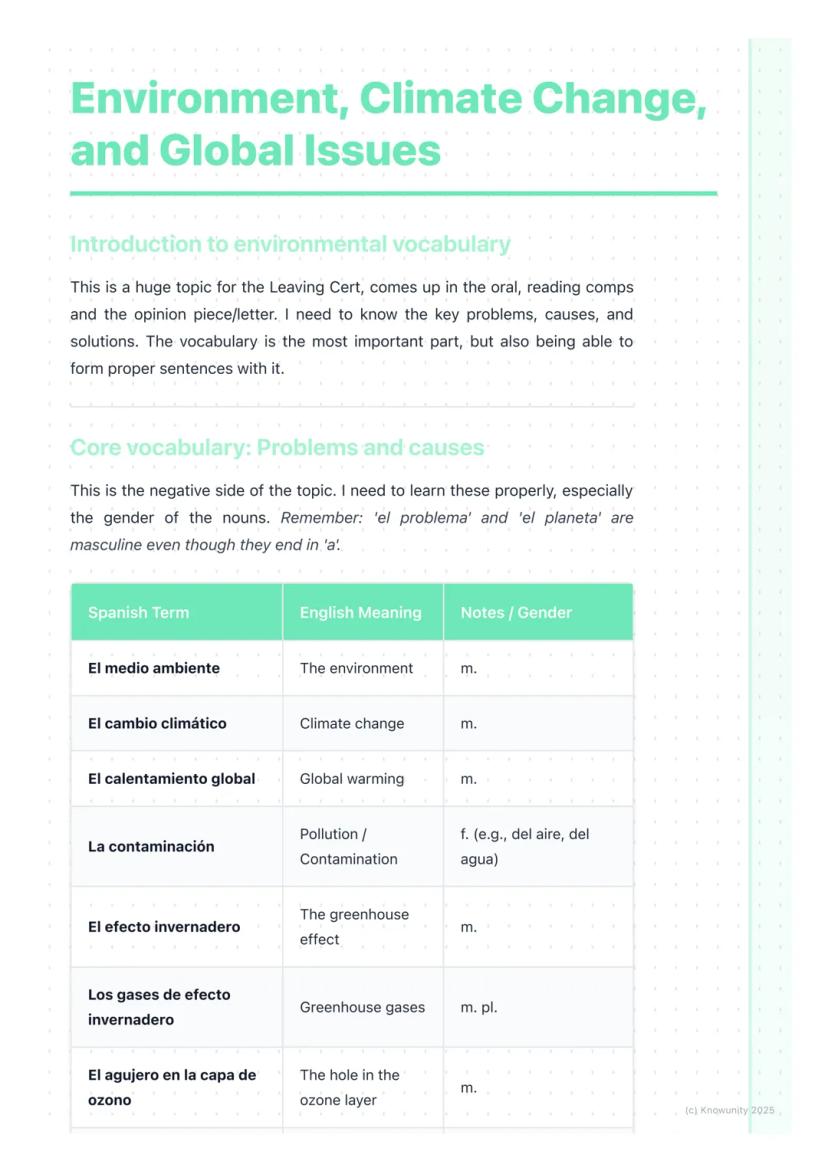
Watch out for sneaky masculine nouns like el problema and el planeta - they end in 'a' but they're still masculine! Key terms you absolutely need to know include el medio ambiente (environment), el cambio climático (climate change), and la contaminación (pollution).
Remember: La contaminación is a big one that comes up constantly - it can refer to air pollution (del aire) or water pollution (del agua).
Quick Tip: Most of these environmental terms are cognates, so focus on getting the gender and pronunciation spot-on rather than memorising completely new words.
2
of 7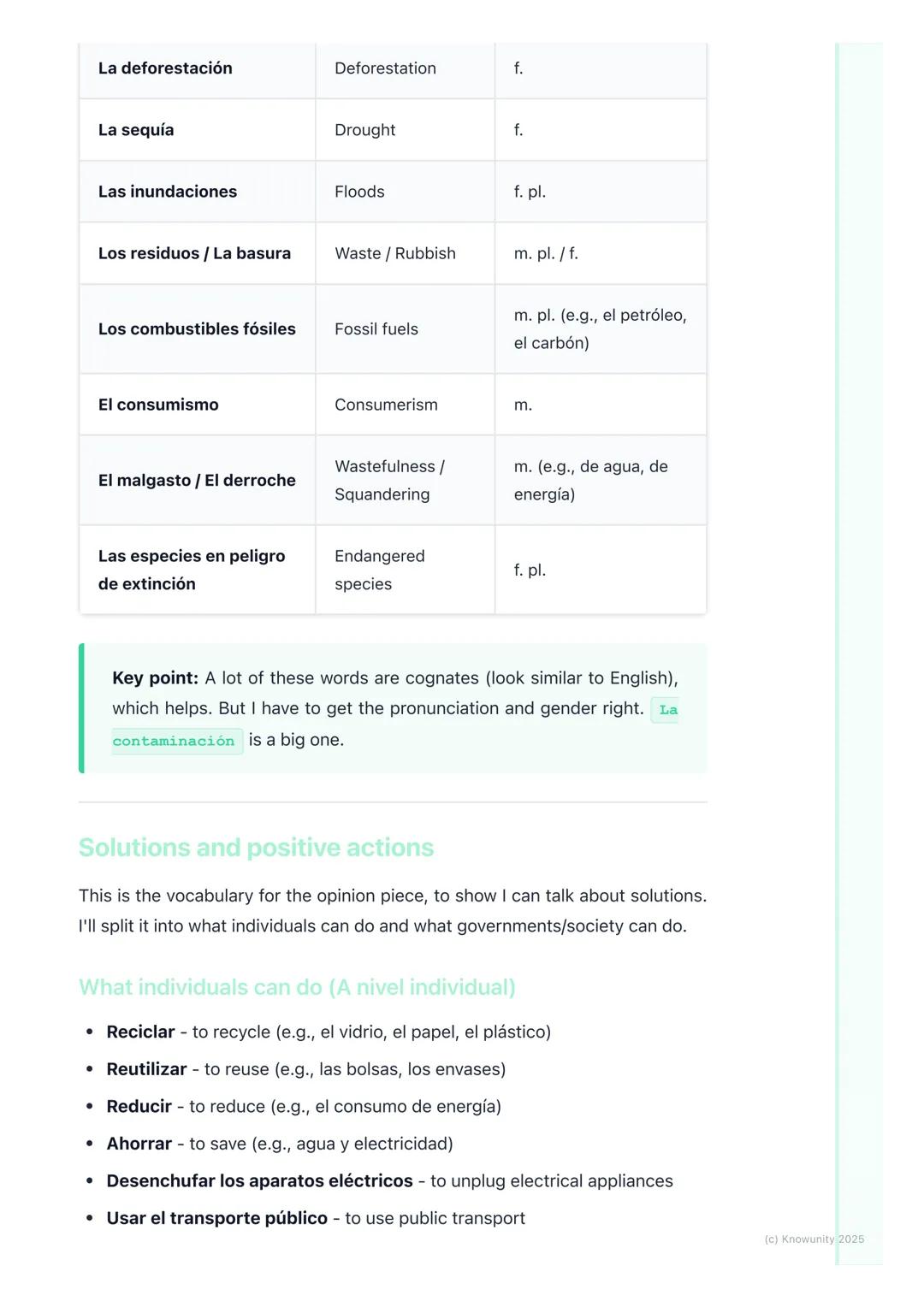
Problems and Causes - The Negative Side
Here's where you learn to talk about what's going wrong with our planet. Deforestation (la deforestación), droughts (la sequía), and floods (las inundaciones) are your go-to disaster vocabulary.
Don't forget about human-caused problems like consumerism (el consumismo) and fossil fuels (los combustibles fósiles). These include petrol (el petróleo) and coal (el carbón). Wastefulness translates to either el malgasto or el derroche.
Endangered species (las especies en peligro de extinción) is a mouthful, but it's crucial for discussing biodiversity. The greenhouse effect (el efecto invernadero) and greenhouse gases (los gases de efecto invernadero) are essential for climate discussions.
Exam Alert: These problem-focused terms are perfect for setting up arguments in opinion pieces - you need to identify issues before proposing solutions.
3
of 7
Individual Solutions - What You Can Do
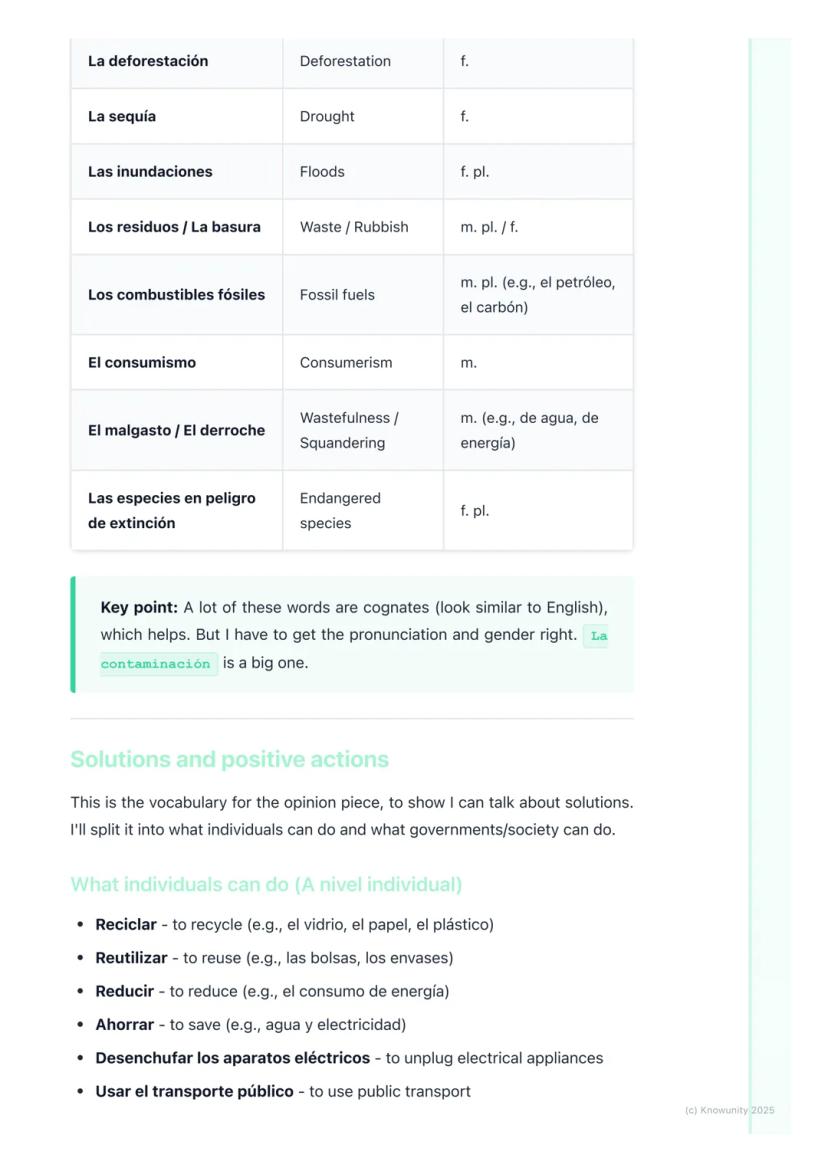
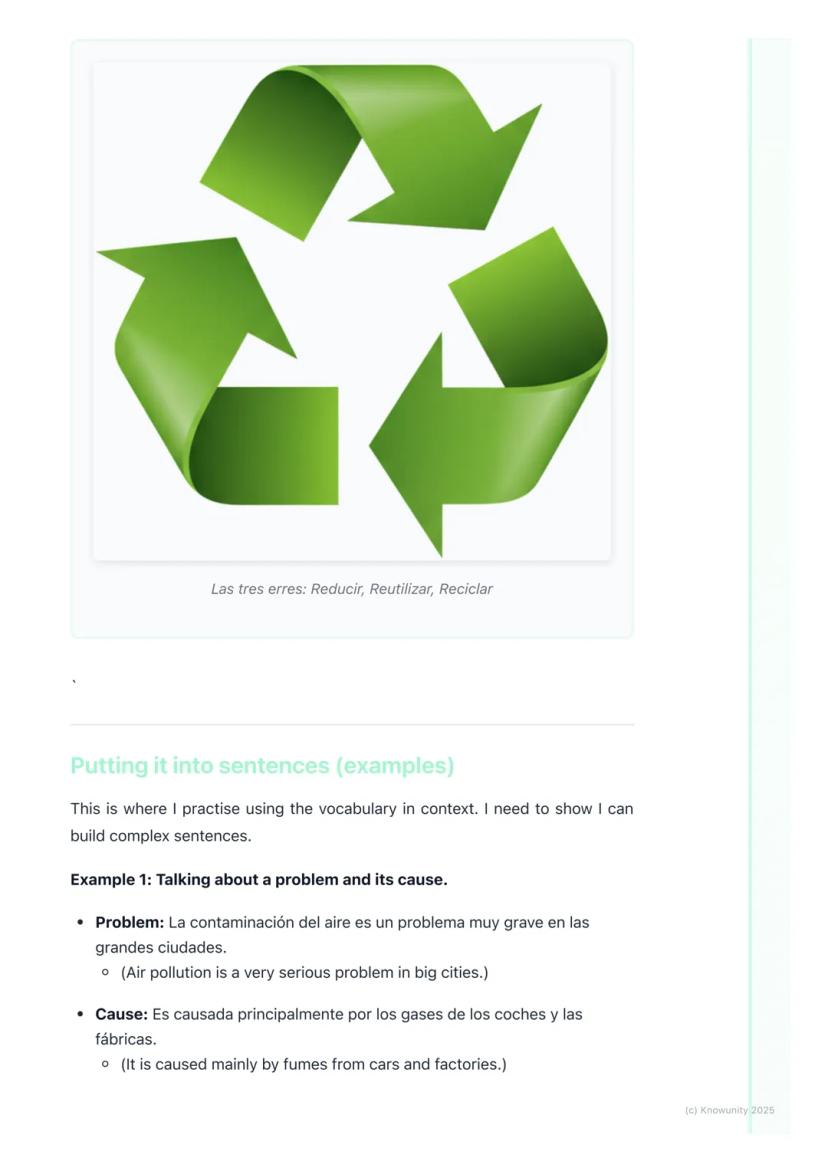
Now for the positive stuff! The three Rs (las tres erres) are your foundation: reducir (reduce), reutilizar (reuse), and reciclar (recycle). You can recycle glass (el vidrio), paper (el papel), and plastic (el plástico).
Simple actions make great exam material: ahorrar (save) water and electricity, desenchufar (unplug) electrical appliances, and usar el transporte público (use public transport). Going local works too - comprar productos locales (buy local products).
Planting trees (plantar árboles) and raising awareness (concienciar a los demás) show you're thinking beyond just personal actions. Avoiding single-use products (evitar los productos de un solo uso) is very current.
Writing Tip: Use these individual actions when discussing what "we" or "young people" can do - perfect for opinion piece conclusions.
4
of 7
Government and Global Solutions
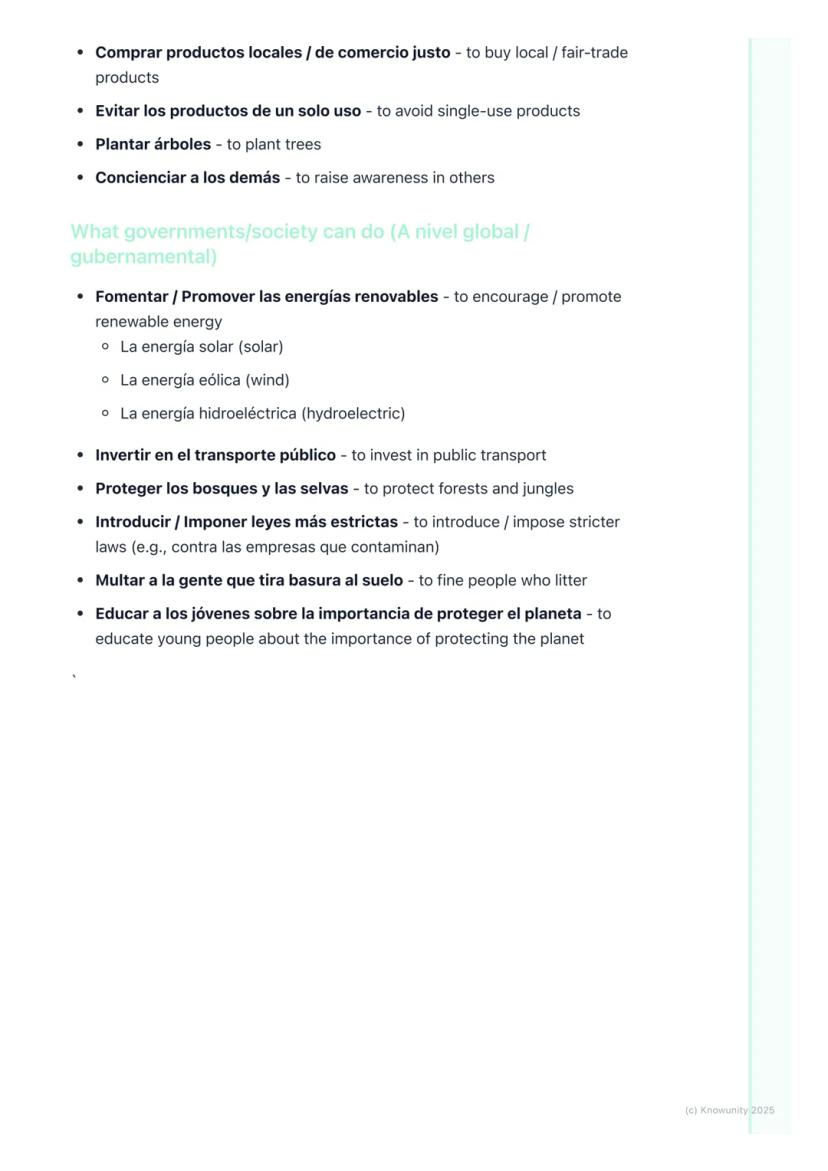
Governments need to encourage renewable energy (fomentar las energías renovables) - specifically solar (la energía solar), wind (la energía eólica), and hydroelectric (la energía hidroeléctrica) power. These are exam gold.
Investing in public transport (invertir en el transporte público) and protecting forests (proteger los bosques y las selvas) are major policy moves. Governments can also impose stricter laws (imponer leyes más estrictas) against polluting companies.
Fining litterers (multar a la gente que tira basura) and educating young people (educar a los jóvenes) about environmental protection show different approaches. Use these when discussing what governments "should do" or "must do".
Grammar Alert: These government actions work brilliantly with "Es necesario que..." + subjunctive - you're showing off complex grammar whilst discussing solutions.
5
of 7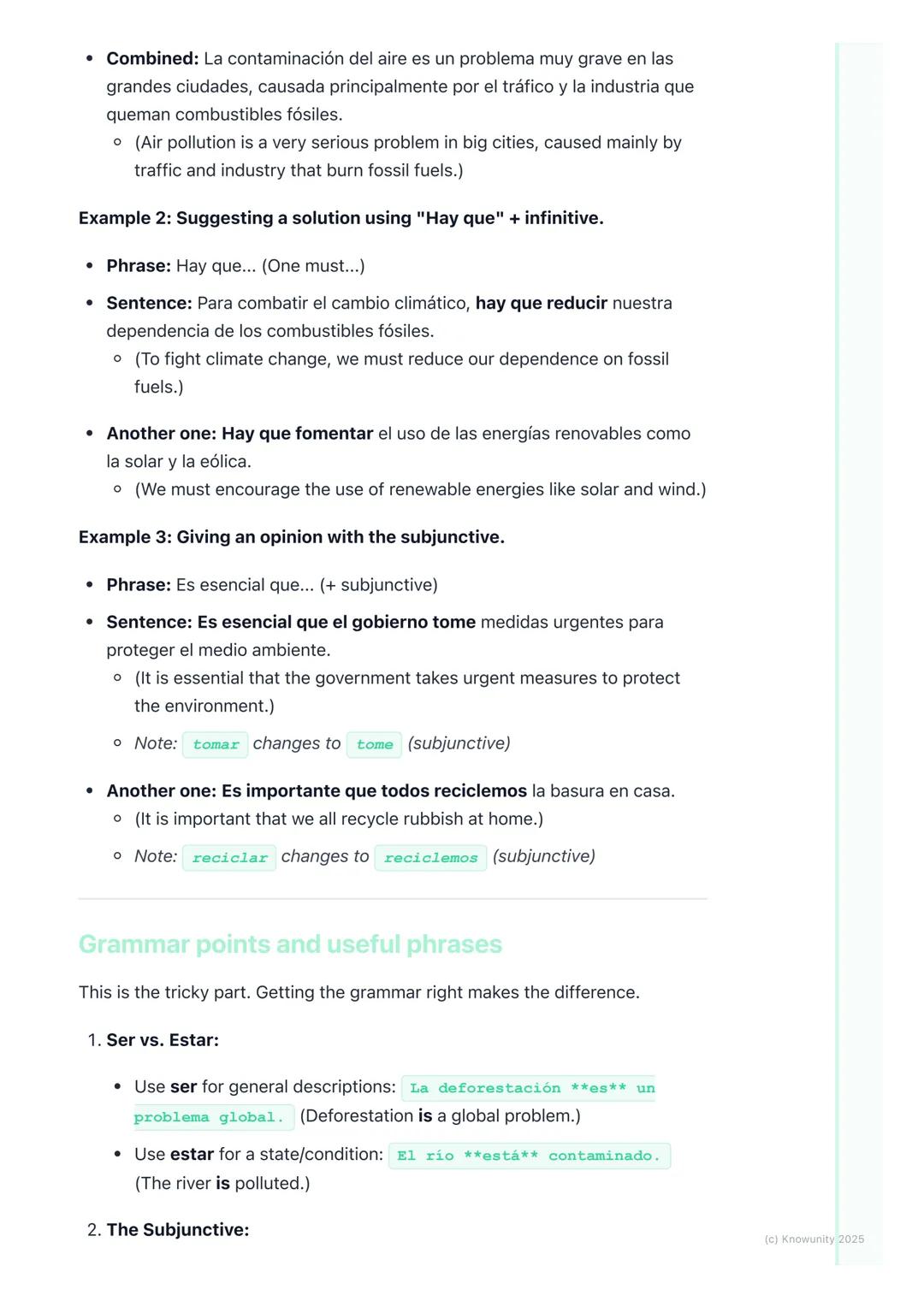
Building Complex Sentences
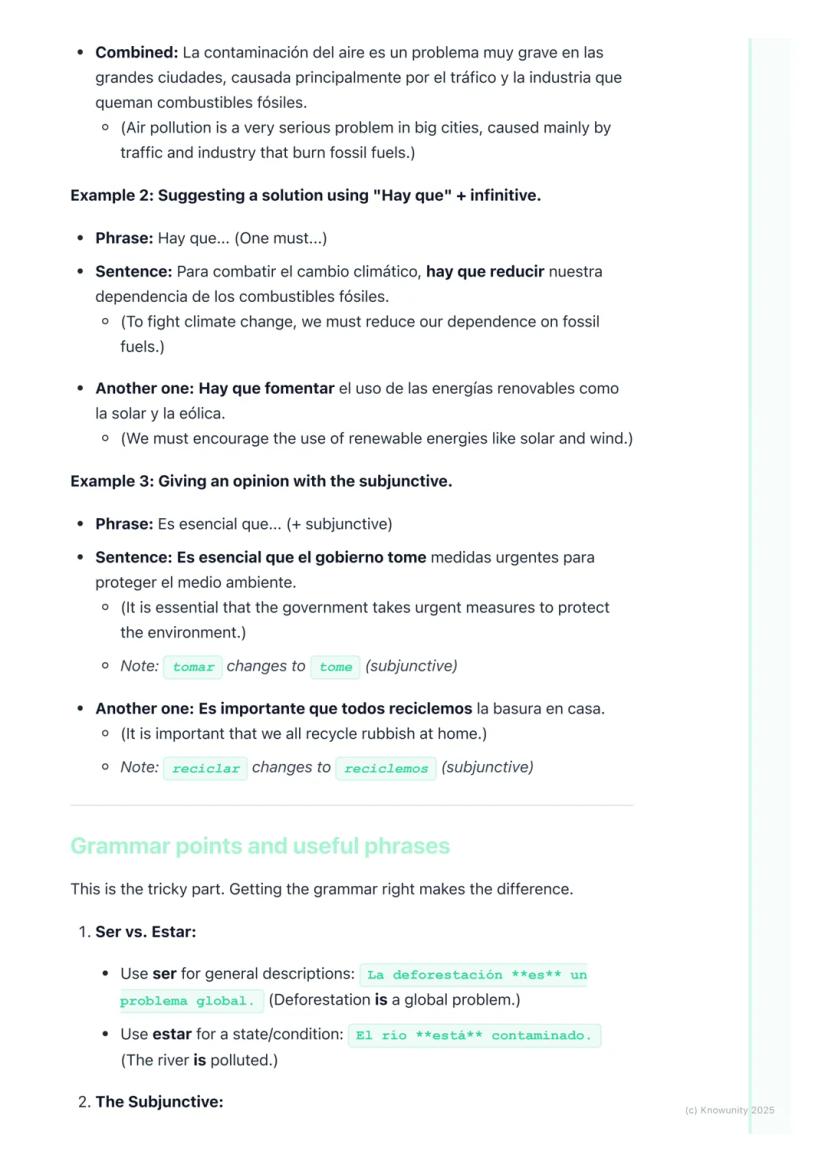
Right, this is where you move from knowing vocabulary to actually impressing examiners. Combining problems with causes makes your Spanish sound sophisticated: "La contaminación del aire es causada principalmente por el tráfico" (Air pollution is caused mainly by traffic).
"Hay que" + infinitive is your best friend for suggestions. "Para combatir el cambio climático, hay que reducir nuestra dependencia de los combustibles fósiles" (To fight climate change, we must reduce our dependence on fossil fuels).
The subjunctive after opinion expressions shows advanced grammar. "Es esencial que el gobierno tome medidas urgentes" (It's essential that the government takes urgent measures). Notice how "tomar" becomes "tome" - that's the subjunctive working.
Exam Success: Don't just list vocabulary - weave it into complex sentences using these structures to show you can actually use Spanish, not just memorise it.
6
of 7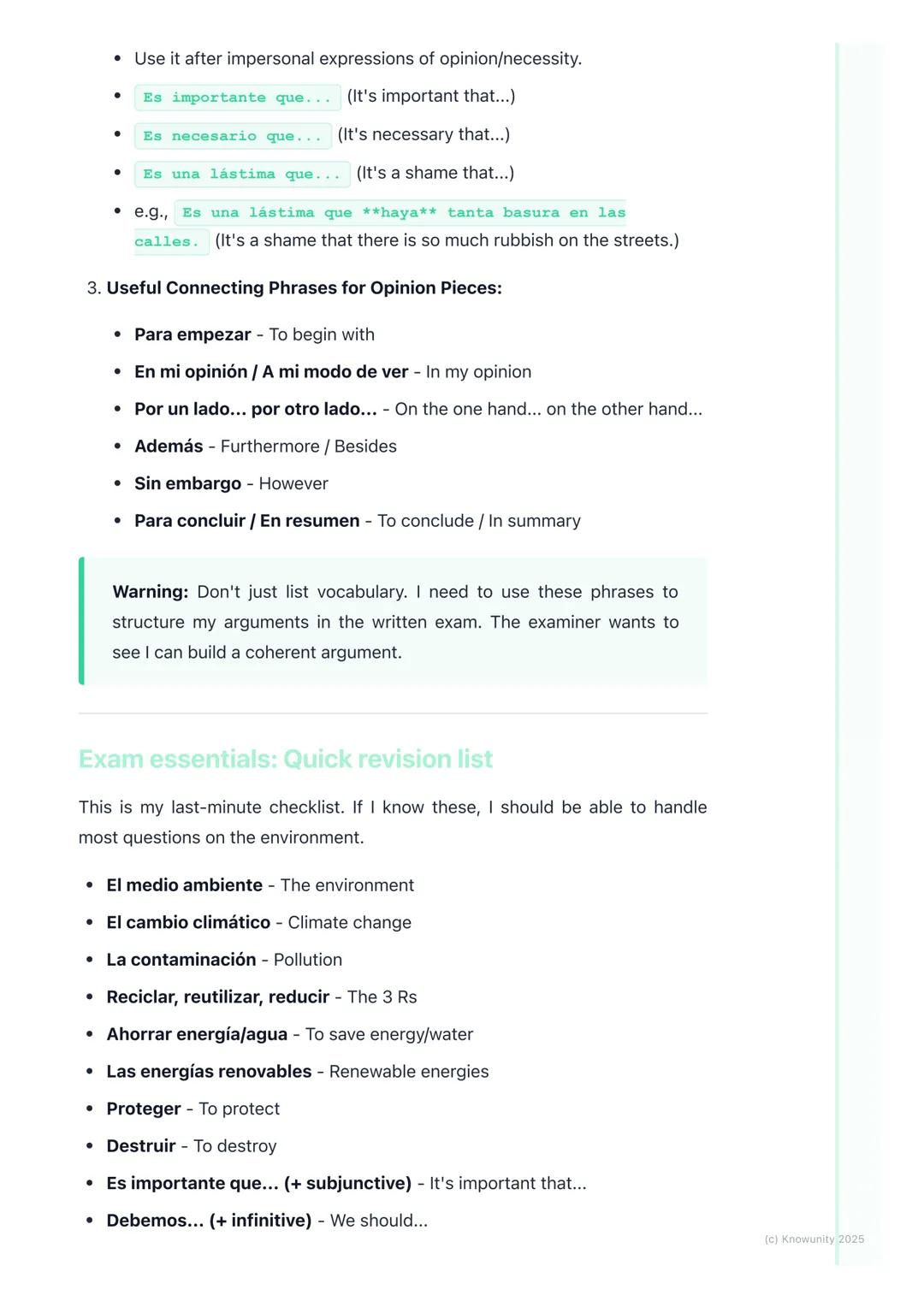
Grammar Points and Useful Phrases
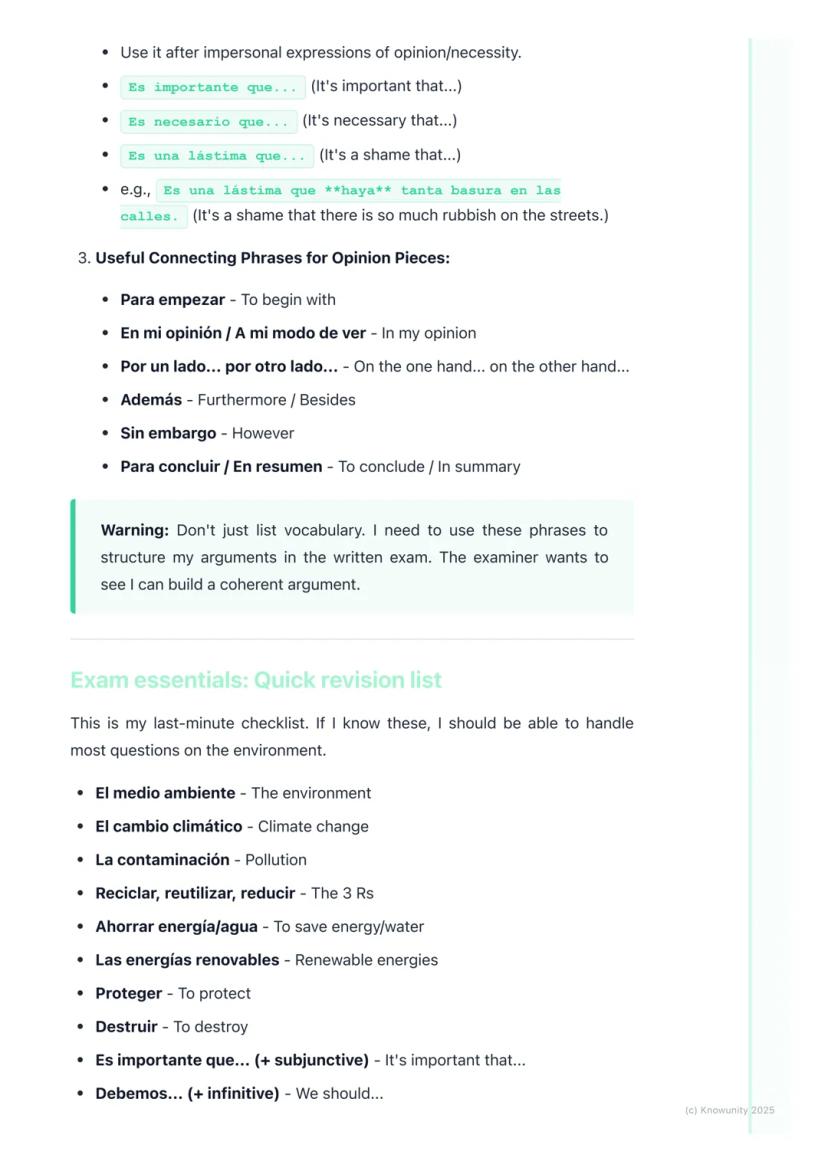
Ser vs. estar trips loads of students up. Use ser for general descriptions: "La deforestación es un problema global." Use estar for current states: "El río está contaminado."
Master these connecting phrases for opinion pieces: Para empezar (to begin with), además (furthermore), sin embargo (however), and para concluir (to conclude). These structure your arguments properly.
The subjunctive appears after expressions like "Es importante que..." and "Es necesario que..." Remember it shows necessity or opinion, not facts. "Es una lástima que haya tanta basura" uses "haya" (subjunctive of "hay").
Quick Check: If you can use "Es importante que..." + subjunctive with environmental vocabulary, you're showing both advanced grammar and topic knowledge - exactly what examiners want to see.
7
of 7
Exam Essentials - Your Quick Revision List
Here's your last-minute survival kit. Know these terms and you can handle most environmental questions: el medio ambiente, el cambio climático, la contaminación, las energías renovables, and proteger.
Master these key phrases: "Es importante que..." , "Debemos..." , and "Hay que..." . They're your go-to structures for expressing opinions and solutions.
Don't forget the key players: el gobierno (government), los jóvenes (young people), el planeta (planet), and el futuro (future). These give you the "who" and "why" for your environmental arguments.
Final Tip: Practice combining these essentials into flowing sentences - that's what separates good answers from great ones in your Leaving Cert exam.
Azt hittük, soha nem fogod megkérdezni...
Mi a Knowunity MI társ?
MI Társunk egy diákközpontú MI eszköz, amely többet nyújt puszta válaszoknál. Millió Knowunity erőforrásra épülve releváns információkat, személyre szabott tanulási terveket, kvízeket és tartalmat biztosít közvetlenül a chatben, alkalmazkodva az egyéni tanulási utadhoz.
Honnan tudom letölteni a Knowunity appot?
Az appot letöltheted a Google Play Store-ból és az Apple App Store-ból.
Tényleg ingyenes a Knowunity?
Pontosan! Élvezd az ingyenes hozzáférést a tanulási tartalmakhoz, kapcsolódj diáktársaiddal, és kapj azonnali segítséget – mind a kezed ügyében.
Legnépszerűbb tananyagok Spanish tantárgyból
2SpanishTechnology, Social Media, and Digital Life
Learners will gain vocabulary to discuss modern technology, internet usage, social networking, and their impact on daily life.
5th Year20
SpanishComparatives and Superlatives
Students will learn how to compare people and things using comparative structures ('más... que', 'menos... que') and superlative forms ('el/la más...').
TY70
Legnépszerűbb tananyagok
9 Irish
IrishIrish oral questions and answers
Questions and answers for the leaving cert oral
5th Year4264
 English
Key Quotes : Sive
Key Quotes and explanations: Sive
6th Year2842
IrishIrish oral questions
Outline of oral questions
5th Year2055
IrishIníon- le hÁine Durkin
Aine Durkin’s poem, Iníon: Themes & summary
5th Year890
IrishIrish poetry 2027
Iníon + Dínit an Bhróin
5th Year1153
IrishLC HL notes- Iníon (poem)
Includes poem in English and Irish, theme, key words & phrases
5th Year2304
EnglishCultural Context : Shawshank Redemption : Sive : Small Things Like These
Comparative Study : Cultural Context : Shawshank Redemption, Sive and Small Things Like These
6th Year1430
IrishMo Ghrá-sa (Idir Lúibíní)
Notes on mo ghrá-sa
5th Year380
IrishAn Gaeilge Aiste
Irish Language essay
6th Year1320
Nem találod amit keresel? Fedezz fel más tantárgyakat.
A diákok imádnak minket — és téged is fognak.
4.6/5App Store
4.7/5Google Play
Az alkalmazás nagyon könnyen használható és jól megtervezett. Mindent megtaláltam, amit eddig kerestem, és sokat tudtam tanulni a prezentációkból! Biztosan használni fogom az alkalmazást egy osztályfeladathoz! És persze inspirációként is nagyszerűen segít.
Stefan SiOS felhasználó
Ez az alkalmazás tényleg nagyszerű. Olyan sok tanulási jegyzet és segítség van benne [...]. Például a francia a problémás tantárgyam, és az alkalmazásban olyan sok segítség lehetőség van. Ennek az alkalmazásnak köszönhetően javult a franciám. Mindenkinek ajánlanám.
Samantha KlichAndroid felhasználó
Hű, tényleg lenyűgözött. Csak úgy kipróbáltam az alkalmazást, mert sokszor láttam reklámozva, és teljesen megdöbbentett. Ez az alkalmazás AZ A SEGÍTSÉG, amire az iskolában szükséged van, és mindenekelőtt olyan sok mindent kínál, mint például gyakorlatokat és összefoglalókat, amik nekem személyesen NAGYON hasznosak voltak.
AnnaiOS felhasználó
Spanish3 megtekintések·Frissítve Jun 14, 2026·7 oldalUnderstanding Climate Change and Global Challenges
Climate change and environmental issues are massive topics for your Leaving Cert Spanish - they pop up everywhere from oral exams to opinion pieces. Mastering the vocabulary and being able to form proper sentences with it is your key to...
1
of 7
Regisztrálj, hogy lásd a tartalmat. Teljesen ingyenes!
- Hozzáférés minden dokumentumhoz
- Javítsd a jegyeidet
- Csatlakozz diákok millióihoz
Environment, Climate Change, and Global Issues
Getting your head around environmental Spanish might seem daunting, but loads of these words are cognates - they look similar to English, which makes your life easier. The tricky bit is nailing the pronunciation and gender of nouns.
Watch out for sneaky masculine nouns like el problema and el planeta - they end in 'a' but they're still masculine! Key terms you absolutely need to know include el medio ambiente (environment), el cambio climático (climate change), and la contaminación (pollution).
Remember: La contaminación is a big one that comes up constantly - it can refer to air pollution (del aire) or water pollution (del agua).
Quick Tip: Most of these environmental terms are cognates, so focus on getting the gender and pronunciation spot-on rather than memorising completely new words.
2
of 7Regisztrálj, hogy lásd a tartalmat. Teljesen ingyenes!
- Hozzáférés minden dokumentumhoz
- Javítsd a jegyeidet
- Csatlakozz diákok millióihoz
Problems and Causes - The Negative Side
Here's where you learn to talk about what's going wrong with our planet. Deforestation (la deforestación), droughts (la sequía), and floods (las inundaciones) are your go-to disaster vocabulary.
Don't forget about human-caused problems like consumerism (el consumismo) and fossil fuels (los combustibles fósiles). These include petrol (el petróleo) and coal (el carbón). Wastefulness translates to either el malgasto or el derroche.
Endangered species (las especies en peligro de extinción) is a mouthful, but it's crucial for discussing biodiversity. The greenhouse effect (el efecto invernadero) and greenhouse gases (los gases de efecto invernadero) are essential for climate discussions.
Exam Alert: These problem-focused terms are perfect for setting up arguments in opinion pieces - you need to identify issues before proposing solutions.
3
of 7Regisztrálj, hogy lásd a tartalmat. Teljesen ingyenes!
- Hozzáférés minden dokumentumhoz
- Javítsd a jegyeidet
- Csatlakozz diákok millióihoz
Individual Solutions - What You Can Do
Now for the positive stuff! The three Rs (las tres erres) are your foundation: reducir (reduce), reutilizar (reuse), and reciclar (recycle). You can recycle glass (el vidrio), paper (el papel), and plastic (el plástico).
Simple actions make great exam material: ahorrar (save) water and electricity, desenchufar (unplug) electrical appliances, and usar el transporte público (use public transport). Going local works too - comprar productos locales (buy local products).
Planting trees (plantar árboles) and raising awareness (concienciar a los demás) show you're thinking beyond just personal actions. Avoiding single-use products (evitar los productos de un solo uso) is very current.
Writing Tip: Use these individual actions when discussing what "we" or "young people" can do - perfect for opinion piece conclusions.
4
of 7Regisztrálj, hogy lásd a tartalmat. Teljesen ingyenes!
- Hozzáférés minden dokumentumhoz
- Javítsd a jegyeidet
- Csatlakozz diákok millióihoz
Government and Global Solutions
Governments need to encourage renewable energy (fomentar las energías renovables) - specifically solar (la energía solar), wind (la energía eólica), and hydroelectric (la energía hidroeléctrica) power. These are exam gold.
Investing in public transport (invertir en el transporte público) and protecting forests (proteger los bosques y las selvas) are major policy moves. Governments can also impose stricter laws (imponer leyes más estrictas) against polluting companies.
Fining litterers (multar a la gente que tira basura) and educating young people (educar a los jóvenes) about environmental protection show different approaches. Use these when discussing what governments "should do" or "must do".
Grammar Alert: These government actions work brilliantly with "Es necesario que..." + subjunctive - you're showing off complex grammar whilst discussing solutions.
5
of 7Regisztrálj, hogy lásd a tartalmat. Teljesen ingyenes!
- Hozzáférés minden dokumentumhoz
- Javítsd a jegyeidet
- Csatlakozz diákok millióihoz
Building Complex Sentences
Right, this is where you move from knowing vocabulary to actually impressing examiners. Combining problems with causes makes your Spanish sound sophisticated: "La contaminación del aire es causada principalmente por el tráfico" (Air pollution is caused mainly by traffic).
"Hay que" + infinitive is your best friend for suggestions. "Para combatir el cambio climático, hay que reducir nuestra dependencia de los combustibles fósiles" (To fight climate change, we must reduce our dependence on fossil fuels).
The subjunctive after opinion expressions shows advanced grammar. "Es esencial que el gobierno tome medidas urgentes" (It's essential that the government takes urgent measures). Notice how "tomar" becomes "tome" - that's the subjunctive working.
Exam Success: Don't just list vocabulary - weave it into complex sentences using these structures to show you can actually use Spanish, not just memorise it.
6
of 7Regisztrálj, hogy lásd a tartalmat. Teljesen ingyenes!
- Hozzáférés minden dokumentumhoz
- Javítsd a jegyeidet
- Csatlakozz diákok millióihoz
Grammar Points and Useful Phrases
Ser vs. estar trips loads of students up. Use ser for general descriptions: "La deforestación es un problema global." Use estar for current states: "El río está contaminado."
Master these connecting phrases for opinion pieces: Para empezar (to begin with), además (furthermore), sin embargo (however), and para concluir (to conclude). These structure your arguments properly.
The subjunctive appears after expressions like "Es importante que..." and "Es necesario que..." Remember it shows necessity or opinion, not facts. "Es una lástima que haya tanta basura" uses "haya" (subjunctive of "hay").
Quick Check: If you can use "Es importante que..." + subjunctive with environmental vocabulary, you're showing both advanced grammar and topic knowledge - exactly what examiners want to see.
7
of 7Regisztrálj, hogy lásd a tartalmat. Teljesen ingyenes!
- Hozzáférés minden dokumentumhoz
- Javítsd a jegyeidet
- Csatlakozz diákok millióihoz
Exam Essentials - Your Quick Revision List
Here's your last-minute survival kit. Know these terms and you can handle most environmental questions: el medio ambiente, el cambio climático, la contaminación, las energías renovables, and proteger.
Master these key phrases: "Es importante que..." , "Debemos..." , and "Hay que..." . They're your go-to structures for expressing opinions and solutions.
Don't forget the key players: el gobierno (government), los jóvenes (young people), el planeta (planet), and el futuro (future). These give you the "who" and "why" for your environmental arguments.
Final Tip: Practice combining these essentials into flowing sentences - that's what separates good answers from great ones in your Leaving Cert exam.
Azt hittük, soha nem fogod megkérdezni...
Mi a Knowunity MI társ?
MI Társunk egy diákközpontú MI eszköz, amely többet nyújt puszta válaszoknál. Millió Knowunity erőforrásra épülve releváns információkat, személyre szabott tanulási terveket, kvízeket és tartalmat biztosít közvetlenül a chatben, alkalmazkodva az egyéni tanulási utadhoz.
Honnan tudom letölteni a Knowunity appot?
Az appot letöltheted a Google Play Store-ból és az Apple App Store-ból.
Tényleg ingyenes a Knowunity?
Pontosan! Élvezd az ingyenes hozzáférést a tanulási tartalmakhoz, kapcsolódj diáktársaiddal, és kapj azonnali segítséget – mind a kezed ügyében.
Legnépszerűbb tananyagok Spanish tantárgyból
2SpanishTechnology, Social Media, and Digital Life
Learners will gain vocabulary to discuss modern technology, internet usage, social networking, and their impact on daily life.
5th Year20
SpanishComparatives and Superlatives
Students will learn how to compare people and things using comparative structures ('más... que', 'menos... que') and superlative forms ('el/la más...').
TY70
Legnépszerűbb tananyagok
9IrishIrish oral questions and answers
Questions and answers for the leaving cert oral
5th Year4264
EnglishKey Quotes : Sive
Key Quotes and explanations: Sive
6th Year2842
IrishIrish oral questions
Outline of oral questions
5th Year2055
IrishIníon- le hÁine Durkin
Aine Durkin’s poem, Iníon: Themes & summary
5th Year890
IrishIrish poetry 2027
Iníon + Dínit an Bhróin
5th Year1153
IrishLC HL notes- Iníon (poem)
Includes poem in English and Irish, theme, key words & phrases
5th Year2304
EnglishCultural Context : Shawshank Redemption : Sive : Small Things Like These
Comparative Study : Cultural Context : Shawshank Redemption, Sive and Small Things Like These
6th Year1430
IrishMo Ghrá-sa (Idir Lúibíní)
Notes on mo ghrá-sa
5th Year380
IrishAn Gaeilge Aiste
Irish Language essay
6th Year1320
Nem találod amit keresel? Fedezz fel más tantárgyakat.
A diákok imádnak minket — és téged is fognak.
4.6/5App Store
4.7/5Google Play
Az alkalmazás nagyon könnyen használható és jól megtervezett. Mindent megtaláltam, amit eddig kerestem, és sokat tudtam tanulni a prezentációkból! Biztosan használni fogom az alkalmazást egy osztályfeladathoz! És persze inspirációként is nagyszerűen segít.
Stefan SiOS felhasználó
Ez az alkalmazás tényleg nagyszerű. Olyan sok tanulási jegyzet és segítség van benne [...]. Például a francia a problémás tantárgyam, és az alkalmazásban olyan sok segítség lehetőség van. Ennek az alkalmazásnak köszönhetően javult a franciám. Mindenkinek ajánlanám.
Samantha KlichAndroid felhasználó
Hű, tényleg lenyűgözött. Csak úgy kipróbáltam az alkalmazást, mert sokszor láttam reklámozva, és teljesen megdöbbentett. Ez az alkalmazás AZ A SEGÍTSÉG, amire az iskolában szükséged van, és mindenekelőtt olyan sok mindent kínál, mint például gyakorlatokat és összefoglalókat, amik nekem személyesen NAGYON hasznosak voltak.
AnnaiOS felhasználó