
Spanish and Latin American culture has given the world some...
 Spanish1 megtekintések·Frissítve Jun 15, 2026·6 oldal
Exploring Key Figures in Spanish Art, Music, and Literature
1 / 6
1
of 6
Key Cultural Figures and Movements
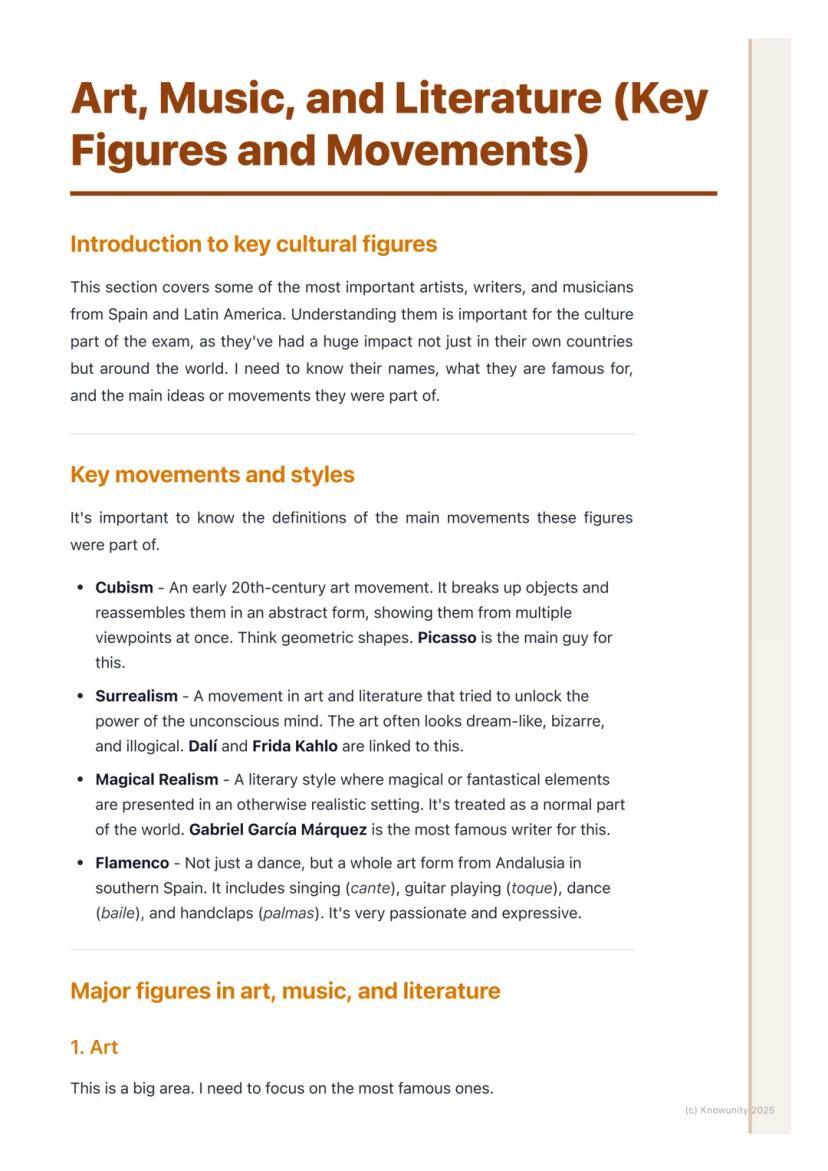
You're about to meet some absolute legends who've shaped culture worldwide. These aren't just names to memorise - they're the people who broke all the rules and created entirely new ways of seeing the world.
Cubism completely revolutionised art by showing objects from multiple angles at once, like seeing all sides of a face simultaneously. Surrealism dove deep into the weird world of dreams and the unconscious mind, creating art that looks like it came straight from your strangest nightmare.
Magical Realism in literature treats impossible things as perfectly normal - imagine a story where someone floats away whilst drinking tea, and everyone just carries on with their conversation. Flamenco isn't just a dance you've seen on holiday - it's a complete art form that combines passionate singing, intricate guitar work, and intense movement to express the deepest human emotions.
Remember: These movements didn't just appear randomly - they were responses to wars, social changes, and artists' desires to express things that traditional art couldn't capture.
2
of 6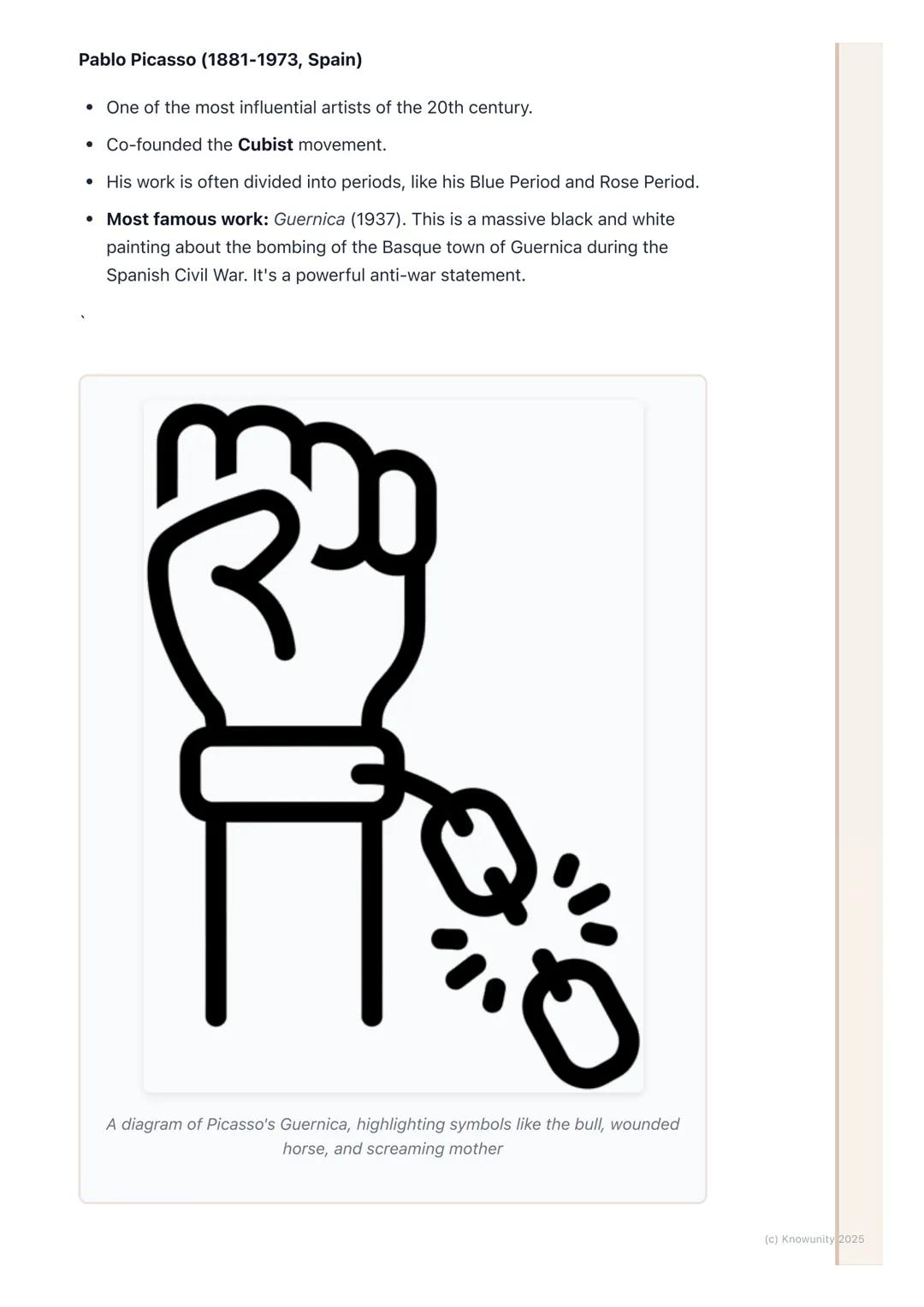
Pablo Picasso - The Revolutionary
Picasso didn't just paint pretty pictures - he completely smashed the rules of how art should look. This Spanish genius co-created Cubism, showing us that you don't need to paint things exactly as your eyes see them.
His masterpiece Guernica isn't something you'd hang in your living room for decoration. This massive black and white painting screams about the horrors of war, specifically the bombing of a Basque town during the Spanish Civil War. The twisted figures, screaming horse, and grieving mother make it impossible to ignore the message.
What makes Picasso brilliant is how he used geometric shapes and multiple viewpoints to show emotion and movement. When you look at Guernica, you're not just seeing one moment - you're experiencing the chaos and terror from every angle simultaneously.
Exam tip: Always connect Guernica to its anti-war message. It's not just about technique - it's about using art to protest violence and suffering.
3
of 6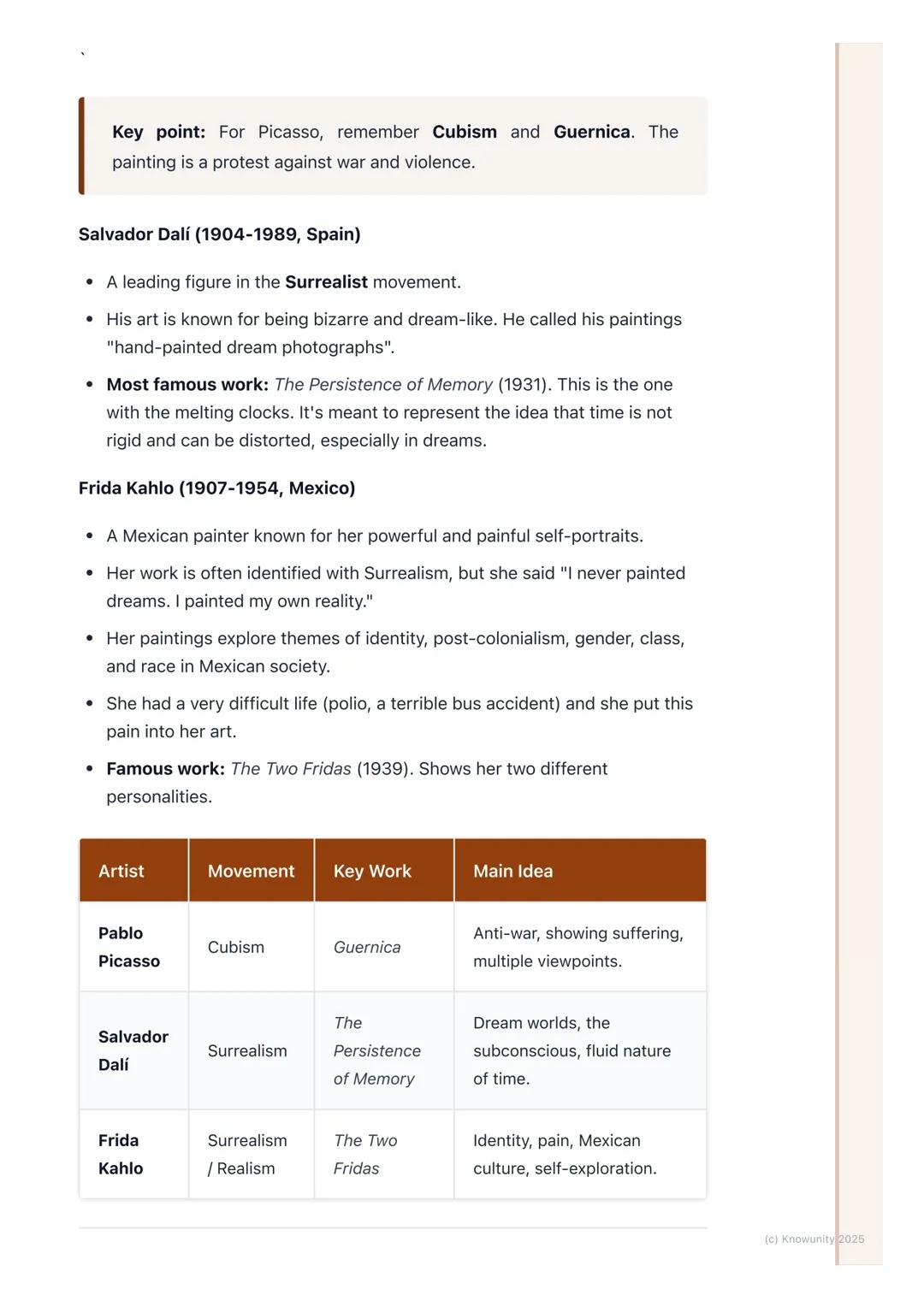
Salvador Dalí and Frida Kahlo - Masters of the Mind
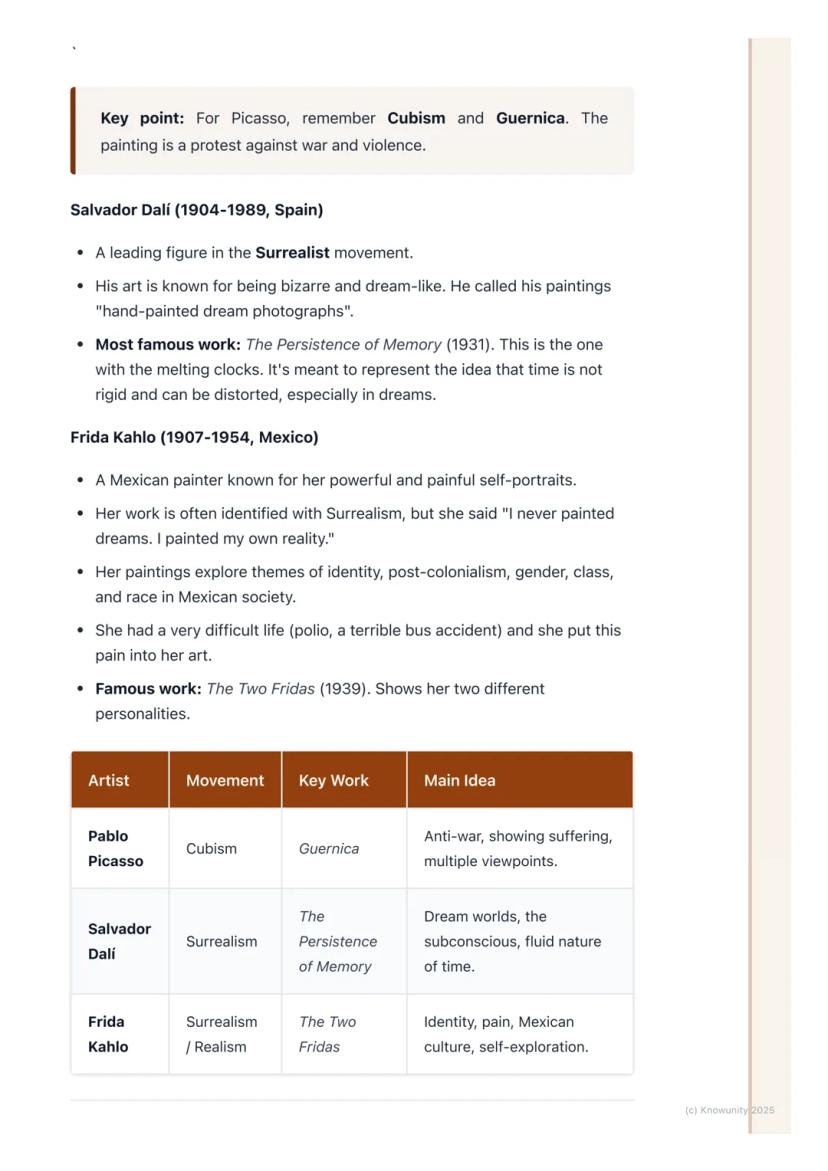
Salvador Dalí painted what he called "hand-painted dream photographs" - and they're exactly as weird as that sounds. His famous melting clocks in The Persistence of Memory show how time becomes fluid and strange in our dreams and memories.
Dalí was part of the Surrealist movement, which explored the unconscious mind. His paintings look like the bizarre logic of dreams, where normal rules don't apply and anything can happen.
Frida Kahlo from Mexico created intensely personal art that explored identity, pain, and Mexican culture. Though often linked with Surrealism, she insisted she painted her reality, not dreams. Her self-portraits, like The Two Fridas, show her complex identity and the physical and emotional pain that shaped her life.
Both artists prove that art can be a way to explore the deepest parts of human experience - whether through dreams or brutal honesty about life's struggles.
Don't confuse: Dalí = dreams and melting clocks; Kahlo = personal reality and Mexican identity. Both deal with the mind, but in completely different ways.
4
of 6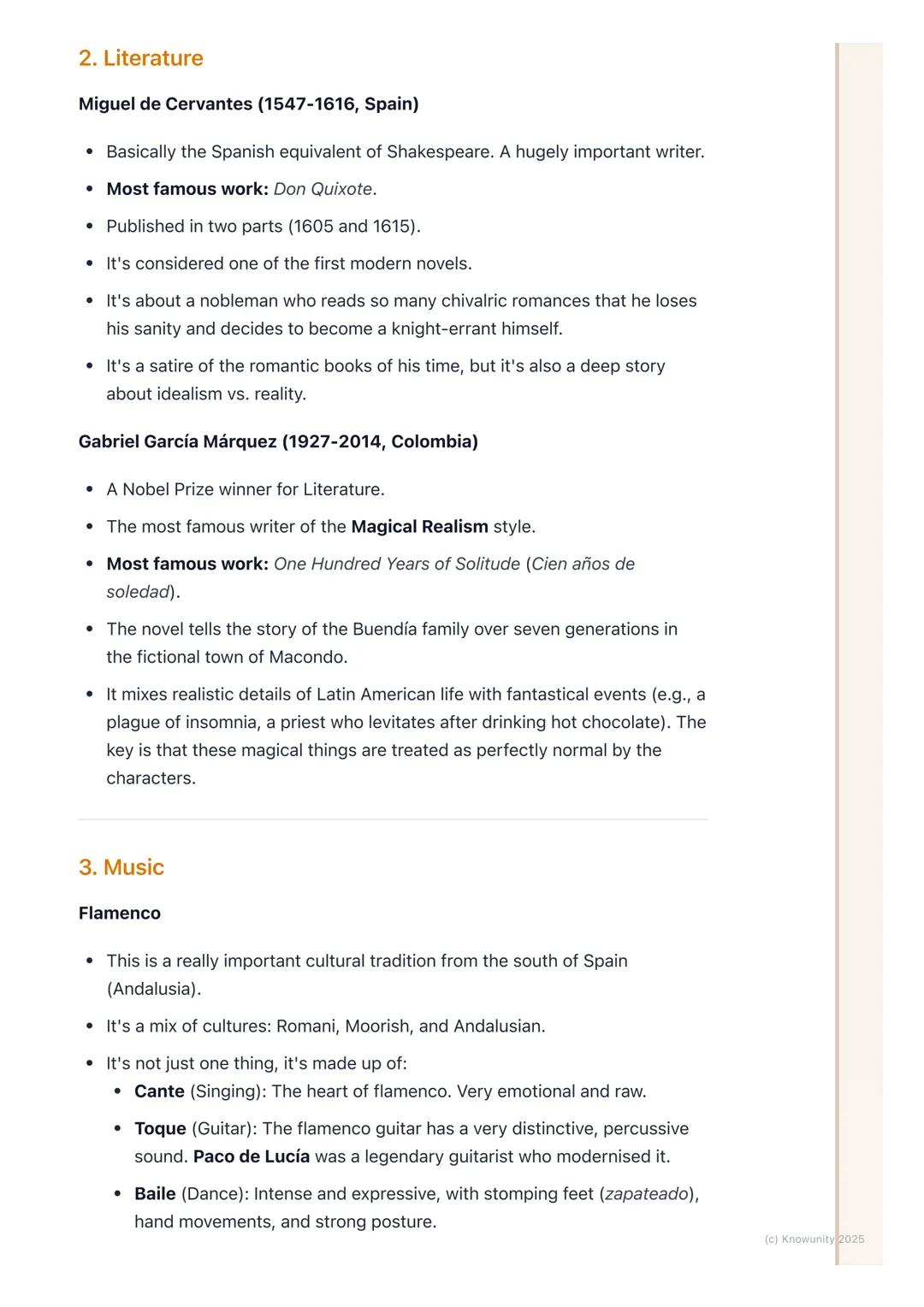
Literary Giants - Cervantes and García Márquez
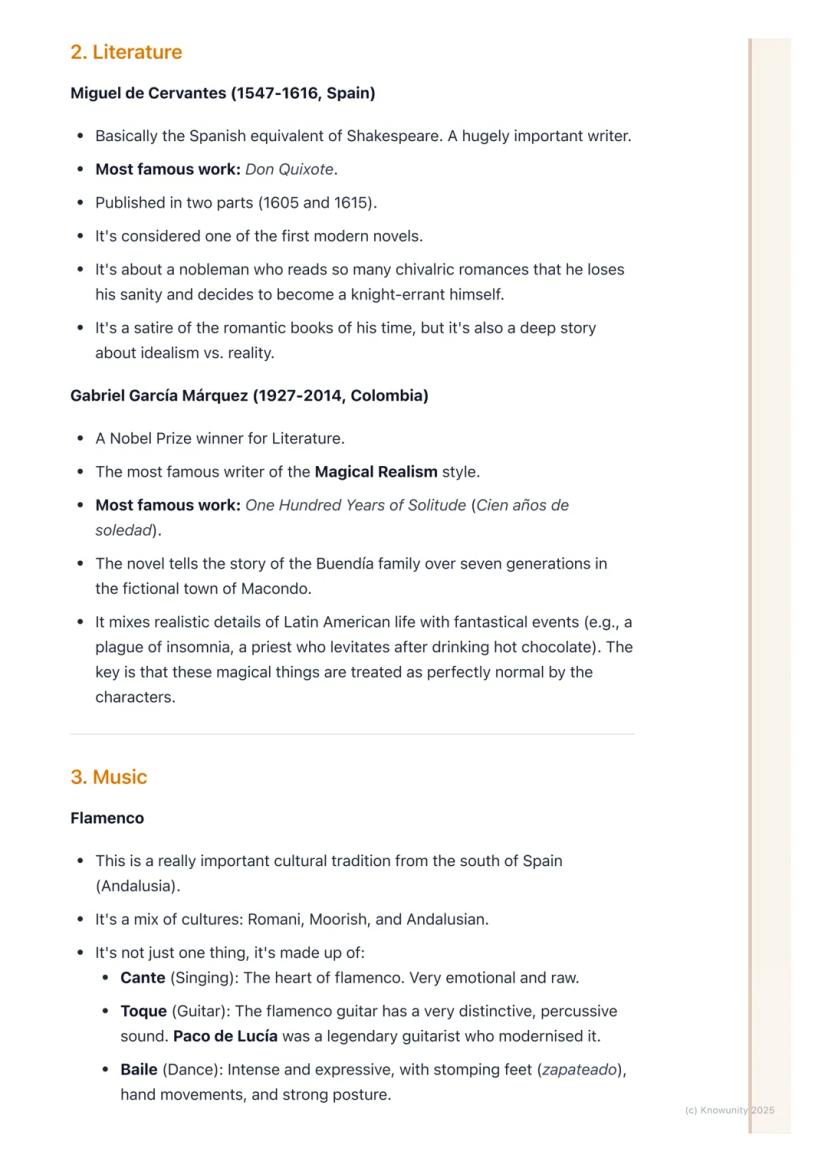
Miguel de Cervantes basically invented the modern novel with Don Quixote. This isn't just some old book you have to read - it's about a man who reads so many fantasy stories that he decides to become a knight himself, fighting windmills he thinks are giants.
The genius of Don Quixote is how it explores the clash between idealistic dreams and harsh reality. It's funny, sad, and surprisingly relevant to anyone who's ever felt out of step with the world around them.
Gabriel García Márquez won the Nobel Prize for creating Magical Realism. In his masterpiece One Hundred Years of Solitude, extraordinary things happen as if they're completely normal - people levitate, plagues of insomnia strike towns, and characters live for impossibly long times.
The key to understanding Magical Realism is that the characters never act surprised by the magical elements. When someone floats away, everyone just accepts it as part of life.
Quick check: If magic is treated as normal and everyday, it's Magical Realism. If characters are amazed by magic, it's fantasy.
5
of 6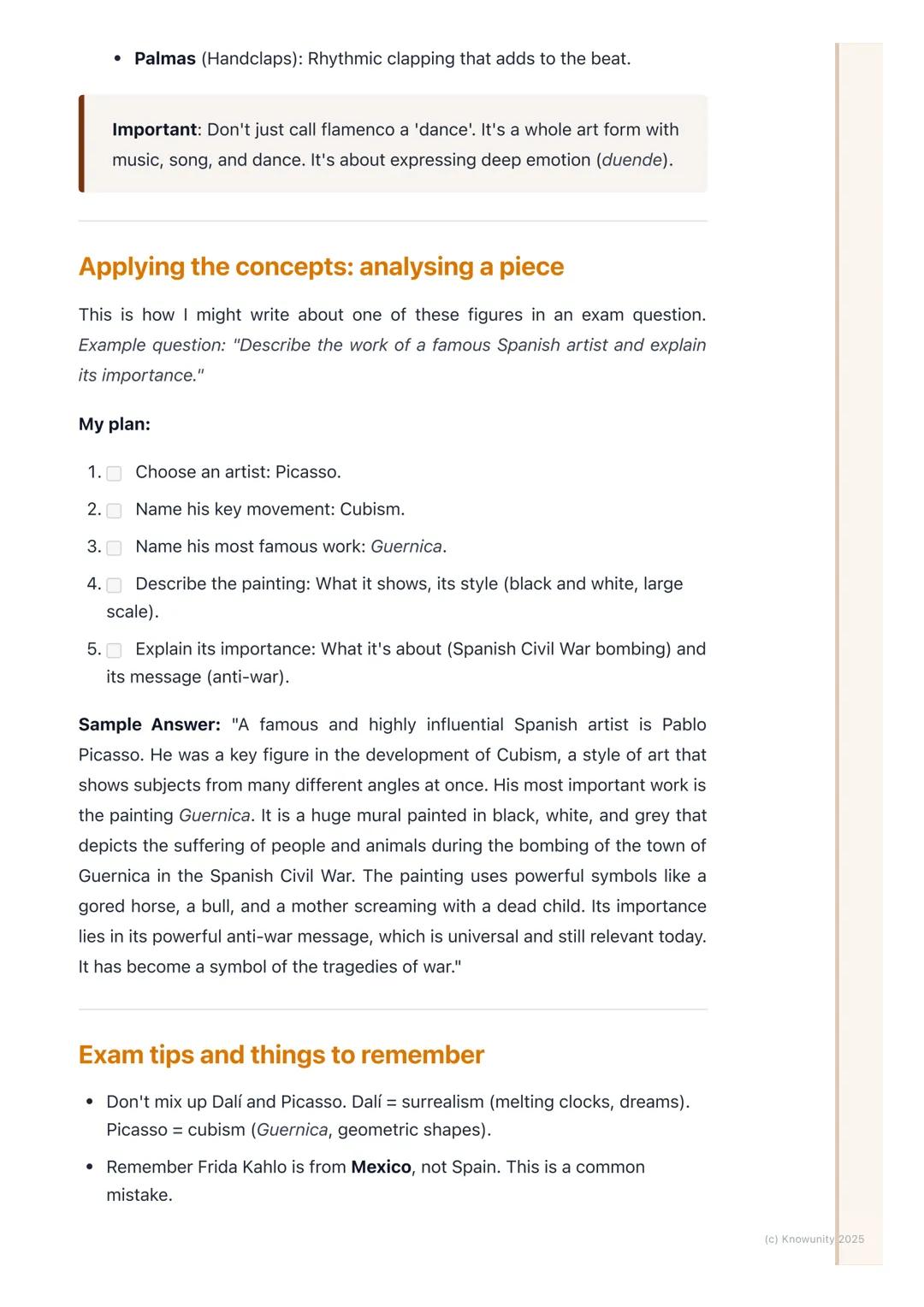
Flamenco - More Than Just a Dance
Forget everything you think you know about flamenco from tourist shows. Real flamenco is an intense art form that combines cante (singing), toque (guitar), baile (dance), and palmas (rhythmic clapping) to create something incredibly powerful.
This art form emerged in Andalusia from a mix of cultures - Romani, Moorish, and Andalusian influences created something entirely unique. The singing is raw and emotional, often expressing deep pain or passion. The guitar work is percussive and complex, whilst the dancing involves precise footwork and dramatic movements.
What makes flamenco special is the concept of duende - a kind of deep, authentic emotion that goes beyond technique. It's about expressing something that can't be put into words, only felt through the music and movement.
Flamenco isn't entertainment - it's a way of expressing the deepest human emotions through a combination of arts that work together to create something more powerful than any of them could achieve alone.
Remember: Never call flamenco "just a dance" in an exam. It's a complete art form that combines multiple elements to express intense emotion.
6
of 6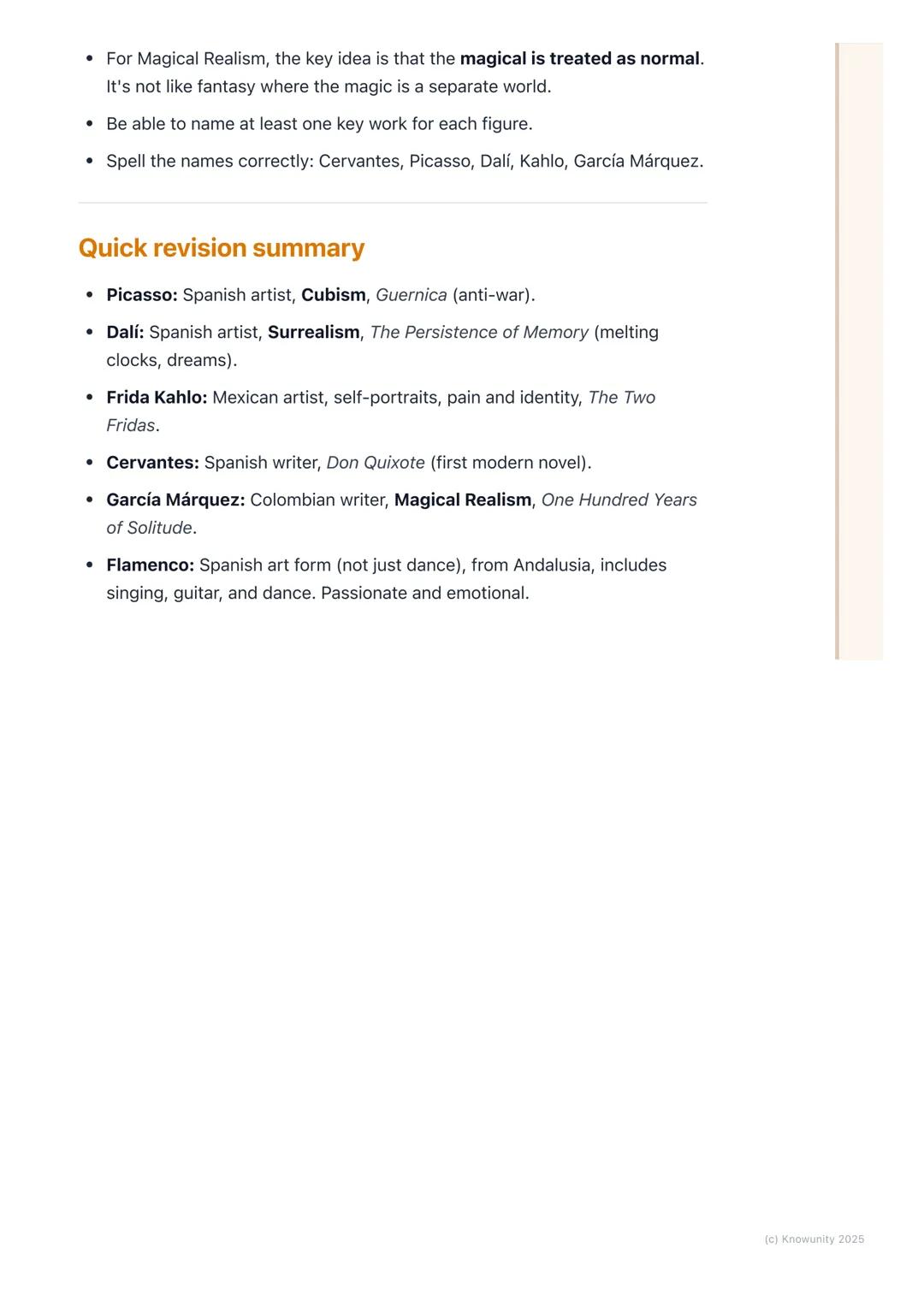
Exam Success Strategy
When writing about these cultural figures, always connect their techniques to their messages. Picasso used Cubism to show the chaos of war in Guernica. Dalí used dream-like imagery to explore the unconscious mind. Kahlo used personal symbolism to explore identity and pain.
For literature questions, remember that Cervantes created the modern novel by mixing comedy with serious themes about reality versus idealism. García Márquez used Magical Realism to tell stories about Latin American life where the extraordinary becomes ordinary.
Quick revision checklist: Picasso = Cubism + Guernica + anti-war message. Dalí = Surrealism + melting clocks + dreams. Kahlo = Mexican + self-portraits + personal reality. Cervantes = Don Quixote + first modern novel. García Márquez = Magical Realism + One Hundred Years of Solitude. Flamenco = complete art form + Andalusia + emotional expression.
Common mistakes to avoid: Don't mix up the Spanish and Mexican artists. Don't call Magical Realism "fantasy." Don't describe flamenco as only dancing.
Confidence booster: You've got this! These artists and writers dealt with universal themes - war, dreams, identity, love, and loss - that you can relate to and understand.
Azt hittük, soha nem fogod megkérdezni...
Mi a Knowunity MI társ?
MI Társunk egy diákközpontú MI eszköz, amely többet nyújt puszta válaszoknál. Millió Knowunity erőforrásra épülve releváns információkat, személyre szabott tanulási terveket, kvízeket és tartalmat biztosít közvetlenül a chatben, alkalmazkodva az egyéni tanulási utadhoz.
Honnan tudom letölteni a Knowunity appot?
Az appot letöltheted a Google Play Store-ból és az Apple App Store-ból.
Tényleg ingyenes a Knowunity?
Pontosan! Élvezd az ingyenes hozzáférést a tanulási tartalmakhoz, kapcsolódj diáktársaiddal, és kapj azonnali segítséget – mind a kezed ügyében.
Legnépszerűbb tananyagok Spanish tantárgyból
2SpanishTechnology, Social Media, and Digital Life
Learners will gain vocabulary to discuss modern technology, internet usage, social networking, and their impact on daily life.
5th Year20
SpanishComparatives and Superlatives
Students will learn how to compare people and things using comparative structures ('más... que', 'menos... que') and superlative forms ('el/la más...').
TY70
Legnépszerűbb tananyagok
9 Irish
IrishIrish oral questions and answers
Questions and answers for the leaving cert oral
5th Year4264
 English
Key Quotes : Sive
Key Quotes and explanations: Sive
6th Year2842
IrishIrish oral questions
Outline of oral questions
5th Year2055
IrishIníon- le hÁine Durkin
Aine Durkin’s poem, Iníon: Themes & summary
5th Year850
IrishIrish poetry 2027
Iníon + Dínit an Bhróin
5th Year1133
IrishLC HL notes- Iníon (poem)
Includes poem in English and Irish, theme, key words & phrases
5th Year2284
EnglishCultural Context : Shawshank Redemption : Sive : Small Things Like These
Comparative Study : Cultural Context : Shawshank Redemption, Sive and Small Things Like These
6th Year1430
IrishMo Ghrá-sa (Idir Lúibíní)
Notes on mo ghrá-sa
5th Year380
IrishAn Gaeilge Aiste
Irish Language essay
6th Year1320
Nem találod amit keresel? Fedezz fel más tantárgyakat.
A diákok imádnak minket — és téged is fognak.
4.6/5App Store
4.7/5Google Play
Az alkalmazás nagyon könnyen használható és jól megtervezett. Mindent megtaláltam, amit eddig kerestem, és sokat tudtam tanulni a prezentációkból! Biztosan használni fogom az alkalmazást egy osztályfeladathoz! És persze inspirációként is nagyszerűen segít.
Stefan SiOS felhasználó
Ez az alkalmazás tényleg nagyszerű. Olyan sok tanulási jegyzet és segítség van benne [...]. Például a francia a problémás tantárgyam, és az alkalmazásban olyan sok segítség lehetőség van. Ennek az alkalmazásnak köszönhetően javult a franciám. Mindenkinek ajánlanám.
Samantha KlichAndroid felhasználó
Hű, tényleg lenyűgözött. Csak úgy kipróbáltam az alkalmazást, mert sokszor láttam reklámozva, és teljesen megdöbbentett. Ez az alkalmazás AZ A SEGÍTSÉG, amire az iskolában szükséged van, és mindenekelőtt olyan sok mindent kínál, mint például gyakorlatokat és összefoglalókat, amik nekem személyesen NAGYON hasznosak voltak.
AnnaiOS felhasználó
Spanish1 megtekintések·Frissítve Jun 15, 2026·6 oldalExploring Key Figures in Spanish Art, Music, and Literature
Spanish and Latin American culture has given the world some of its most revolutionary artists, writers, and musicians. These creative giants didn't just make pretty pictures or entertaining stories - they completely changed how we think about art, literature, and...
1
of 6
Regisztrálj, hogy lásd a tartalmat. Teljesen ingyenes!
- Hozzáférés minden dokumentumhoz
- Javítsd a jegyeidet
- Csatlakozz diákok millióihoz
Key Cultural Figures and Movements
You're about to meet some absolute legends who've shaped culture worldwide. These aren't just names to memorise - they're the people who broke all the rules and created entirely new ways of seeing the world.
Cubism completely revolutionised art by showing objects from multiple angles at once, like seeing all sides of a face simultaneously. Surrealism dove deep into the weird world of dreams and the unconscious mind, creating art that looks like it came straight from your strangest nightmare.
Magical Realism in literature treats impossible things as perfectly normal - imagine a story where someone floats away whilst drinking tea, and everyone just carries on with their conversation. Flamenco isn't just a dance you've seen on holiday - it's a complete art form that combines passionate singing, intricate guitar work, and intense movement to express the deepest human emotions.
Remember: These movements didn't just appear randomly - they were responses to wars, social changes, and artists' desires to express things that traditional art couldn't capture.
2
of 6Regisztrálj, hogy lásd a tartalmat. Teljesen ingyenes!
- Hozzáférés minden dokumentumhoz
- Javítsd a jegyeidet
- Csatlakozz diákok millióihoz
Pablo Picasso - The Revolutionary
Picasso didn't just paint pretty pictures - he completely smashed the rules of how art should look. This Spanish genius co-created Cubism, showing us that you don't need to paint things exactly as your eyes see them.
His masterpiece Guernica isn't something you'd hang in your living room for decoration. This massive black and white painting screams about the horrors of war, specifically the bombing of a Basque town during the Spanish Civil War. The twisted figures, screaming horse, and grieving mother make it impossible to ignore the message.
What makes Picasso brilliant is how he used geometric shapes and multiple viewpoints to show emotion and movement. When you look at Guernica, you're not just seeing one moment - you're experiencing the chaos and terror from every angle simultaneously.
Exam tip: Always connect Guernica to its anti-war message. It's not just about technique - it's about using art to protest violence and suffering.
3
of 6Regisztrálj, hogy lásd a tartalmat. Teljesen ingyenes!
- Hozzáférés minden dokumentumhoz
- Javítsd a jegyeidet
- Csatlakozz diákok millióihoz
Salvador Dalí and Frida Kahlo - Masters of the Mind
Salvador Dalí painted what he called "hand-painted dream photographs" - and they're exactly as weird as that sounds. His famous melting clocks in The Persistence of Memory show how time becomes fluid and strange in our dreams and memories.
Dalí was part of the Surrealist movement, which explored the unconscious mind. His paintings look like the bizarre logic of dreams, where normal rules don't apply and anything can happen.
Frida Kahlo from Mexico created intensely personal art that explored identity, pain, and Mexican culture. Though often linked with Surrealism, she insisted she painted her reality, not dreams. Her self-portraits, like The Two Fridas, show her complex identity and the physical and emotional pain that shaped her life.
Both artists prove that art can be a way to explore the deepest parts of human experience - whether through dreams or brutal honesty about life's struggles.
Don't confuse: Dalí = dreams and melting clocks; Kahlo = personal reality and Mexican identity. Both deal with the mind, but in completely different ways.
4
of 6Regisztrálj, hogy lásd a tartalmat. Teljesen ingyenes!
- Hozzáférés minden dokumentumhoz
- Javítsd a jegyeidet
- Csatlakozz diákok millióihoz
Literary Giants - Cervantes and García Márquez
Miguel de Cervantes basically invented the modern novel with Don Quixote. This isn't just some old book you have to read - it's about a man who reads so many fantasy stories that he decides to become a knight himself, fighting windmills he thinks are giants.
The genius of Don Quixote is how it explores the clash between idealistic dreams and harsh reality. It's funny, sad, and surprisingly relevant to anyone who's ever felt out of step with the world around them.
Gabriel García Márquez won the Nobel Prize for creating Magical Realism. In his masterpiece One Hundred Years of Solitude, extraordinary things happen as if they're completely normal - people levitate, plagues of insomnia strike towns, and characters live for impossibly long times.
The key to understanding Magical Realism is that the characters never act surprised by the magical elements. When someone floats away, everyone just accepts it as part of life.
Quick check: If magic is treated as normal and everyday, it's Magical Realism. If characters are amazed by magic, it's fantasy.
5
of 6Regisztrálj, hogy lásd a tartalmat. Teljesen ingyenes!
- Hozzáférés minden dokumentumhoz
- Javítsd a jegyeidet
- Csatlakozz diákok millióihoz
Flamenco - More Than Just a Dance
Forget everything you think you know about flamenco from tourist shows. Real flamenco is an intense art form that combines cante (singing), toque (guitar), baile (dance), and palmas (rhythmic clapping) to create something incredibly powerful.
This art form emerged in Andalusia from a mix of cultures - Romani, Moorish, and Andalusian influences created something entirely unique. The singing is raw and emotional, often expressing deep pain or passion. The guitar work is percussive and complex, whilst the dancing involves precise footwork and dramatic movements.
What makes flamenco special is the concept of duende - a kind of deep, authentic emotion that goes beyond technique. It's about expressing something that can't be put into words, only felt through the music and movement.
Flamenco isn't entertainment - it's a way of expressing the deepest human emotions through a combination of arts that work together to create something more powerful than any of them could achieve alone.
Remember: Never call flamenco "just a dance" in an exam. It's a complete art form that combines multiple elements to express intense emotion.
6
of 6Regisztrálj, hogy lásd a tartalmat. Teljesen ingyenes!
- Hozzáférés minden dokumentumhoz
- Javítsd a jegyeidet
- Csatlakozz diákok millióihoz
Exam Success Strategy
When writing about these cultural figures, always connect their techniques to their messages. Picasso used Cubism to show the chaos of war in Guernica. Dalí used dream-like imagery to explore the unconscious mind. Kahlo used personal symbolism to explore identity and pain.
For literature questions, remember that Cervantes created the modern novel by mixing comedy with serious themes about reality versus idealism. García Márquez used Magical Realism to tell stories about Latin American life where the extraordinary becomes ordinary.
Quick revision checklist: Picasso = Cubism + Guernica + anti-war message. Dalí = Surrealism + melting clocks + dreams. Kahlo = Mexican + self-portraits + personal reality. Cervantes = Don Quixote + first modern novel. García Márquez = Magical Realism + One Hundred Years of Solitude. Flamenco = complete art form + Andalusia + emotional expression.
Common mistakes to avoid: Don't mix up the Spanish and Mexican artists. Don't call Magical Realism "fantasy." Don't describe flamenco as only dancing.
Confidence booster: You've got this! These artists and writers dealt with universal themes - war, dreams, identity, love, and loss - that you can relate to and understand.
Azt hittük, soha nem fogod megkérdezni...
Mi a Knowunity MI társ?
MI Társunk egy diákközpontú MI eszköz, amely többet nyújt puszta válaszoknál. Millió Knowunity erőforrásra épülve releváns információkat, személyre szabott tanulási terveket, kvízeket és tartalmat biztosít közvetlenül a chatben, alkalmazkodva az egyéni tanulási utadhoz.
Honnan tudom letölteni a Knowunity appot?
Az appot letöltheted a Google Play Store-ból és az Apple App Store-ból.
Tényleg ingyenes a Knowunity?
Pontosan! Élvezd az ingyenes hozzáférést a tanulási tartalmakhoz, kapcsolódj diáktársaiddal, és kapj azonnali segítséget – mind a kezed ügyében.
Legnépszerűbb tananyagok Spanish tantárgyból
2SpanishTechnology, Social Media, and Digital Life
Learners will gain vocabulary to discuss modern technology, internet usage, social networking, and their impact on daily life.
5th Year20
SpanishComparatives and Superlatives
Students will learn how to compare people and things using comparative structures ('más... que', 'menos... que') and superlative forms ('el/la más...').
TY70
Legnépszerűbb tananyagok
9IrishIrish oral questions and answers
Questions and answers for the leaving cert oral
5th Year4264
EnglishKey Quotes : Sive
Key Quotes and explanations: Sive
6th Year2842
IrishIrish oral questions
Outline of oral questions
5th Year2055
IrishIníon- le hÁine Durkin
Aine Durkin’s poem, Iníon: Themes & summary
5th Year850
IrishIrish poetry 2027
Iníon + Dínit an Bhróin
5th Year1133
IrishLC HL notes- Iníon (poem)
Includes poem in English and Irish, theme, key words & phrases
5th Year2284
EnglishCultural Context : Shawshank Redemption : Sive : Small Things Like These
Comparative Study : Cultural Context : Shawshank Redemption, Sive and Small Things Like These
6th Year1430
IrishMo Ghrá-sa (Idir Lúibíní)
Notes on mo ghrá-sa
5th Year380
IrishAn Gaeilge Aiste
Irish Language essay
6th Year1320
Nem találod amit keresel? Fedezz fel más tantárgyakat.
A diákok imádnak minket — és téged is fognak.
4.6/5App Store
4.7/5Google Play
Az alkalmazás nagyon könnyen használható és jól megtervezett. Mindent megtaláltam, amit eddig kerestem, és sokat tudtam tanulni a prezentációkból! Biztosan használni fogom az alkalmazást egy osztályfeladathoz! És persze inspirációként is nagyszerűen segít.
Stefan SiOS felhasználó
Ez az alkalmazás tényleg nagyszerű. Olyan sok tanulási jegyzet és segítség van benne [...]. Például a francia a problémás tantárgyam, és az alkalmazásban olyan sok segítség lehetőség van. Ennek az alkalmazásnak köszönhetően javult a franciám. Mindenkinek ajánlanám.
Samantha KlichAndroid felhasználó
Hű, tényleg lenyűgözött. Csak úgy kipróbáltam az alkalmazást, mert sokszor láttam reklámozva, és teljesen megdöbbentett. Ez az alkalmazás AZ A SEGÍTSÉG, amire az iskolában szükséged van, és mindenekelőtt olyan sok mindent kínál, mint például gyakorlatokat és összefoglalókat, amik nekem személyesen NAGYON hasznosak voltak.
AnnaiOS felhasználó