
Ever wondered what everything around you is actually made of?... Továbbiak megjelenítése
 Science
 Irish
Irish English
 Geography
Regisztrálj, hogy lásd a tartalmatTeljesen ingyenes!
Hozzáférés minden dokumentumhoz
Javítsd a jegyeidet
Csatlakozz diákok millióihoz
Knowunity AI
Tantárgyak
Triangle Congruence and Similarity Theorems
Triangle Properties and Classification
Linear Equations and Graphs
Geometric Angle Relationships
Trigonometric Functions and Identities
Equation Solving Techniques
Circle Geometry Fundamentals
Division Operations and Methods
Basic Differentiation Rules
Exponent and Logarithm Properties
Összes témakör megjelenítése
Human Organ Systems
Reproductive Cell Cycles
Biological Sciences Subdisciplines
Cellular Energy Metabolism
Autotrophic Energy Processes
Inheritance Patterns and Principles
Biomolecular Structure and Organization
Cell Cycle and Division Mechanics
Cellular Organization and Development
Biological Structural Organization
Összes témakör megjelenítése
Chemical Sciences and Applications
Atomic Structure and Composition
Molecular Electron Structure Representation
Atomic Electron Behavior
Matter Properties and Water
Mole Concept and Calculations
Gas Laws and Behavior
Periodic Table Organization
Chemical Thermodynamics Fundamentals
Chemical Bond Types and Properties
Összes témakör megjelenítése
European Renaissance and Enlightenment
European Cultural Movements 800-1920
American Revolution Era 1763-1797
American Civil War 1861-1865
Global Imperial Systems
Mongol and Chinese Dynasties
U.S. Presidents and World Leaders
Historical Sources and Documentation
World Wars Era and Impact
World Religious Systems
Összes témakör megjelenítése
Classic and Contemporary Novels
Literary Character Analysis
Rhetorical Theory and Practice
Classic Literary Narratives
Reading Analysis and Interpretation
Narrative Structure and Techniques
English Language Components
Influential English-Language Authors
Basic Sentence Structure
Narrative Voice and Perspective
Összes témakör megjelenítése
4
•
Frissítve May 8, 2026
•
Ever wondered what everything around you is actually made of?... Továbbiak megjelenítése
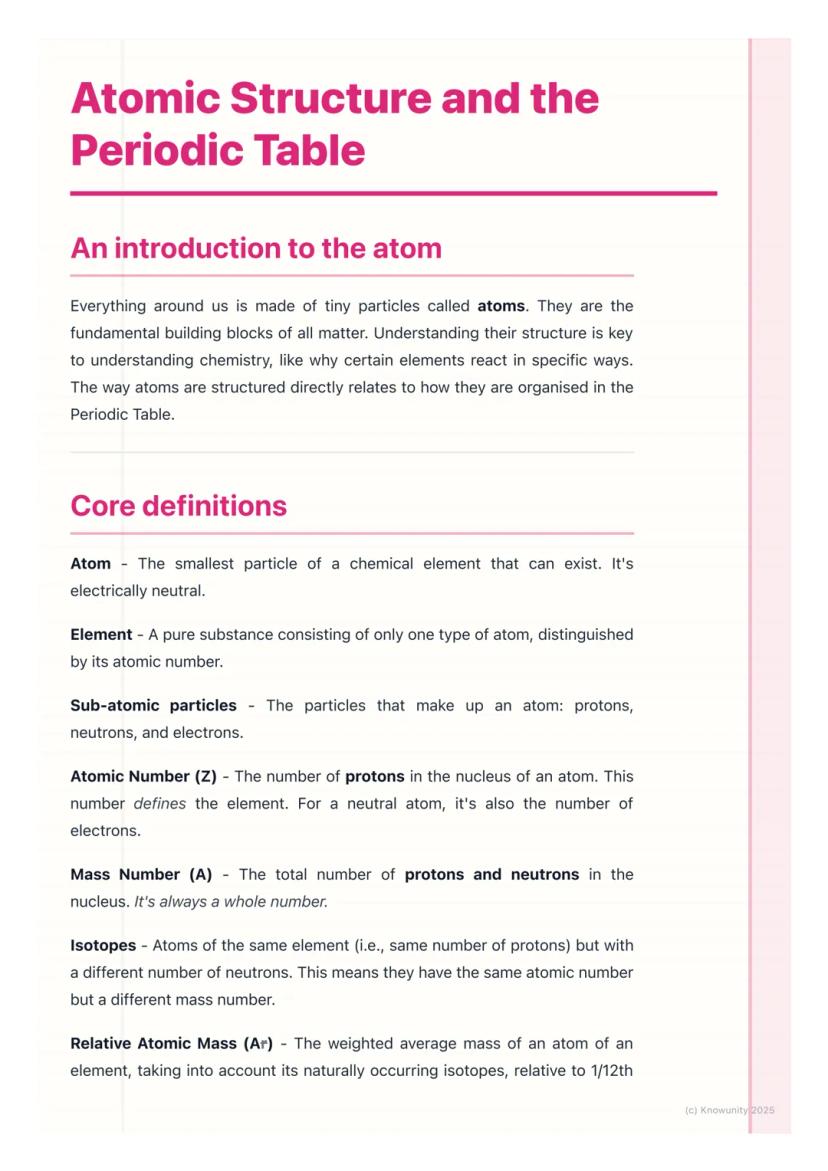

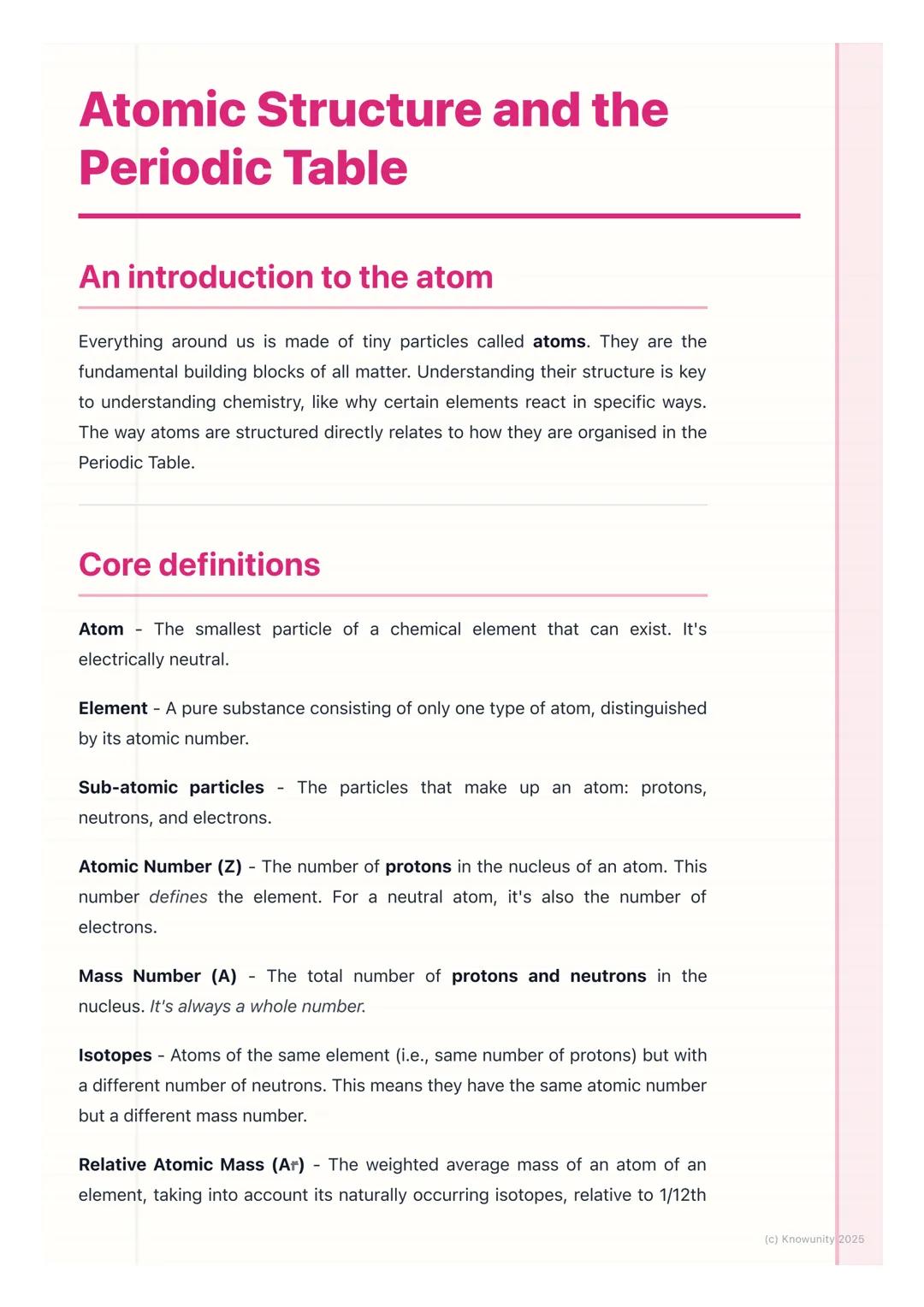
Think of atoms as the LEGO blocks of the universe - they're the smallest pieces that still keep all the properties of an element. Every single thing you can touch, see, or breathe is made up of these incredibly tiny particles.
What makes atoms really clever is that they're mostly empty space with a super dense centre called the nucleus. Around this nucleus, electrons zoom about in specific areas called shells. It's a bit like planets orbiting the sun, but way more exciting because it determines how elements will react with each other.
The brilliant thing about atoms is that they're electrically neutral - they have equal amounts of positive and negative charges that balance each other out perfectly. This balance is what keeps matter stable and predictable.
Quick Tip: Remember that atoms are the smallest particles of an element that still act like that element - break them down further and you lose what makes oxygen "oxygen" or gold "gold"!
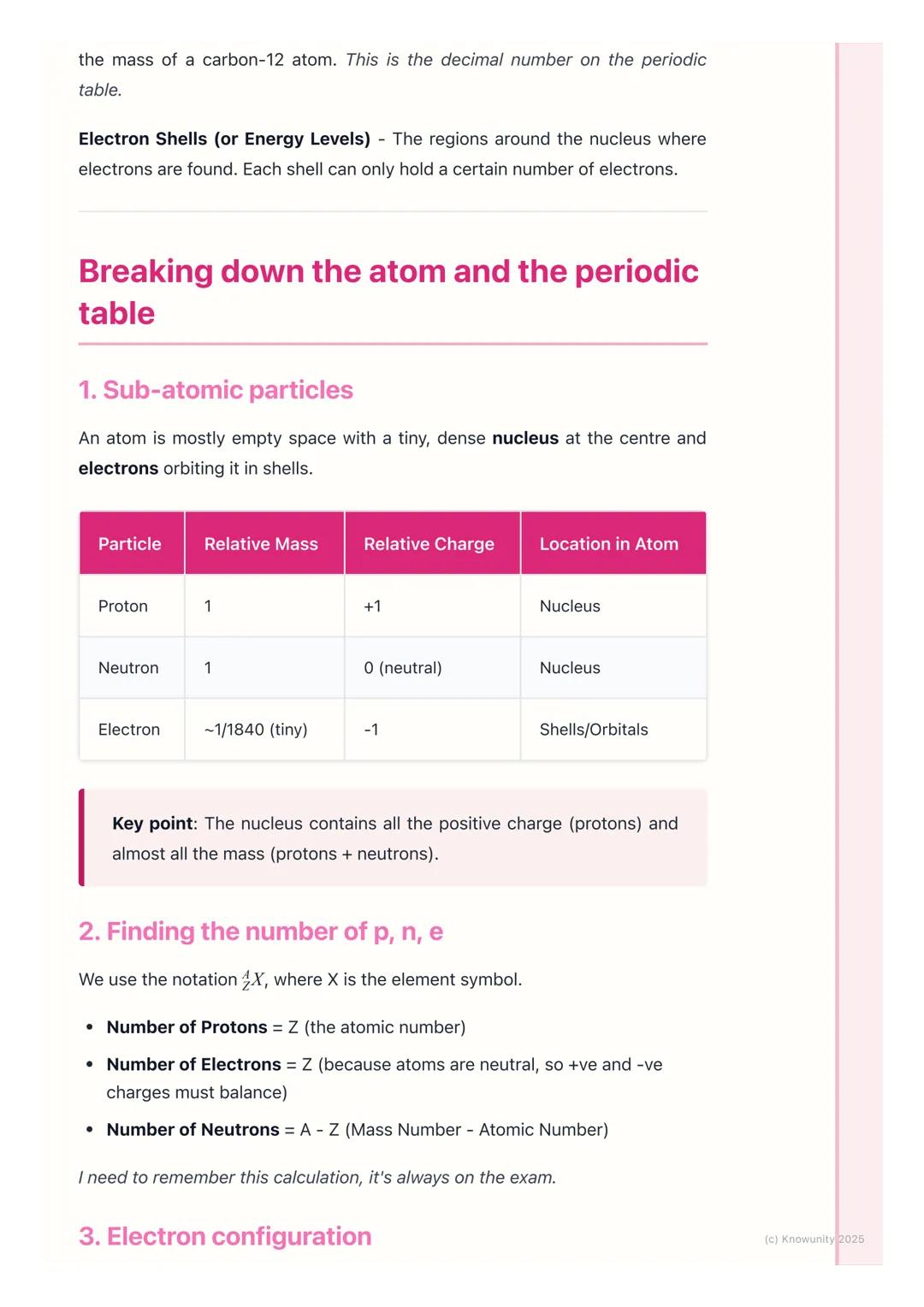
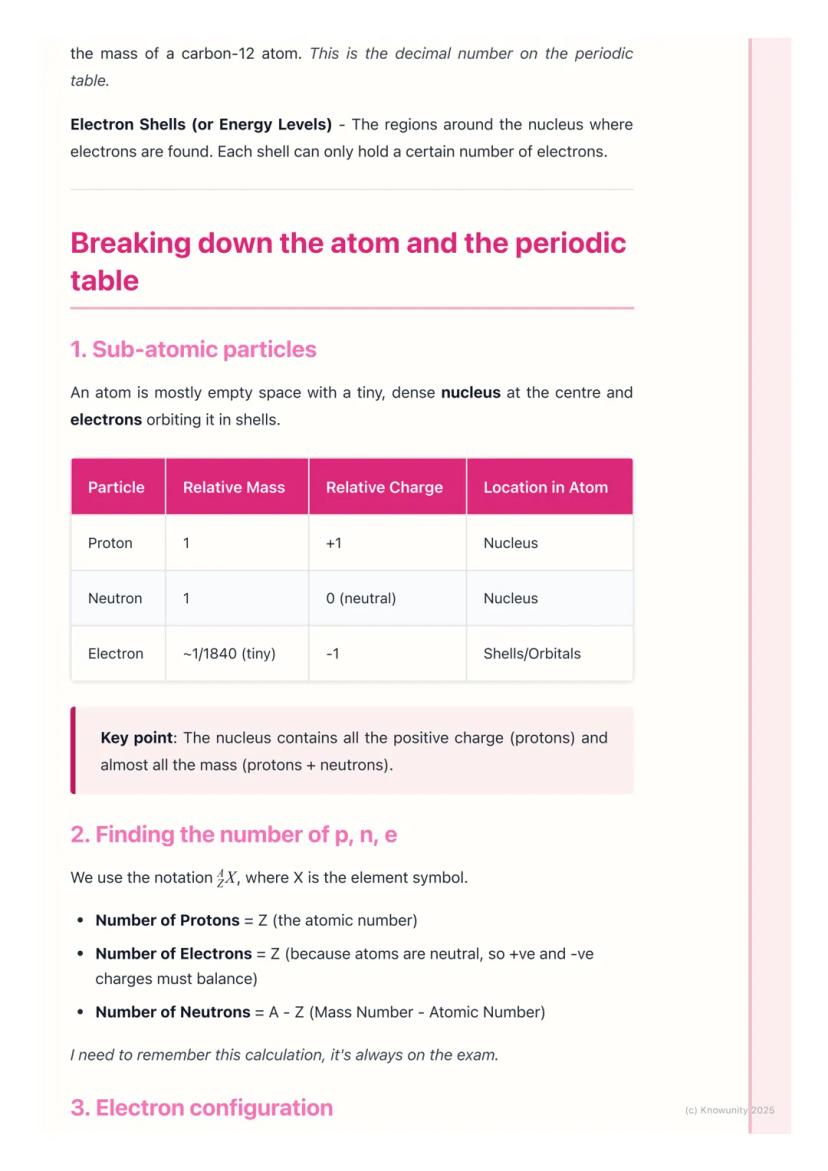
Inside every atom, you'll find three main players: protons, neutrons, and electrons. Protons carry a positive charge and live in the nucleus with neutrons (which are neutral). Electrons, with their negative charge, whiz around the nucleus in shells.
Here's what you need to remember: protons have a relative mass of 1 and a +1 charge, neutrons also have a mass of 1 but no charge, and electrons are incredibly light with a -1 charge.
The atomic number (Z) tells you how many protons an element has - this is like its ID card because it never changes for that element. The mass number (A) is the total of protons plus neutrons in the nucleus.
To find the number of particles, use this dead simple formula: protons = Z, electrons = Z (for neutral atoms), and neutrons = A - Z. Master this calculation because it's guaranteed to show up on your exams.
Exam Alert: The notation ᴬ/ᴢX always appears on tests - A is the big number on top (mass number), Z is the small number below (atomic number), and X is the element symbol.
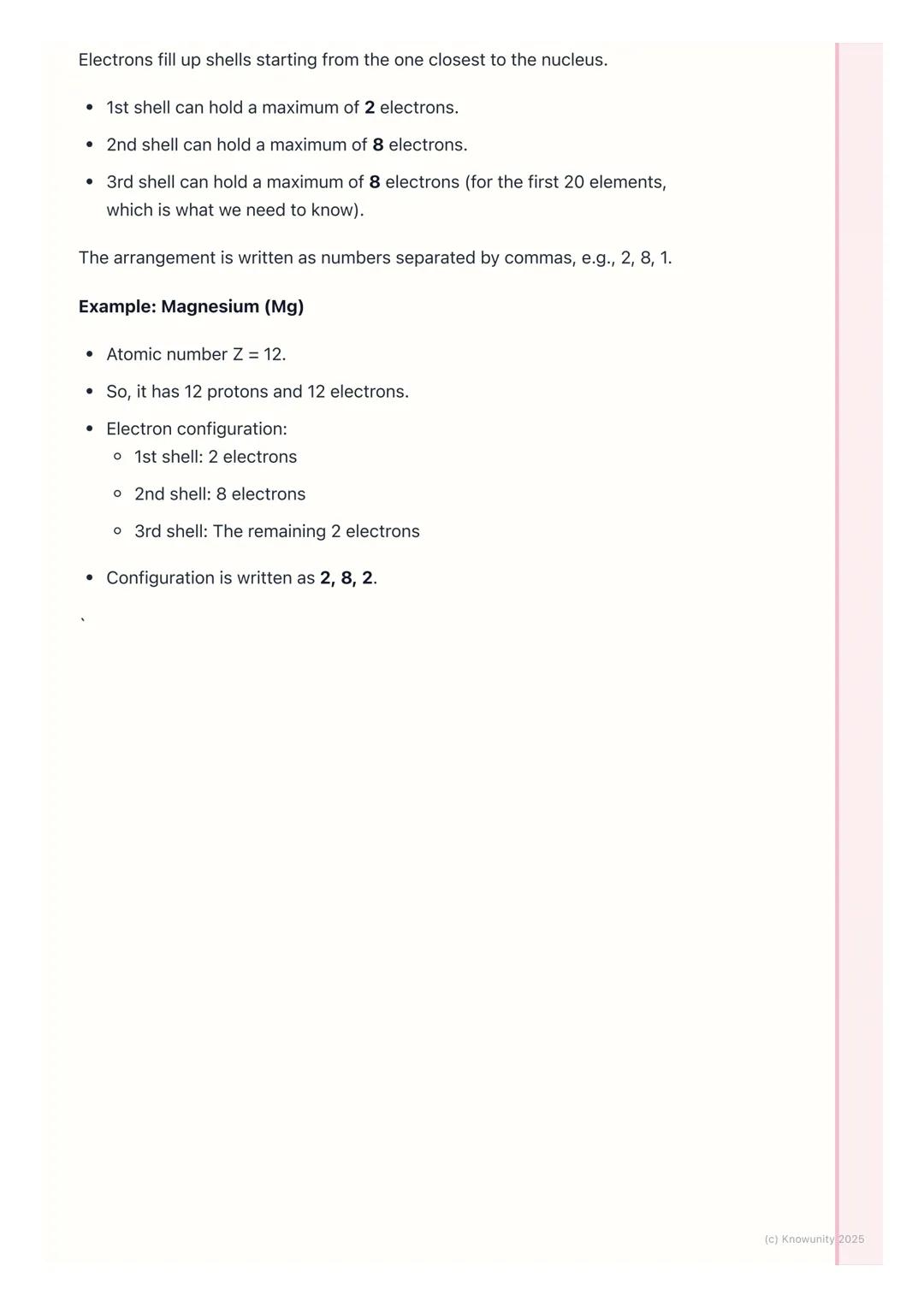
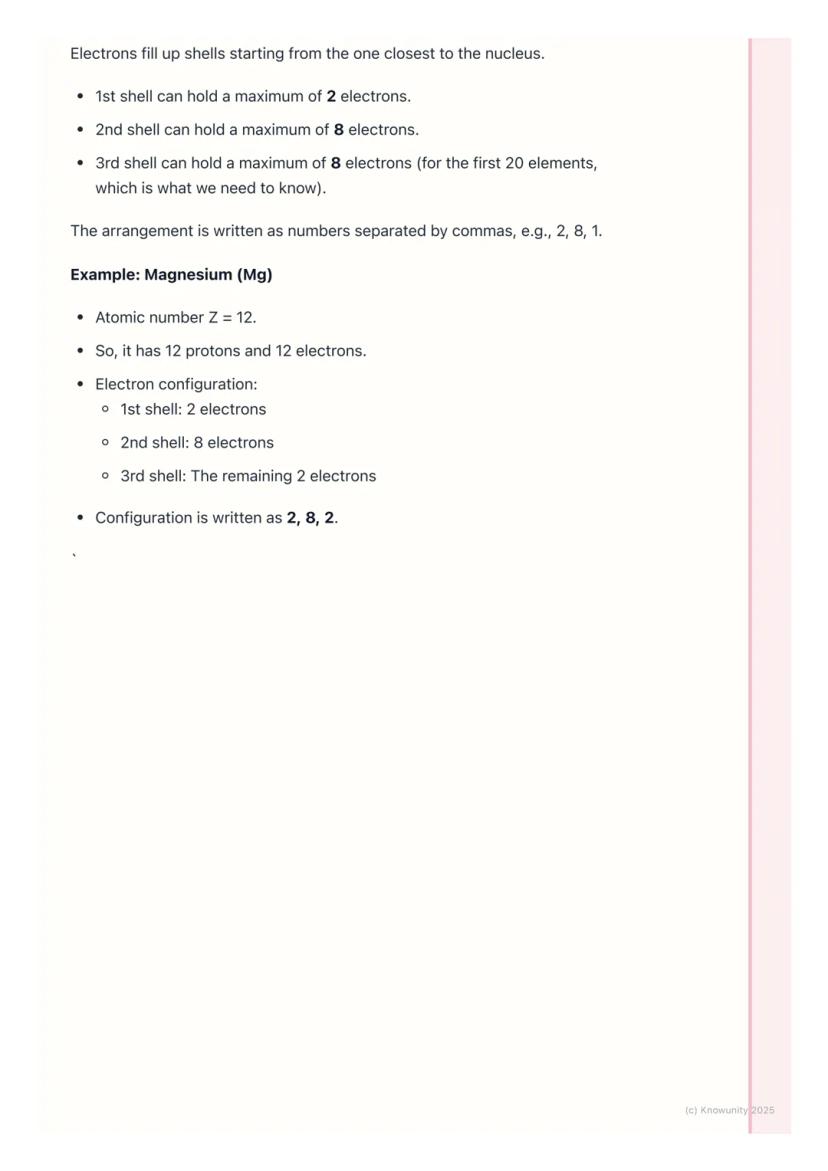
Electrons don't just randomly float around the nucleus - they follow strict rules about where they can live. Think of electron shells as different floors of a building, and electrons fill up from the ground floor upwards.
The first shell (closest to the nucleus) can only hold 2 electrons maximum. The second shell can hold up to 8 electrons, and for the first 20 elements you need to know, the third shell also holds a maximum of 8 electrons.
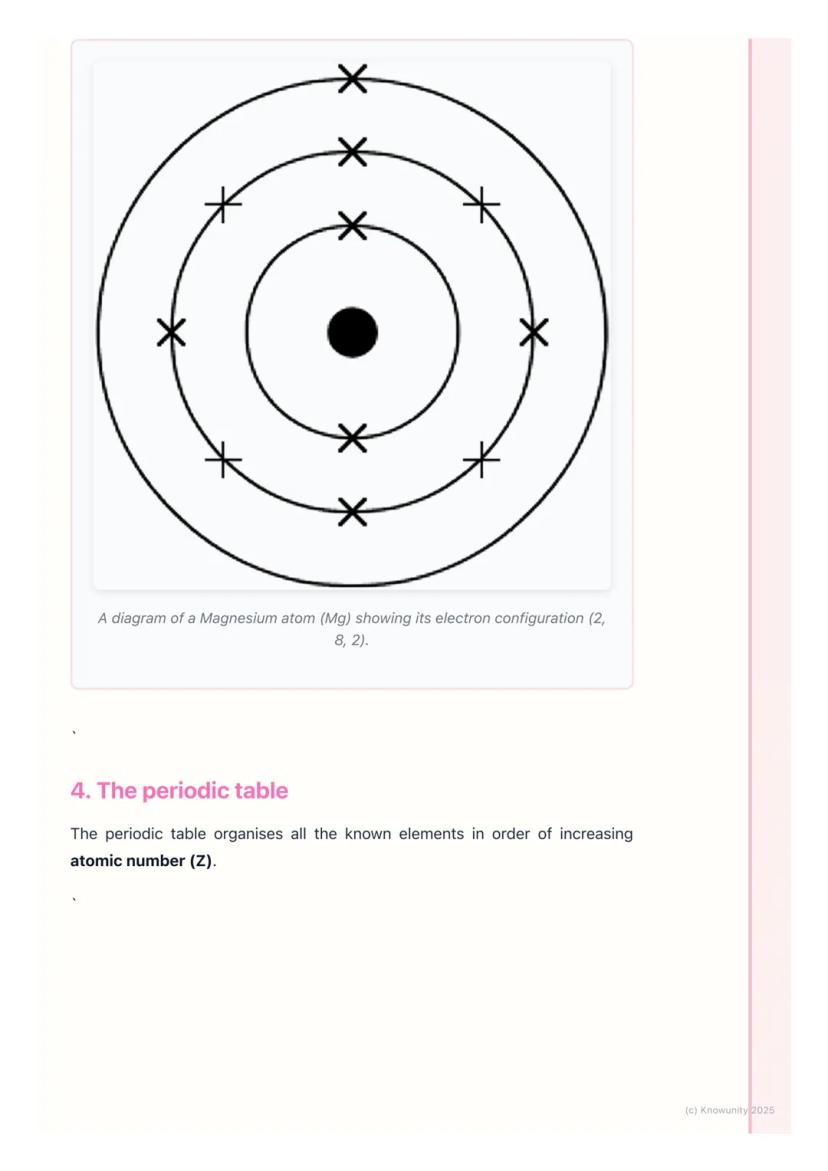
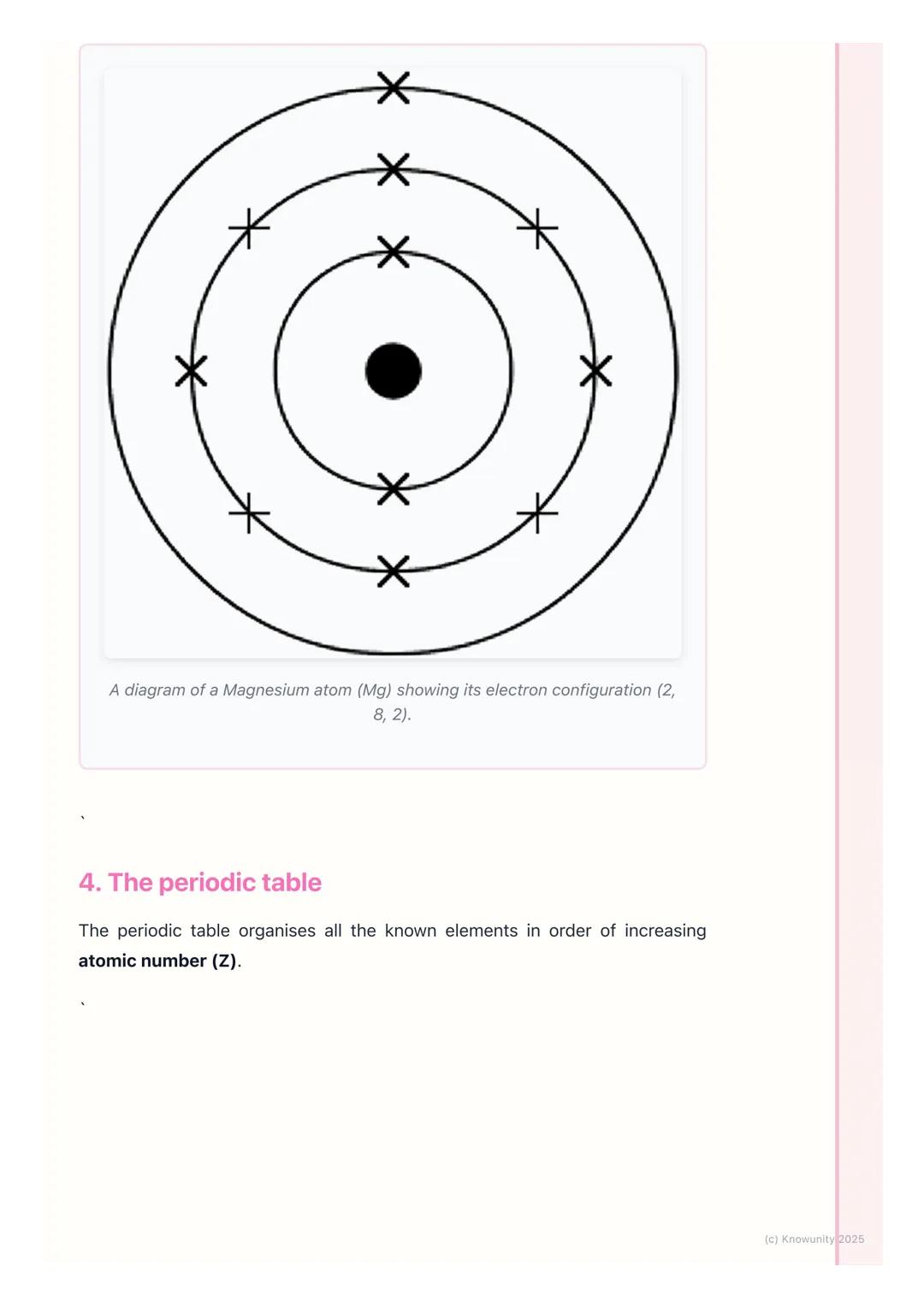
Let's use magnesium as an example. It has an atomic number of 12, so it has 12 electrons. These get arranged as: 2 electrons in the first shell, 8 in the second shell, and the remaining 2 in the third shell. We write this as 2, 8, 2.
Getting electron configuration right is crucial because it directly links to how elements are organised in the periodic table and explains why certain elements behave similarly to others.
Memory Trick: For the first 20 elements, shells fill in the pattern 2, 8, 8 - like a simple countdown that helps you work out any element's electron arrangement!
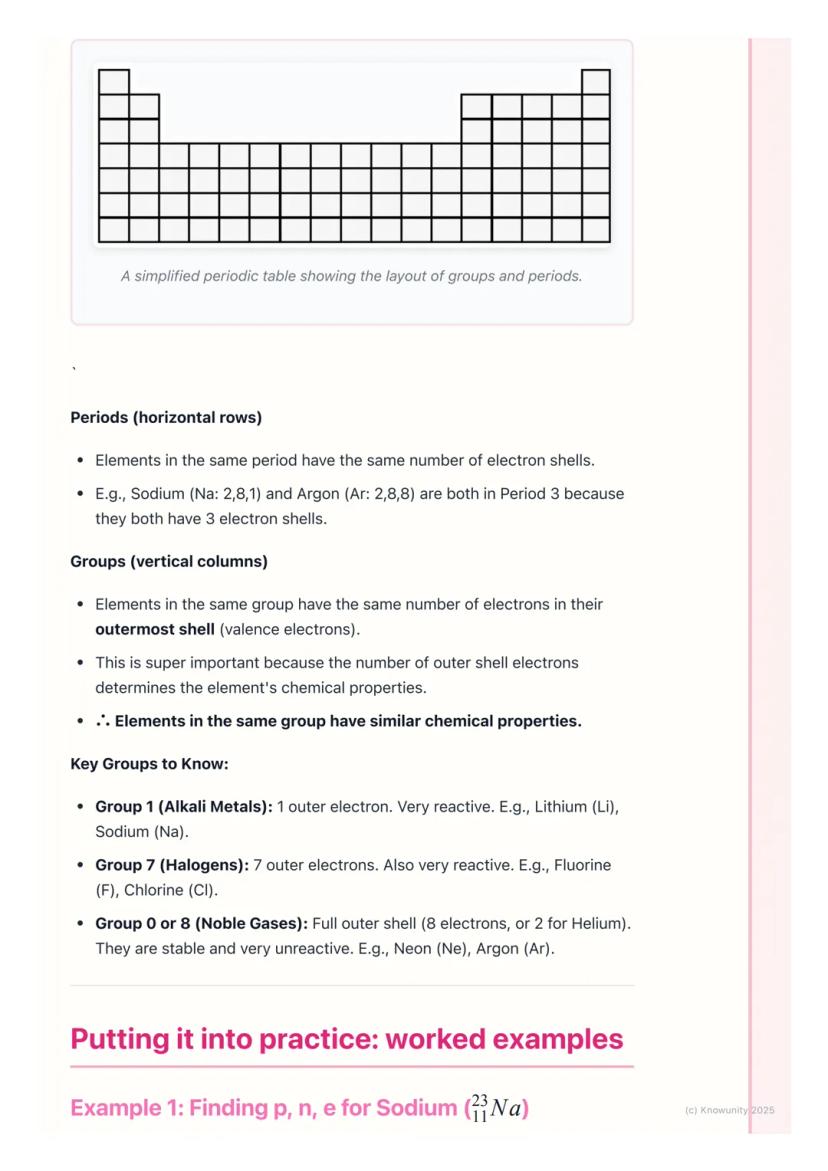
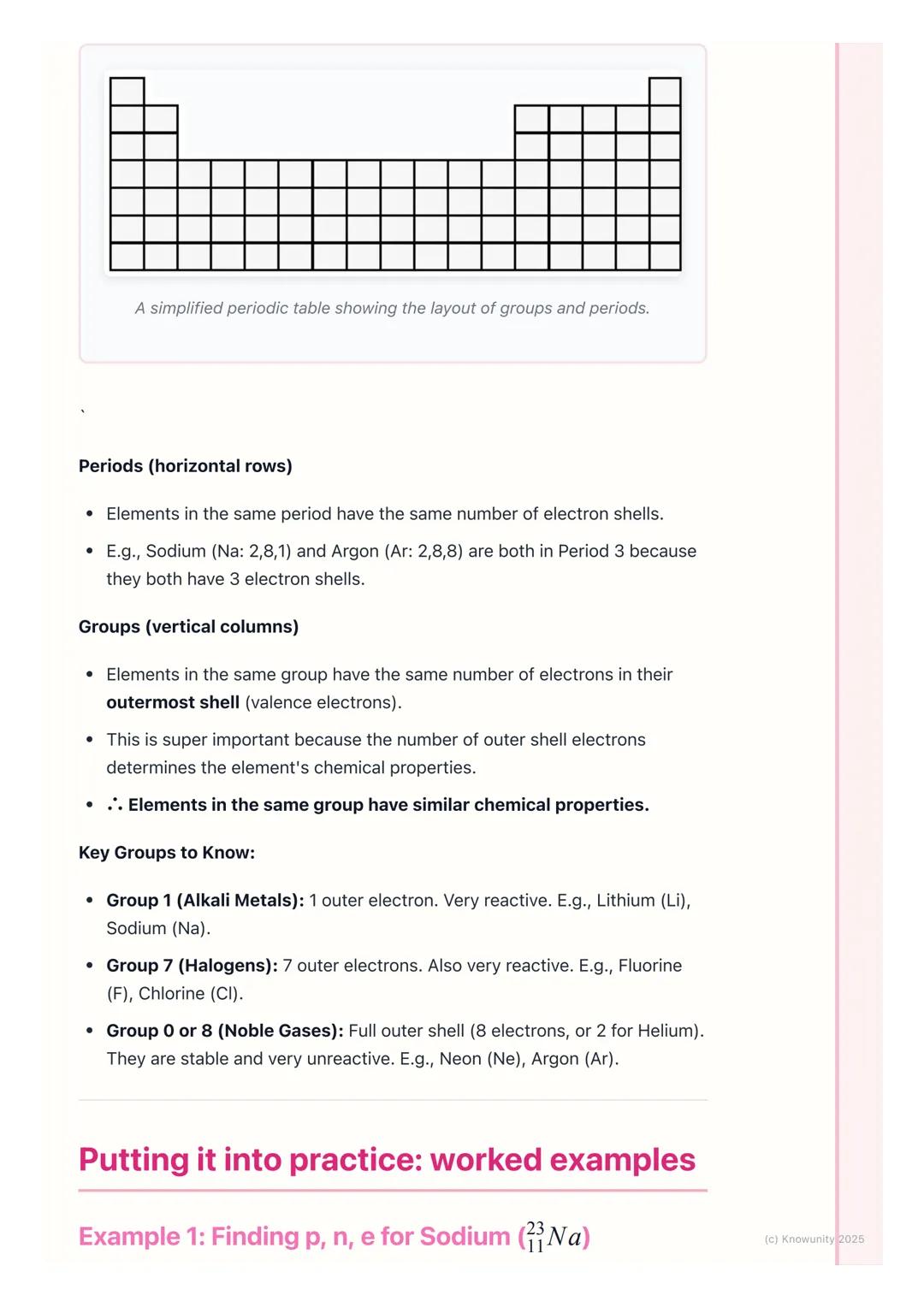
The periodic table isn't just a random list of elements - it's actually a brilliant map that shows you exactly how atoms are structured. Elements are arranged in order of increasing atomic number, which means more and more protons as you move from left to right.
Periods are the horizontal rows, and here's the key insight: all elements in the same period have the same number of electron shells. So sodium (2,8,1) and argon (2,8,8) are both in period 3 because they both have exactly 3 electron shells.
Groups are the vertical columns, and this is where it gets really interesting. Elements in the same group have the same number of electrons in their outermost shell, which means they behave very similarly in chemical reactions.
The outermost electrons (called valence electrons) are like the element's personality - they determine how it will react with other elements. Same number of outer electrons equals similar chemical behaviour.
Key Insight: The periodic table is basically a cheat sheet for predicting how elements will behave - once you understand the pattern, chemistry becomes much more logical!
Group 1 (Alkali Metals) elements have just 1 electron in their outer shell, making them incredibly reactive - they desperately want to lose that lone electron. Think lithium, sodium, and potassium - they all react explosively with water.
Group 7 (Halogens) have 7 outer electrons and are equally reactive, but for the opposite reason - they're desperate to gain 1 more electron to fill their outer shell. Fluorine and chlorine are classic examples that form salts when they react with metals.
Group 0 (Noble Gases) are the chilled-out elements with full outer shells - helium has 2 electrons, while neon and argon have 8. Because their outer shells are complete, they're incredibly stable and rarely react with anything.
Understanding these groups helps you predict reactions before they happen. Elements in the same group will generally react in similar ways because they have the same outer electron arrangement.
Exam Focus: You'll definitely need to identify which group an element belongs to from its electron configuration - the number of outer electrons equals the group number (except for Group 0)!
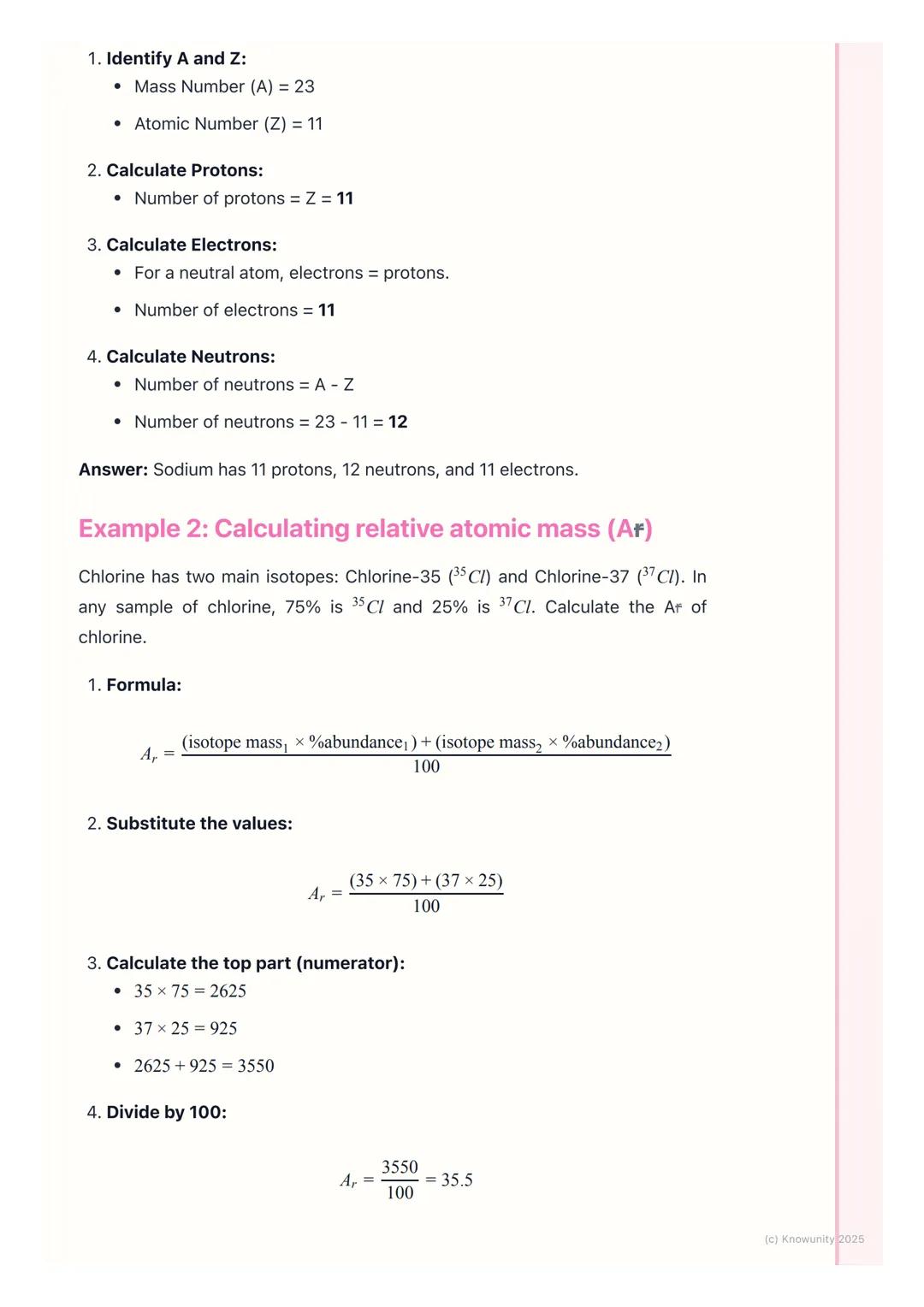
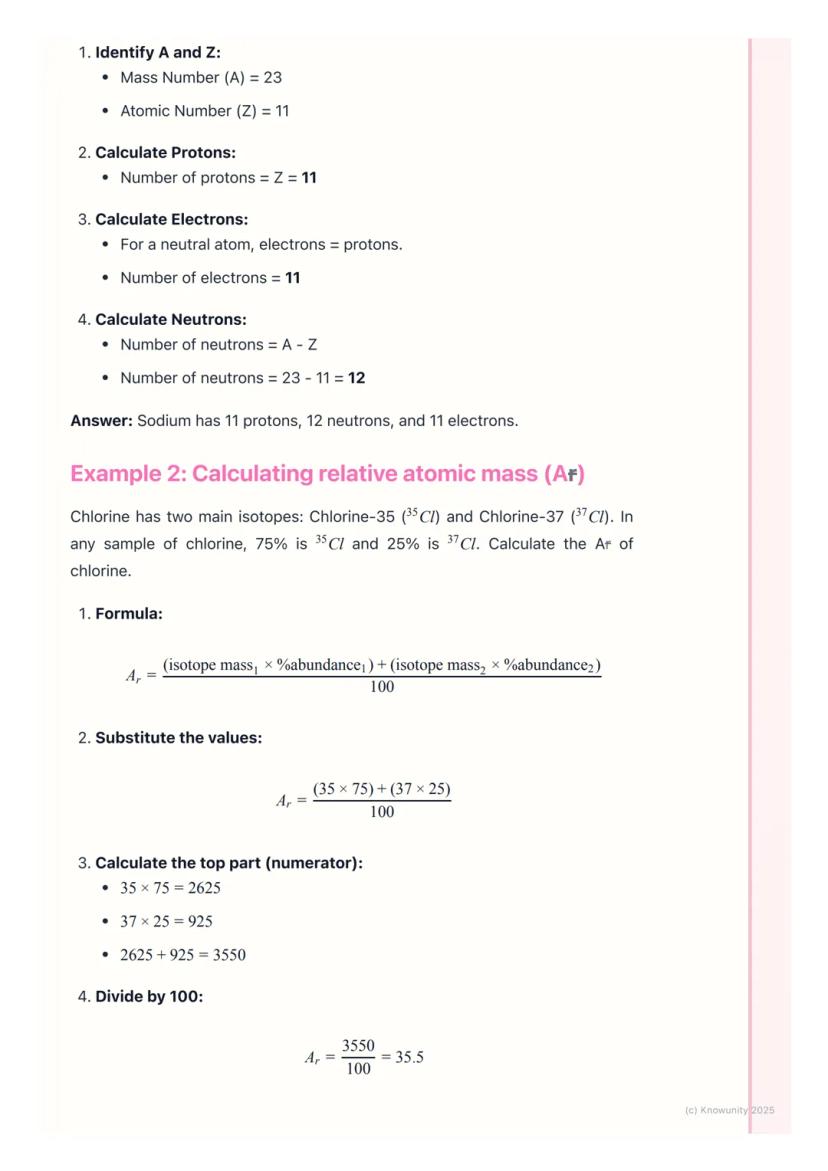
Let's work through sodium (²³₁₁Na) step by step. The mass number A = 23 and atomic number Z = 11. This means: protons = 11, electrons = 11 (same as protons for neutral atoms), and neutrons = 23 - 11 = 12.
For relative atomic mass calculations, you need to account for isotopes - atoms of the same element with different numbers of neutrons. Chlorine exists as 75% chlorine-35 and 25% chlorine-37.
The calculation is: Ar = [(35 × 75) + (37 × 25)] ÷ 100 = [2625 + 925] ÷ 100 = 35.5. This matches the decimal number you see on the periodic table for chlorine.
Isotopes are crucial to understand - they're the same element (same number of protons) but with different neutrons, so they have different mass numbers but identical chemical properties.
Calculation Tip: Always double-check your relative atomic mass answer against the periodic table - if they don't match, you've made an error in your working!
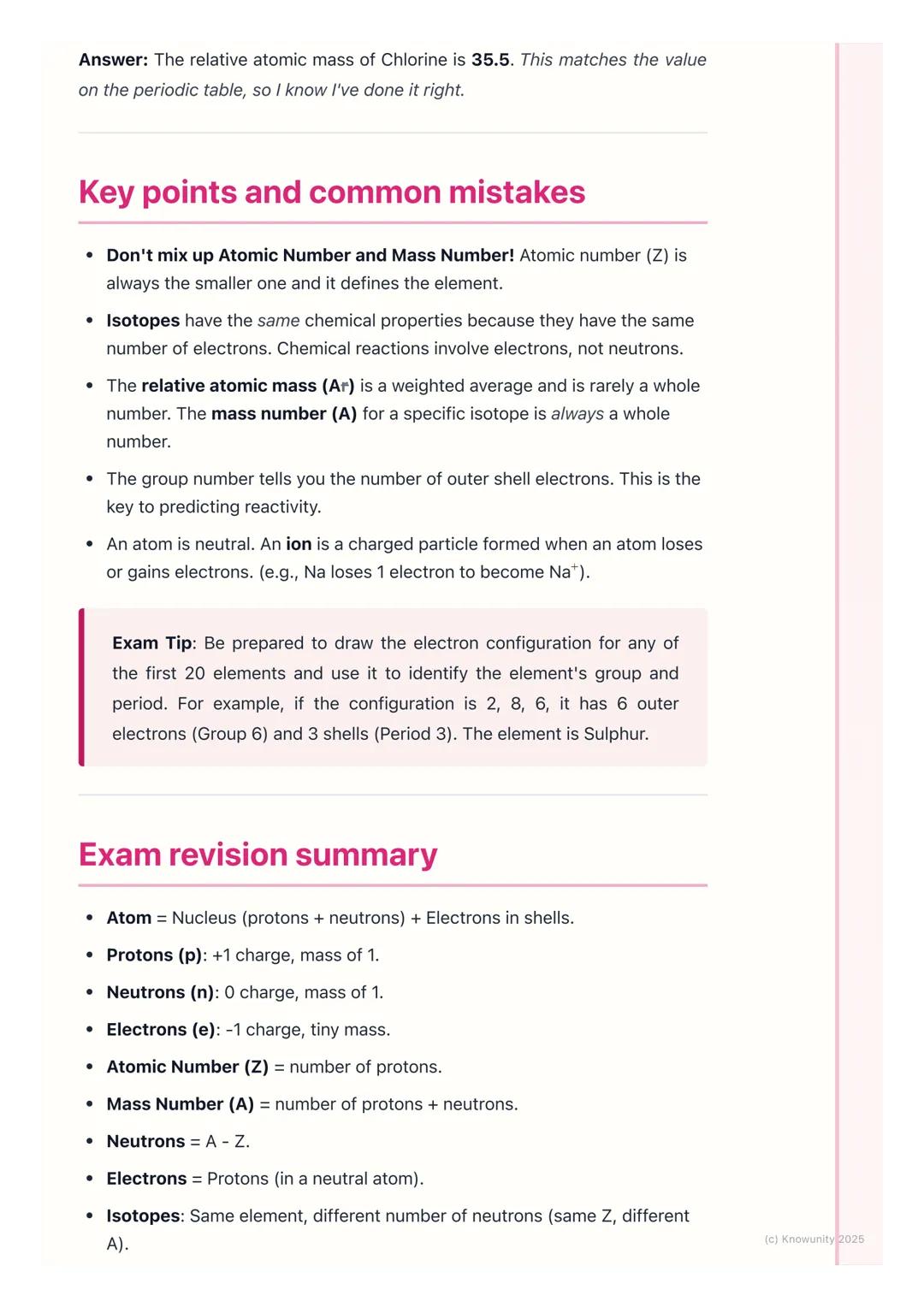
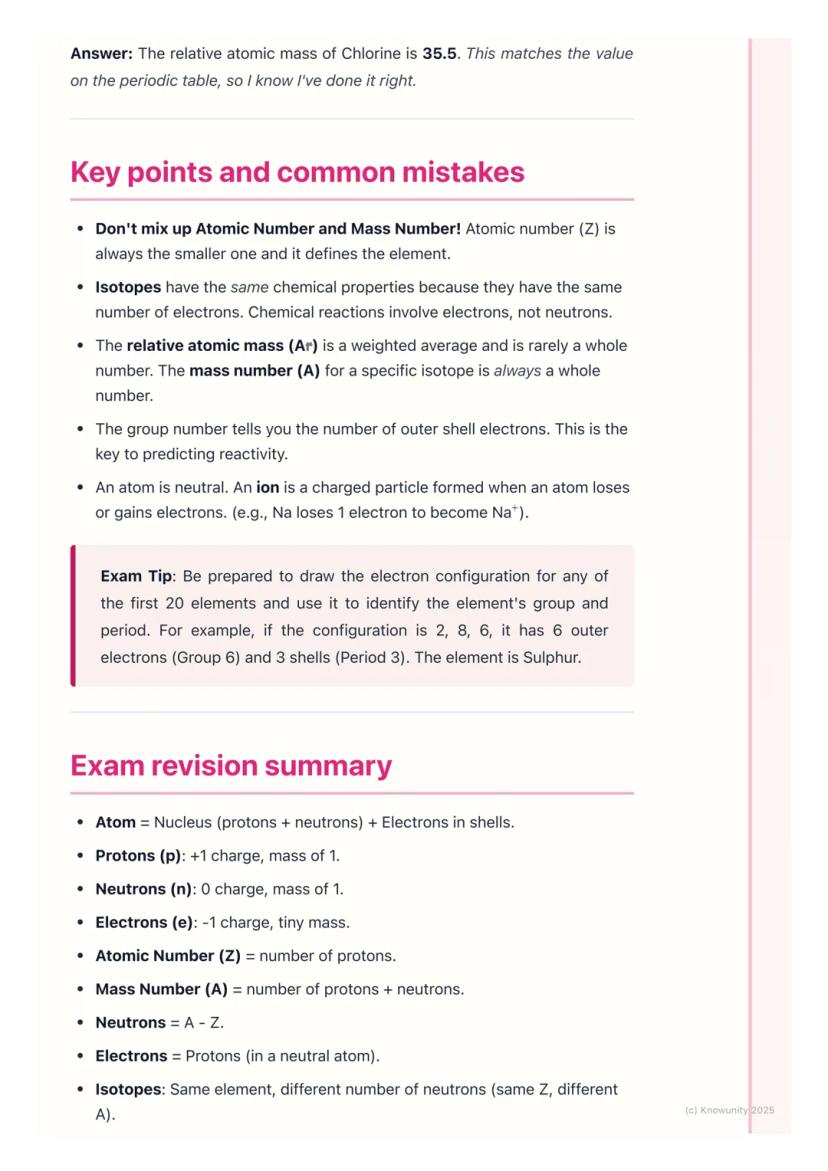
Don't mix up atomic number and mass number - the atomic number is always smaller and defines what element you're dealing with. The mass number tells you the total particles in the nucleus.
Remember that isotopes have identical chemical properties because chemical reactions involve electrons, not neutrons. Different neutron numbers only affect the atomic mass, not how the element behaves chemically.
The relative atomic mass on the periodic table is usually a decimal because it's a weighted average of all naturally occurring isotopes. However, the mass number for any specific isotope is always a whole number.
Group numbers directly tell you the outer electron count, which is your key to predicting reactivity patterns. Master this connection and you'll find chemistry much more logical.
Final Exam Tip: Practice drawing electron configurations for the first 20 elements until you can do it in your sleep - this skill unlocks so many other chemistry concepts!

MI Társunk egy diákközpontú MI eszköz, amely többet nyújt puszta válaszoknál. Millió Knowunity erőforrásra épülve releváns információkat, személyre szabott tanulási terveket, kvízeket és tartalmat biztosít közvetlenül a chatben, alkalmazkodva az egyéni tanulási utadhoz.
Az appot letöltheted a Google Play Store-ból és az Apple App Store-ból.
Pontosan! Élvezd az ingyenes hozzáférést a tanulási tartalmakhoz, kapcsolódj diáktársaiddal, és kapj azonnali segítséget – mind a kezed ügyében.
App Store
Google Play
Az alkalmazás nagyon könnyen használható és jól megtervezett. Mindent megtaláltam, amit eddig kerestem, és sokat tudtam tanulni a prezentációkból! Biztosan használni fogom az alkalmazást egy osztályfeladathoz! És persze inspirációként is nagyszerűen segít.
Stefan S
iOS felhasználó
Ez az alkalmazás tényleg nagyszerű. Olyan sok tanulási jegyzet és segítség van benne [...]. Például a francia a problémás tantárgyam, és az alkalmazásban olyan sok segítség lehetőség van. Ennek az alkalmazásnak köszönhetően javult a franciám. Mindenkinek ajánlanám.
Samantha Klich
Android felhasználó
Hű, tényleg lenyűgözött. Csak úgy kipróbáltam az alkalmazást, mert sokszor láttam reklámozva, és teljesen megdöbbentett. Ez az alkalmazás AZ A SEGÍTSÉG, amire az iskolában szükséged van, és mindenekelőtt olyan sok mindent kínál, mint például gyakorlatokat és összefoglalókat, amik nekem személyesen NAGYON hasznosak voltak.
Anna
iOS felhasználó
A legjobb app a földön! Nincs szó rá, mert túl jó
Thomas R
iOS felhasználó
Egyszerűen elképesztő. 10x jobban tudok ismételni vele, ez az app egy egyértelmű 10/10. Mindenkinek ajánlom. Nézhetem és kereshetem a jegyzeteket. El tudom menteni őket tantárgy mappákba. Bármikor átismételhetem, amikor visszatérek. Ha még nem próbáltad ezt az appot, tényleg lemaradsz valamiről.
Basil
Android felhasználó
Ez az app sokkal magabiztosabbá tett a vizsgafelkészülésben, nem csak azáltal, hogy növelte az önbizalmam olyan funkciókkal, amik lehetővé teszik, hogy kapcsolódj másokhoz és kevésbé érezd magad egyedül, hanem azáltal is, ahogy maga az app arra épül, hogy jobban érezd magad. Könnyű navigálni, szórakoztató használni, és hasznos bárkinek, aki bármilyen területen küzd.
David K
iOS felhasználó
Az alkalmazás egyszerűen nagyszerű! Csak be kell írnom a témakört a keresősávba, és szuper gyorsan megkapom a választ. Nem kell megnéznem 10 YouTube videót, hogy megértsek valamit, így időt spórolok. Nagyon ajánlom!
Sudenaz Ocak
Android felhasználó
Az iskolában nagyon rossz voltam matekból, de az alkalmazásnak köszönhetően most jobban megy. Annyira hálás vagyok, hogy megcsináltátok az appot.
Greenlight Bonnie
Android felhasználó
nagyon megbízható app, ami segít fejleszteni a matekos, angolος és más kapcsolódó témákat a munkáidban. kérlek használd ezt az appot, ha nehézségeid vannak egyes területeken, ez az app kulcsfontosságú ehhez. bárcsak korábban írtam volna értékelést. és ingyenes is, szóval ne izgulj emiatt.
Rohan U
Android felhasználó
Tudom, hogy sok app hamis fiókokat használ az értékelések növelésére, de ez az app megérdemli az összeset. Eredetileg 4-est kaptam az angol vizsgáimon, és most 7-est kaptam. Három nappal a vizsga előttig nem is tudtam erről az appról, és NAGYON sokat segített. Kérlek tényleg bízz bennem és használd, mert biztos vagyok benne, hogy te is látni fogsz fejlődést.
Xander S
iOS felhasználó
A KVÍZEK ÉS TANULÓKÁRTYÁK ANNYIRA HASZNOSAK ÉS IMÁDOM A Knowunity MI-t. LITERÁLISAN OLYAN MINT A CHATGPT DE OKOSABB!! SEGÍTETT A SZEMPILLASPIRÁL PROBLÉMÁIMMAL IS!! VALAMINT A VALÓS TANTÁRGYAIMMAL IS! NYILVÁN 😍😁😲🤑💗✨🎀😮
Elisha
iOS felhasználó
Ez az app tényleg a legjobb. A tanulást olyan unalmasnak tartom, de ez az app annyira könnyűvé teszi az egész szervezését, aztán megkérheted az ingyenes MI-t, hogy teszteljen téged, annyira jó és könnyedén feltöltheted a saját anyagaidat. nagyon ajánlom mint aki most írom a gyakorló vizsgákat
Paul T
iOS felhasználó
Az alkalmazás nagyon könnyen használható és jól megtervezett. Mindent megtaláltam, amit eddig kerestem, és sokat tudtam tanulni a prezentációkból! Biztosan használni fogom az alkalmazást egy osztályfeladathoz! És persze inspirációként is nagyszerűen segít.
Stefan S
iOS felhasználó
Ez az alkalmazás tényleg nagyszerű. Olyan sok tanulási jegyzet és segítség van benne [...]. Például a francia a problémás tantárgyam, és az alkalmazásban olyan sok segítség lehetőség van. Ennek az alkalmazásnak köszönhetően javult a franciám. Mindenkinek ajánlanám.
Samantha Klich
Android felhasználó
Hű, tényleg lenyűgözött. Csak úgy kipróbáltam az alkalmazást, mert sokszor láttam reklámozva, és teljesen megdöbbentett. Ez az alkalmazás AZ A SEGÍTSÉG, amire az iskolában szükséged van, és mindenekelőtt olyan sok mindent kínál, mint például gyakorlatokat és összefoglalókat, amik nekem személyesen NAGYON hasznosak voltak.
Anna
iOS felhasználó
A legjobb app a földön! Nincs szó rá, mert túl jó
Thomas R
iOS felhasználó
Egyszerűen elképesztő. 10x jobban tudok ismételni vele, ez az app egy egyértelmű 10/10. Mindenkinek ajánlom. Nézhetem és kereshetem a jegyzeteket. El tudom menteni őket tantárgy mappákba. Bármikor átismételhetem, amikor visszatérek. Ha még nem próbáltad ezt az appot, tényleg lemaradsz valamiről.
Basil
Android felhasználó
Ez az app sokkal magabiztosabbá tett a vizsgafelkészülésben, nem csak azáltal, hogy növelte az önbizalmam olyan funkciókkal, amik lehetővé teszik, hogy kapcsolódj másokhoz és kevésbé érezd magad egyedül, hanem azáltal is, ahogy maga az app arra épül, hogy jobban érezd magad. Könnyű navigálni, szórakoztató használni, és hasznos bárkinek, aki bármilyen területen küzd.
David K
iOS felhasználó
Az alkalmazás egyszerűen nagyszerű! Csak be kell írnom a témakört a keresősávba, és szuper gyorsan megkapom a választ. Nem kell megnéznem 10 YouTube videót, hogy megértsek valamit, így időt spórolok. Nagyon ajánlom!
Sudenaz Ocak
Android felhasználó
Az iskolában nagyon rossz voltam matekból, de az alkalmazásnak köszönhetően most jobban megy. Annyira hálás vagyok, hogy megcsináltátok az appot.
Greenlight Bonnie
Android felhasználó
nagyon megbízható app, ami segít fejleszteni a matekos, angolος és más kapcsolódó témákat a munkáidban. kérlek használd ezt az appot, ha nehézségeid vannak egyes területeken, ez az app kulcsfontosságú ehhez. bárcsak korábban írtam volna értékelést. és ingyenes is, szóval ne izgulj emiatt.
Rohan U
Android felhasználó
Tudom, hogy sok app hamis fiókokat használ az értékelések növelésére, de ez az app megérdemli az összeset. Eredetileg 4-est kaptam az angol vizsgáimon, és most 7-est kaptam. Három nappal a vizsga előttig nem is tudtam erről az appról, és NAGYON sokat segített. Kérlek tényleg bízz bennem és használd, mert biztos vagyok benne, hogy te is látni fogsz fejlődést.
Xander S
iOS felhasználó
A KVÍZEK ÉS TANULÓKÁRTYÁK ANNYIRA HASZNOSAK ÉS IMÁDOM A Knowunity MI-t. LITERÁLISAN OLYAN MINT A CHATGPT DE OKOSABB!! SEGÍTETT A SZEMPILLASPIRÁL PROBLÉMÁIMMAL IS!! VALAMINT A VALÓS TANTÁRGYAIMMAL IS! NYILVÁN 😍😁😲🤑💗✨🎀😮
Elisha
iOS felhasználó
Ez az app tényleg a legjobb. A tanulást olyan unalmasnak tartom, de ez az app annyira könnyűvé teszi az egész szervezését, aztán megkérheted az ingyenes MI-t, hogy teszteljen téged, annyira jó és könnyedén feltöltheted a saját anyagaidat. nagyon ajánlom mint aki most írom a gyakorló vizsgákat
Paul T
iOS felhasználó
Ever wondered what everything around you is actually made of? It all comes down to atoms- tiny building blocks that make up absolutely everything, from your phone to the air you breathe. Understanding how atoms work is the key... Továbbiak megjelenítése
Hozzáférés minden dokumentumhoz
Javítsd a jegyeidet
Csatlakozz diákok millióihoz
Think of atoms as the LEGO blocks of the universe - they're the smallest pieces that still keep all the properties of an element. Every single thing you can touch, see, or breathe is made up of these incredibly tiny particles.
What makes atoms really clever is that they're mostly empty space with a super dense centre called the nucleus. Around this nucleus, electrons zoom about in specific areas called shells. It's a bit like planets orbiting the sun, but way more exciting because it determines how elements will react with each other.
The brilliant thing about atoms is that they're electrically neutral - they have equal amounts of positive and negative charges that balance each other out perfectly. This balance is what keeps matter stable and predictable.
Quick Tip: Remember that atoms are the smallest particles of an element that still act like that element - break them down further and you lose what makes oxygen "oxygen" or gold "gold"!
Hozzáférés minden dokumentumhoz
Javítsd a jegyeidet
Csatlakozz diákok millióihoz
Inside every atom, you'll find three main players: protons, neutrons, and electrons. Protons carry a positive charge and live in the nucleus with neutrons (which are neutral). Electrons, with their negative charge, whiz around the nucleus in shells.
Here's what you need to remember: protons have a relative mass of 1 and a +1 charge, neutrons also have a mass of 1 but no charge, and electrons are incredibly light with a -1 charge.
The atomic number (Z) tells you how many protons an element has - this is like its ID card because it never changes for that element. The mass number (A) is the total of protons plus neutrons in the nucleus.
To find the number of particles, use this dead simple formula: protons = Z, electrons = Z (for neutral atoms), and neutrons = A - Z. Master this calculation because it's guaranteed to show up on your exams.
Exam Alert: The notation ᴬ/ᴢX always appears on tests - A is the big number on top (mass number), Z is the small number below (atomic number), and X is the element symbol.
Hozzáférés minden dokumentumhoz
Javítsd a jegyeidet
Csatlakozz diákok millióihoz
Electrons don't just randomly float around the nucleus - they follow strict rules about where they can live. Think of electron shells as different floors of a building, and electrons fill up from the ground floor upwards.
The first shell (closest to the nucleus) can only hold 2 electrons maximum. The second shell can hold up to 8 electrons, and for the first 20 elements you need to know, the third shell also holds a maximum of 8 electrons.
Let's use magnesium as an example. It has an atomic number of 12, so it has 12 electrons. These get arranged as: 2 electrons in the first shell, 8 in the second shell, and the remaining 2 in the third shell. We write this as 2, 8, 2.
Getting electron configuration right is crucial because it directly links to how elements are organised in the periodic table and explains why certain elements behave similarly to others.
Memory Trick: For the first 20 elements, shells fill in the pattern 2, 8, 8 - like a simple countdown that helps you work out any element's electron arrangement!
Hozzáférés minden dokumentumhoz
Javítsd a jegyeidet
Csatlakozz diákok millióihoz
The periodic table isn't just a random list of elements - it's actually a brilliant map that shows you exactly how atoms are structured. Elements are arranged in order of increasing atomic number, which means more and more protons as you move from left to right.
Periods are the horizontal rows, and here's the key insight: all elements in the same period have the same number of electron shells. So sodium (2,8,1) and argon (2,8,8) are both in period 3 because they both have exactly 3 electron shells.
Groups are the vertical columns, and this is where it gets really interesting. Elements in the same group have the same number of electrons in their outermost shell, which means they behave very similarly in chemical reactions.
The outermost electrons (called valence electrons) are like the element's personality - they determine how it will react with other elements. Same number of outer electrons equals similar chemical behaviour.
Key Insight: The periodic table is basically a cheat sheet for predicting how elements will behave - once you understand the pattern, chemistry becomes much more logical!
Hozzáférés minden dokumentumhoz
Javítsd a jegyeidet
Csatlakozz diákok millióihoz
Group 1 (Alkali Metals) elements have just 1 electron in their outer shell, making them incredibly reactive - they desperately want to lose that lone electron. Think lithium, sodium, and potassium - they all react explosively with water.
Group 7 (Halogens) have 7 outer electrons and are equally reactive, but for the opposite reason - they're desperate to gain 1 more electron to fill their outer shell. Fluorine and chlorine are classic examples that form salts when they react with metals.
Group 0 (Noble Gases) are the chilled-out elements with full outer shells - helium has 2 electrons, while neon and argon have 8. Because their outer shells are complete, they're incredibly stable and rarely react with anything.
Understanding these groups helps you predict reactions before they happen. Elements in the same group will generally react in similar ways because they have the same outer electron arrangement.
Exam Focus: You'll definitely need to identify which group an element belongs to from its electron configuration - the number of outer electrons equals the group number (except for Group 0)!
Hozzáférés minden dokumentumhoz
Javítsd a jegyeidet
Csatlakozz diákok millióihoz
Let's work through sodium (²³₁₁Na) step by step. The mass number A = 23 and atomic number Z = 11. This means: protons = 11, electrons = 11 (same as protons for neutral atoms), and neutrons = 23 - 11 = 12.
For relative atomic mass calculations, you need to account for isotopes - atoms of the same element with different numbers of neutrons. Chlorine exists as 75% chlorine-35 and 25% chlorine-37.
The calculation is: Ar = [(35 × 75) + (37 × 25)] ÷ 100 = [2625 + 925] ÷ 100 = 35.5. This matches the decimal number you see on the periodic table for chlorine.
Isotopes are crucial to understand - they're the same element (same number of protons) but with different neutrons, so they have different mass numbers but identical chemical properties.
Calculation Tip: Always double-check your relative atomic mass answer against the periodic table - if they don't match, you've made an error in your working!
Hozzáférés minden dokumentumhoz
Javítsd a jegyeidet
Csatlakozz diákok millióihoz
Don't mix up atomic number and mass number - the atomic number is always smaller and defines what element you're dealing with. The mass number tells you the total particles in the nucleus.
Remember that isotopes have identical chemical properties because chemical reactions involve electrons, not neutrons. Different neutron numbers only affect the atomic mass, not how the element behaves chemically.
The relative atomic mass on the periodic table is usually a decimal because it's a weighted average of all naturally occurring isotopes. However, the mass number for any specific isotope is always a whole number.
Group numbers directly tell you the outer electron count, which is your key to predicting reactivity patterns. Master this connection and you'll find chemistry much more logical.
Final Exam Tip: Practice drawing electron configurations for the first 20 elements until you can do it in your sleep - this skill unlocks so many other chemistry concepts!
Hozzáférés minden dokumentumhoz
Javítsd a jegyeidet
Csatlakozz diákok millióihoz
MI Társunk egy diákközpontú MI eszköz, amely többet nyújt puszta válaszoknál. Millió Knowunity erőforrásra épülve releváns információkat, személyre szabott tanulási terveket, kvízeket és tartalmat biztosít közvetlenül a chatben, alkalmazkodva az egyéni tanulási utadhoz.
Az appot letöltheted a Google Play Store-ból és az Apple App Store-ból.
Pontosan! Élvezd az ingyenes hozzáférést a tanulási tartalmakhoz, kapcsolódj diáktársaiddal, és kapj azonnali segítséget – mind a kezed ügyében.
1
Intelligens Eszközök ÚJ
Alakítsd át ezeket a jegyzeteket: ✓ 50+ Gyakorló Feladat ✓ Interaktív Tanulókártyák ✓ Teljes próbavizsga ✓ Esszé Vázlatok
App Store
Google Play
Az alkalmazás nagyon könnyen használható és jól megtervezett. Mindent megtaláltam, amit eddig kerestem, és sokat tudtam tanulni a prezentációkból! Biztosan használni fogom az alkalmazást egy osztályfeladathoz! És persze inspirációként is nagyszerűen segít.
Stefan S
iOS felhasználó
Ez az alkalmazás tényleg nagyszerű. Olyan sok tanulási jegyzet és segítség van benne [...]. Például a francia a problémás tantárgyam, és az alkalmazásban olyan sok segítség lehetőség van. Ennek az alkalmazásnak köszönhetően javult a franciám. Mindenkinek ajánlanám.
Samantha Klich
Android felhasználó
Hű, tényleg lenyűgözött. Csak úgy kipróbáltam az alkalmazást, mert sokszor láttam reklámozva, és teljesen megdöbbentett. Ez az alkalmazás AZ A SEGÍTSÉG, amire az iskolában szükséged van, és mindenekelőtt olyan sok mindent kínál, mint például gyakorlatokat és összefoglalókat, amik nekem személyesen NAGYON hasznosak voltak.
Anna
iOS felhasználó
A legjobb app a földön! Nincs szó rá, mert túl jó
Thomas R
iOS felhasználó
Egyszerűen elképesztő. 10x jobban tudok ismételni vele, ez az app egy egyértelmű 10/10. Mindenkinek ajánlom. Nézhetem és kereshetem a jegyzeteket. El tudom menteni őket tantárgy mappákba. Bármikor átismételhetem, amikor visszatérek. Ha még nem próbáltad ezt az appot, tényleg lemaradsz valamiről.
Basil
Android felhasználó
Ez az app sokkal magabiztosabbá tett a vizsgafelkészülésben, nem csak azáltal, hogy növelte az önbizalmam olyan funkciókkal, amik lehetővé teszik, hogy kapcsolódj másokhoz és kevésbé érezd magad egyedül, hanem azáltal is, ahogy maga az app arra épül, hogy jobban érezd magad. Könnyű navigálni, szórakoztató használni, és hasznos bárkinek, aki bármilyen területen küzd.
David K
iOS felhasználó
Az alkalmazás egyszerűen nagyszerű! Csak be kell írnom a témakört a keresősávba, és szuper gyorsan megkapom a választ. Nem kell megnéznem 10 YouTube videót, hogy megértsek valamit, így időt spórolok. Nagyon ajánlom!
Sudenaz Ocak
Android felhasználó
Az iskolában nagyon rossz voltam matekból, de az alkalmazásnak köszönhetően most jobban megy. Annyira hálás vagyok, hogy megcsináltátok az appot.
Greenlight Bonnie
Android felhasználó
nagyon megbízható app, ami segít fejleszteni a matekos, angolος és más kapcsolódó témákat a munkáidban. kérlek használd ezt az appot, ha nehézségeid vannak egyes területeken, ez az app kulcsfontosságú ehhez. bárcsak korábban írtam volna értékelést. és ingyenes is, szóval ne izgulj emiatt.
Rohan U
Android felhasználó
Tudom, hogy sok app hamis fiókokat használ az értékelések növelésére, de ez az app megérdemli az összeset. Eredetileg 4-est kaptam az angol vizsgáimon, és most 7-est kaptam. Három nappal a vizsga előttig nem is tudtam erről az appról, és NAGYON sokat segített. Kérlek tényleg bízz bennem és használd, mert biztos vagyok benne, hogy te is látni fogsz fejlődést.
Xander S
iOS felhasználó
A KVÍZEK ÉS TANULÓKÁRTYÁK ANNYIRA HASZNOSAK ÉS IMÁDOM A Knowunity MI-t. LITERÁLISAN OLYAN MINT A CHATGPT DE OKOSABB!! SEGÍTETT A SZEMPILLASPIRÁL PROBLÉMÁIMMAL IS!! VALAMINT A VALÓS TANTÁRGYAIMMAL IS! NYILVÁN 😍😁😲🤑💗✨🎀😮
Elisha
iOS felhasználó
Ez az app tényleg a legjobb. A tanulást olyan unalmasnak tartom, de ez az app annyira könnyűvé teszi az egész szervezését, aztán megkérheted az ingyenes MI-t, hogy teszteljen téged, annyira jó és könnyedén feltöltheted a saját anyagaidat. nagyon ajánlom mint aki most írom a gyakorló vizsgákat
Paul T
iOS felhasználó
Az alkalmazás nagyon könnyen használható és jól megtervezett. Mindent megtaláltam, amit eddig kerestem, és sokat tudtam tanulni a prezentációkból! Biztosan használni fogom az alkalmazást egy osztályfeladathoz! És persze inspirációként is nagyszerűen segít.
Stefan S
iOS felhasználó
Ez az alkalmazás tényleg nagyszerű. Olyan sok tanulási jegyzet és segítség van benne [...]. Például a francia a problémás tantárgyam, és az alkalmazásban olyan sok segítség lehetőség van. Ennek az alkalmazásnak köszönhetően javult a franciám. Mindenkinek ajánlanám.
Samantha Klich
Android felhasználó
Hű, tényleg lenyűgözött. Csak úgy kipróbáltam az alkalmazást, mert sokszor láttam reklámozva, és teljesen megdöbbentett. Ez az alkalmazás AZ A SEGÍTSÉG, amire az iskolában szükséged van, és mindenekelőtt olyan sok mindent kínál, mint például gyakorlatokat és összefoglalókat, amik nekem személyesen NAGYON hasznosak voltak.
Anna
iOS felhasználó
A legjobb app a földön! Nincs szó rá, mert túl jó
Thomas R
iOS felhasználó
Egyszerűen elképesztő. 10x jobban tudok ismételni vele, ez az app egy egyértelmű 10/10. Mindenkinek ajánlom. Nézhetem és kereshetem a jegyzeteket. El tudom menteni őket tantárgy mappákba. Bármikor átismételhetem, amikor visszatérek. Ha még nem próbáltad ezt az appot, tényleg lemaradsz valamiről.
Basil
Android felhasználó
Ez az app sokkal magabiztosabbá tett a vizsgafelkészülésben, nem csak azáltal, hogy növelte az önbizalmam olyan funkciókkal, amik lehetővé teszik, hogy kapcsolódj másokhoz és kevésbé érezd magad egyedül, hanem azáltal is, ahogy maga az app arra épül, hogy jobban érezd magad. Könnyű navigálni, szórakoztató használni, és hasznos bárkinek, aki bármilyen területen küzd.
David K
iOS felhasználó
Az alkalmazás egyszerűen nagyszerű! Csak be kell írnom a témakört a keresősávba, és szuper gyorsan megkapom a választ. Nem kell megnéznem 10 YouTube videót, hogy megértsek valamit, így időt spórolok. Nagyon ajánlom!
Sudenaz Ocak
Android felhasználó
Az iskolában nagyon rossz voltam matekból, de az alkalmazásnak köszönhetően most jobban megy. Annyira hálás vagyok, hogy megcsináltátok az appot.
Greenlight Bonnie
Android felhasználó
nagyon megbízható app, ami segít fejleszteni a matekos, angolος és más kapcsolódó témákat a munkáidban. kérlek használd ezt az appot, ha nehézségeid vannak egyes területeken, ez az app kulcsfontosságú ehhez. bárcsak korábban írtam volna értékelést. és ingyenes is, szóval ne izgulj emiatt.
Rohan U
Android felhasználó
Tudom, hogy sok app hamis fiókokat használ az értékelések növelésére, de ez az app megérdemli az összeset. Eredetileg 4-est kaptam az angol vizsgáimon, és most 7-est kaptam. Három nappal a vizsga előttig nem is tudtam erről az appról, és NAGYON sokat segített. Kérlek tényleg bízz bennem és használd, mert biztos vagyok benne, hogy te is látni fogsz fejlődést.
Xander S
iOS felhasználó
A KVÍZEK ÉS TANULÓKÁRTYÁK ANNYIRA HASZNOSAK ÉS IMÁDOM A Knowunity MI-t. LITERÁLISAN OLYAN MINT A CHATGPT DE OKOSABB!! SEGÍTETT A SZEMPILLASPIRÁL PROBLÉMÁIMMAL IS!! VALAMINT A VALÓS TANTÁRGYAIMMAL IS! NYILVÁN 😍😁😲🤑💗✨🎀😮
Elisha
iOS felhasználó
Ez az app tényleg a legjobb. A tanulást olyan unalmasnak tartom, de ez az app annyira könnyűvé teszi az egész szervezését, aztán megkérheted az ingyenes MI-t, hogy teszteljen téged, annyira jó és könnyedén feltöltheted a saját anyagaidat. nagyon ajánlom mint aki most írom a gyakorló vizsgákat
Paul T
iOS felhasználó