
Ever wondered why you don't slip when you walk or... Továbbiak megjelenítése
 Physics2 megtekintések·Frissítve May 26, 2026·5 oldal
Understanding Friction: The Force Opposing Motion
1 / 5
1
of 5
What is Friction?
Friction is basically nature's way of putting the brakes on things. It's a contact force that happens when two surfaces touch and rub against each other, always trying to slow down or stop movement.
Think about it - without friction, you'd slide around like you're on ice all the time! It's the reason you can walk, write with a pencil, or stop your bike when you need to.
The key thing to remember is that friction always works in the opposite direction to movement. So if you're pushing a book to the right, friction pushes back to the left.
Remember This: Friction is a contact force - objects have to be touching for it to work!
2
of 5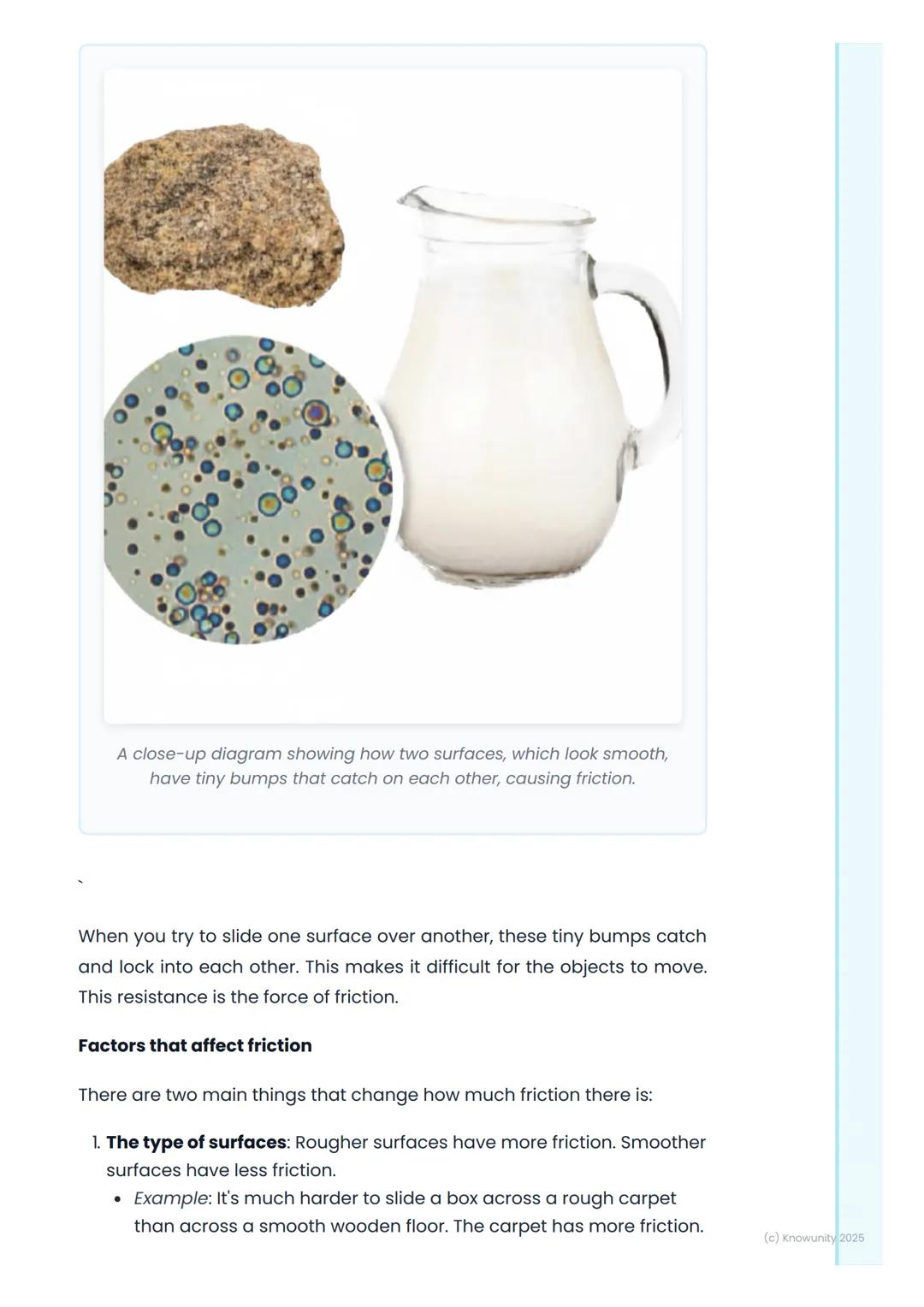
How Friction Actually Works
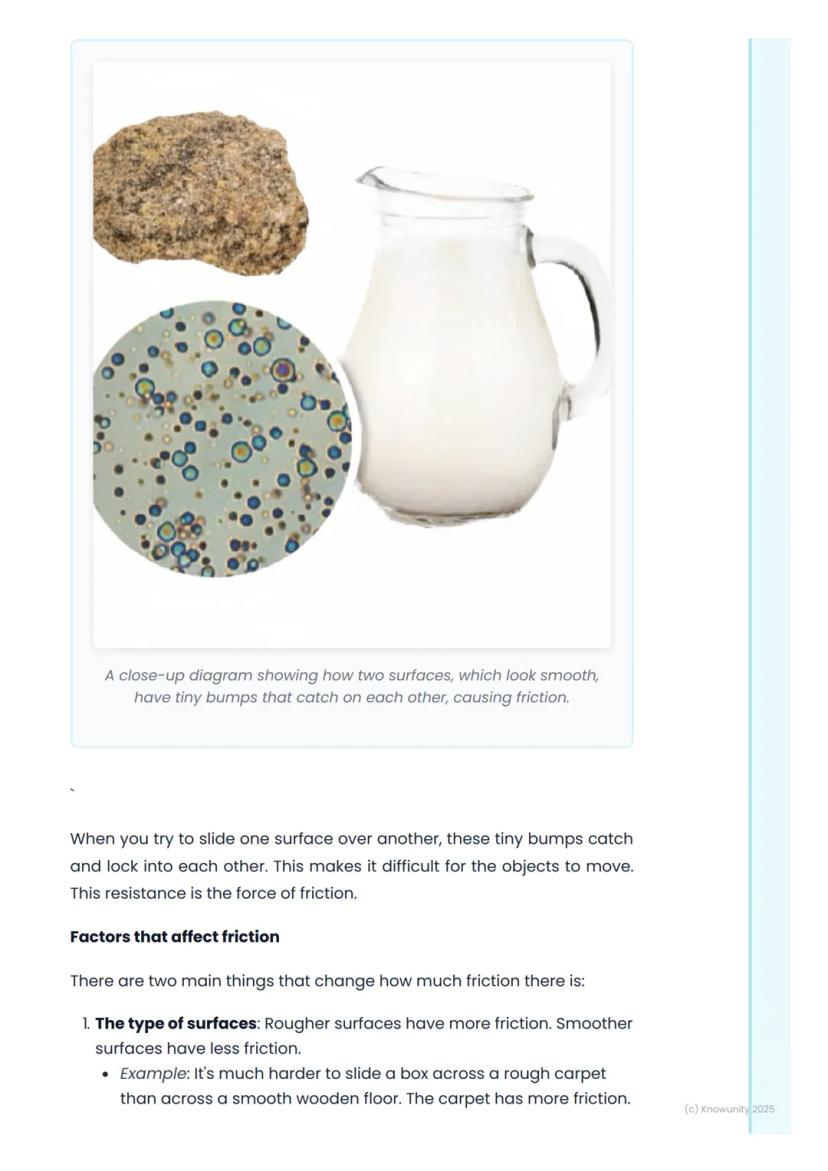
Here's something that might surprise you - even the smoothest surfaces aren't actually smooth at all! Under a microscope, everything looks like a mountain range with tiny bumps and valleys.
When you try to slide one surface over another, these microscopic bumps catch and lock into each other like tiny puzzle pieces. This creates resistance, which is what we feel as friction.
It's like trying to slide two pieces of velcro past each other - all those little hooks and loops catch on each other and make it difficult to move.
Think About It: Even a perfectly polished table has bumps smaller than you can see - that's why there's still some friction!
3
of 5
What Makes Friction Stronger or Weaker?
Two main things control how much friction you get between surfaces. First, surface texture makes a huge difference - rougher surfaces create more friction than smooth ones.
Try sliding a box across carpet versus a wooden floor, and you'll feel the difference immediately! The carpet grabs onto the box much more.
Second, weight matters. The harder surfaces are pressed together, the more those tiny bumps lock into each other. This is why a heavy school bag full of books is much harder to drag than an empty one.
Quick Test: Try pushing an empty wheelie bin versus a full one - the difference you feel is all about friction!
4
of 5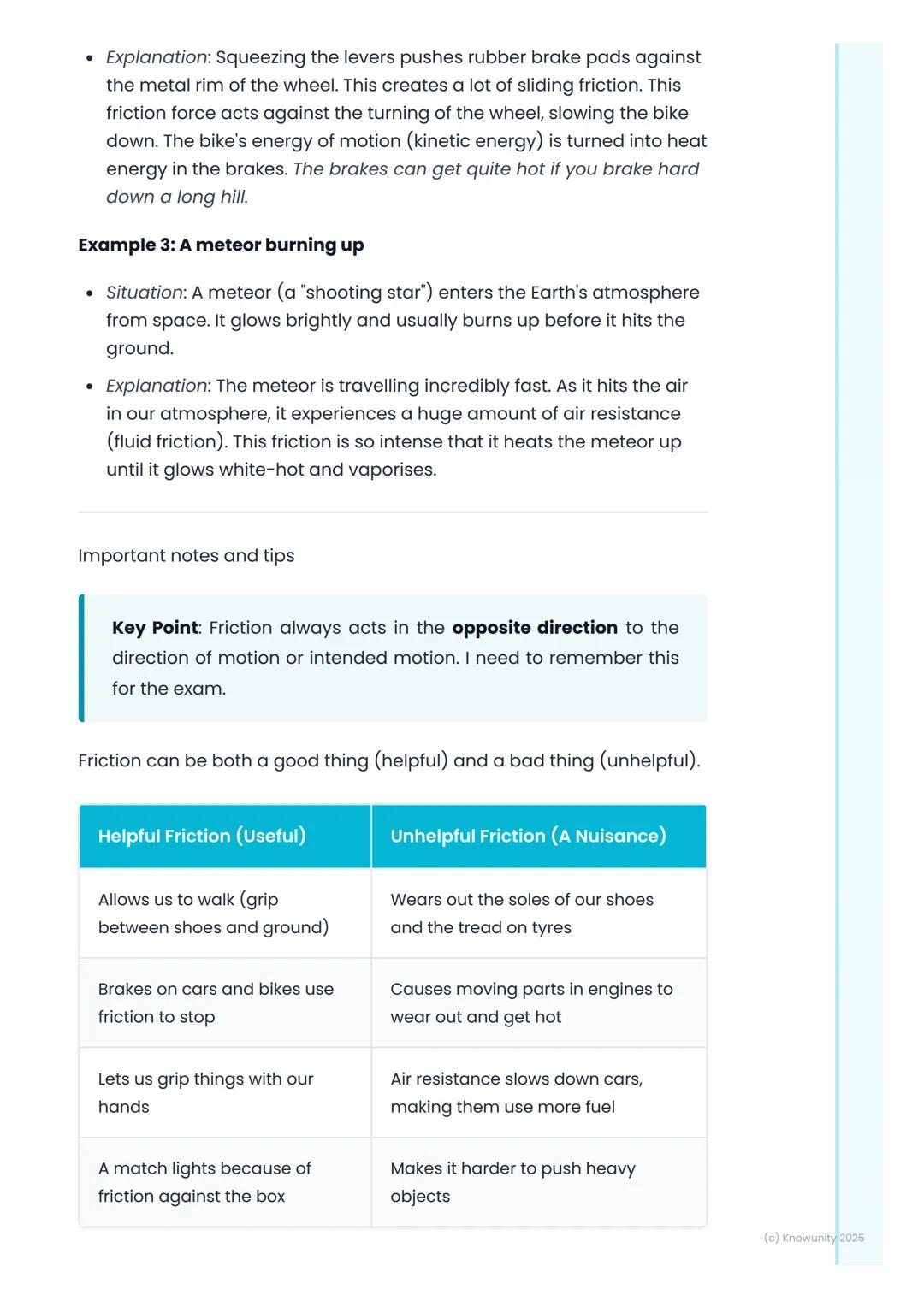
The Different Types of Friction
There are four main types of friction you need to know. Static friction is the strongest - it's what stops things from starting to move (like trying to push a heavy sofa).
Sliding friction happens when surfaces are already moving past each other. It's weaker than static friction, which is why it's easier to keep something moving than to start it moving.
Rolling friction is much weaker than sliding friction - that's why wheels are so brilliant for moving heavy things! Finally, fluid friction includes air resistance and water resistance, which slow down everything from falling leaves to swimming fish.
Real Example: This is why bike brakes work - they create sliding friction between the brake pads and wheel rim to slow you down!
5
of 5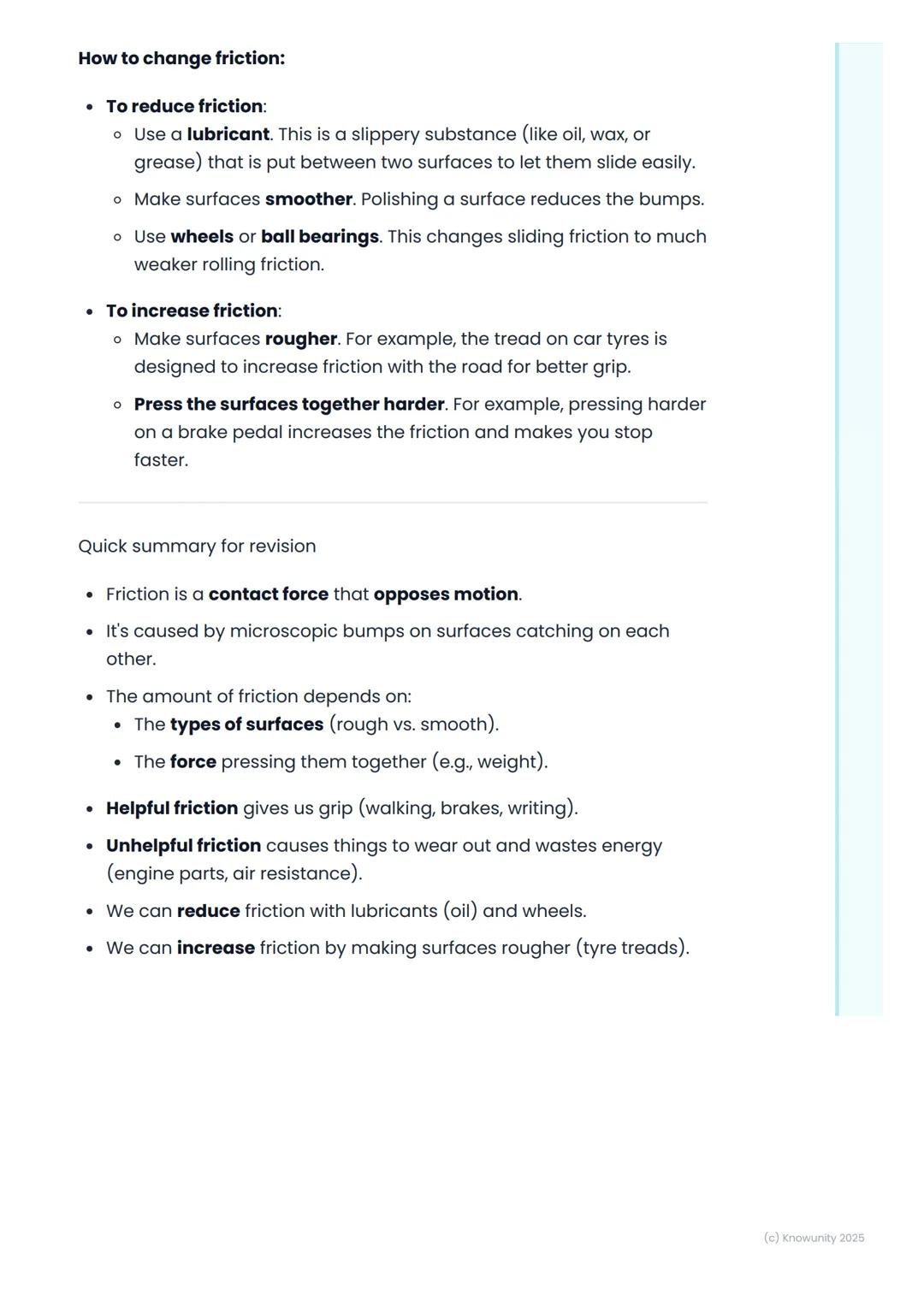
Friction in Action - Real Life Examples
Friction is everywhere in your daily life doing important jobs. When you write with a pencil, friction scrapes off tiny bits of graphite onto the paper - no friction means no writing!
Bike brakes use sliding friction to convert your movement energy into heat energy, which is why brakes get warm after heavy use. Even shooting stars are caused by friction - meteors heat up so much from air resistance that they glow white-hot.
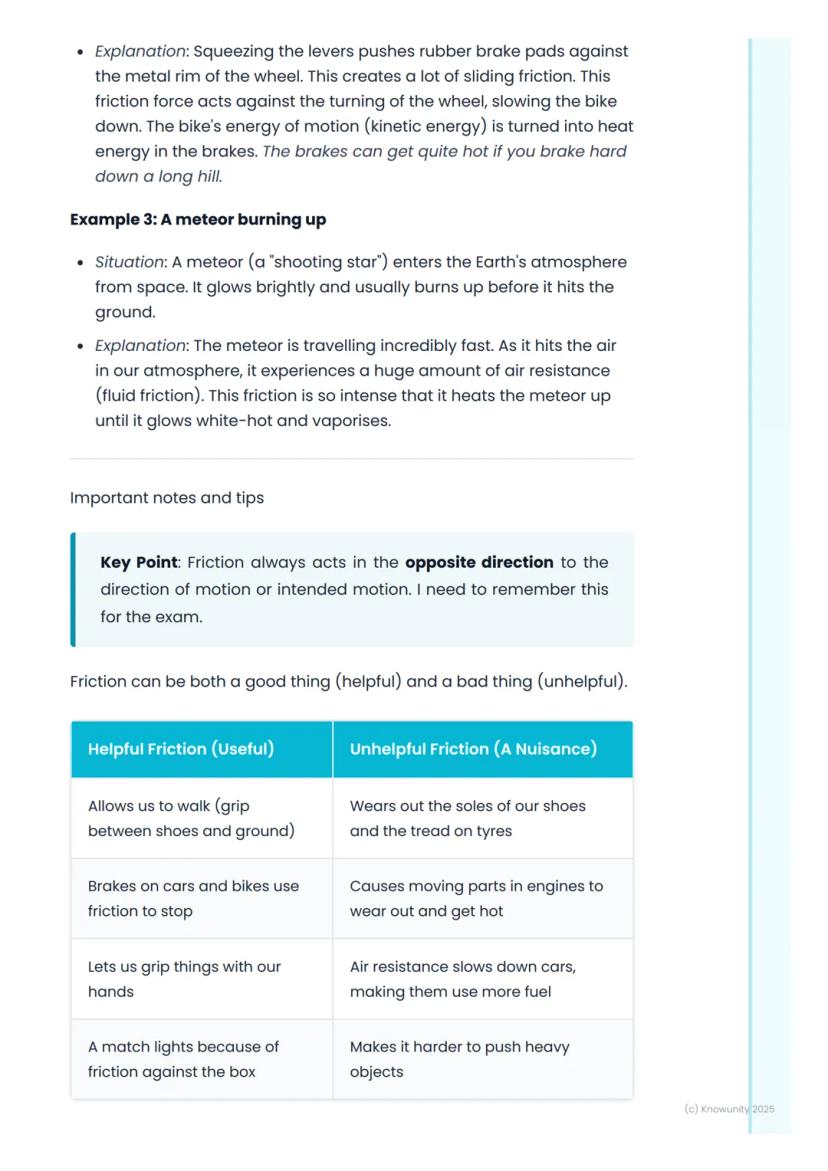
Sometimes friction is helpful (letting you walk without slipping), and sometimes it's annoying (wearing out your shoes and making cars use more fuel). You can reduce friction with lubricants like oil, or increase it by making surfaces rougher like car tyre treads.
Remember: Friction can be your friend (brakes, grip) or your enemy (wear and tear) - it all depends on the situation!
Azt hittük, soha nem fogod megkérdezni...
Mi a Knowunity MI társ?
MI Társunk egy diákközpontú MI eszköz, amely többet nyújt puszta válaszoknál. Millió Knowunity erőforrásra épülve releváns információkat, személyre szabott tanulási terveket, kvízeket és tartalmat biztosít közvetlenül a chatben, alkalmazkodva az egyéni tanulási utadhoz.
Honnan tudom letölteni a Knowunity appot?
Az appot letöltheted a Google Play Store-ból és az Apple App Store-ból.
Tényleg ingyenes a Knowunity?
Pontosan! Élvezd az ingyenes hozzáférést a tanulási tartalmakhoz, kapcsolódj diáktársaiddal, és kapj azonnali segítséget – mind a kezed ügyében.
Legnépszerűbb tananyagok Physics tantárgyból
3PhysicsBalanced and Unbalanced Forces
Students will explore how balanced forces result in no change in motion, while unbalanced forces cause an object to accelerate or change direction.
2nd Year421
PhysicsTypes of Forces
Students will identify common forces such as gravity (pulling objects down), friction (opposing motion), and air resistance (slowing objects in the air).
2nd Year460
PhysicsSpeed, Distance, and Time
Students will learn the basic concepts of speed, distance, and time, and how they relate to each other in describing motion.
2nd Year100
Legnépszerűbb tananyagok
9 Irish
IrishIrish oral questions and answers
Questions and answers for the leaving cert oral
5th Year4254
IrishIrish oral questions
Outline of oral questions
5th Year2055
IrishIníon- le hÁine Durkin
Aine Durkin’s poem, Iníon: Themes & summary
5th Year850
 English
Key Quotes : Sive
Key Quotes and explanations: Sive
6th Year2572
IrishIrish poetry 2027
Iníon + Dínit an Bhróin
5th Year1133
IrishLC HL notes- Iníon (poem)
Includes poem in English and Irish, theme, key words & phrases
5th Year2284
IrishGaeilge Grammar Office
All the basics you need to know on Irish grammar.
6th Year933
IrishMo Ghrá-sa (Idir Lúibíní)
Notes on mo ghrá-sa
5th Year350
IrishAn Gaeilge Aiste
Irish Language essay
6th Year1290
Nem találod amit keresel? Fedezz fel más tantárgyakat.
A diákok imádnak minket — és téged is fognak.
4.6/5App Store
4.7/5Google Play
Az alkalmazás nagyon könnyen használható és jól megtervezett. Mindent megtaláltam, amit eddig kerestem, és sokat tudtam tanulni a prezentációkból! Biztosan használni fogom az alkalmazást egy osztályfeladathoz! És persze inspirációként is nagyszerűen segít.
Stefan SiOS felhasználó
Ez az alkalmazás tényleg nagyszerű. Olyan sok tanulási jegyzet és segítség van benne [...]. Például a francia a problémás tantárgyam, és az alkalmazásban olyan sok segítség lehetőség van. Ennek az alkalmazásnak köszönhetően javult a franciám. Mindenkinek ajánlanám.
Samantha KlichAndroid felhasználó
Hű, tényleg lenyűgözött. Csak úgy kipróbáltam az alkalmazást, mert sokszor láttam reklámozva, és teljesen megdöbbentett. Ez az alkalmazás AZ A SEGÍTSÉG, amire az iskolában szükséged van, és mindenekelőtt olyan sok mindent kínál, mint például gyakorlatokat és összefoglalókat, amik nekem személyesen NAGYON hasznosak voltak.
AnnaiOS felhasználó
Physics2 megtekintések·Frissítve May 26, 2026·5 oldalUnderstanding Friction: The Force Opposing Motion
Ever wondered why you don't slip when you walk or how bike brakes actually work? It's all down to friction - one of the most important forces in physics that affects literally everything you do every day. Understanding friction will... Továbbiak megjelenítése
1
of 5Regisztrálj, hogy lásd a tartalmat. Teljesen ingyenes!
- Hozzáférés minden dokumentumhoz
- Javítsd a jegyeidet
- Csatlakozz diákok millióihoz
What is Friction?
Friction is basically nature's way of putting the brakes on things. It's a contact force that happens when two surfaces touch and rub against each other, always trying to slow down or stop movement.
Think about it - without friction, you'd slide around like you're on ice all the time! It's the reason you can walk, write with a pencil, or stop your bike when you need to.
The key thing to remember is that friction always works in the opposite direction to movement. So if you're pushing a book to the right, friction pushes back to the left.
Remember This: Friction is a contact force - objects have to be touching for it to work!
2
of 5Regisztrálj, hogy lásd a tartalmat. Teljesen ingyenes!
- Hozzáférés minden dokumentumhoz
- Javítsd a jegyeidet
- Csatlakozz diákok millióihoz
How Friction Actually Works
Here's something that might surprise you - even the smoothest surfaces aren't actually smooth at all! Under a microscope, everything looks like a mountain range with tiny bumps and valleys.
When you try to slide one surface over another, these microscopic bumps catch and lock into each other like tiny puzzle pieces. This creates resistance, which is what we feel as friction.
It's like trying to slide two pieces of velcro past each other - all those little hooks and loops catch on each other and make it difficult to move.
Think About It: Even a perfectly polished table has bumps smaller than you can see - that's why there's still some friction!
3
of 5Regisztrálj, hogy lásd a tartalmat. Teljesen ingyenes!
- Hozzáférés minden dokumentumhoz
- Javítsd a jegyeidet
- Csatlakozz diákok millióihoz
What Makes Friction Stronger or Weaker?
Two main things control how much friction you get between surfaces. First, surface texture makes a huge difference - rougher surfaces create more friction than smooth ones.
Try sliding a box across carpet versus a wooden floor, and you'll feel the difference immediately! The carpet grabs onto the box much more.
Second, weight matters. The harder surfaces are pressed together, the more those tiny bumps lock into each other. This is why a heavy school bag full of books is much harder to drag than an empty one.
Quick Test: Try pushing an empty wheelie bin versus a full one - the difference you feel is all about friction!
4
of 5Regisztrálj, hogy lásd a tartalmat. Teljesen ingyenes!
- Hozzáférés minden dokumentumhoz
- Javítsd a jegyeidet
- Csatlakozz diákok millióihoz
The Different Types of Friction
There are four main types of friction you need to know. Static friction is the strongest - it's what stops things from starting to move (like trying to push a heavy sofa).
Sliding friction happens when surfaces are already moving past each other. It's weaker than static friction, which is why it's easier to keep something moving than to start it moving.
Rolling friction is much weaker than sliding friction - that's why wheels are so brilliant for moving heavy things! Finally, fluid friction includes air resistance and water resistance, which slow down everything from falling leaves to swimming fish.
Real Example: This is why bike brakes work - they create sliding friction between the brake pads and wheel rim to slow you down!
5
of 5Regisztrálj, hogy lásd a tartalmat. Teljesen ingyenes!
- Hozzáférés minden dokumentumhoz
- Javítsd a jegyeidet
- Csatlakozz diákok millióihoz
Friction in Action - Real Life Examples
Friction is everywhere in your daily life doing important jobs. When you write with a pencil, friction scrapes off tiny bits of graphite onto the paper - no friction means no writing!
Bike brakes use sliding friction to convert your movement energy into heat energy, which is why brakes get warm after heavy use. Even shooting stars are caused by friction - meteors heat up so much from air resistance that they glow white-hot.
Sometimes friction is helpful (letting you walk without slipping), and sometimes it's annoying (wearing out your shoes and making cars use more fuel). You can reduce friction with lubricants like oil, or increase it by making surfaces rougher like car tyre treads.
Remember: Friction can be your friend (brakes, grip) or your enemy (wear and tear) - it all depends on the situation!
Azt hittük, soha nem fogod megkérdezni...
Mi a Knowunity MI társ?
MI Társunk egy diákközpontú MI eszköz, amely többet nyújt puszta válaszoknál. Millió Knowunity erőforrásra épülve releváns információkat, személyre szabott tanulási terveket, kvízeket és tartalmat biztosít közvetlenül a chatben, alkalmazkodva az egyéni tanulási utadhoz.
Honnan tudom letölteni a Knowunity appot?
Az appot letöltheted a Google Play Store-ból és az Apple App Store-ból.
Tényleg ingyenes a Knowunity?
Pontosan! Élvezd az ingyenes hozzáférést a tanulási tartalmakhoz, kapcsolódj diáktársaiddal, és kapj azonnali segítséget – mind a kezed ügyében.
Legnépszerűbb tananyagok Physics tantárgyból
3PhysicsBalanced and Unbalanced Forces
Students will explore how balanced forces result in no change in motion, while unbalanced forces cause an object to accelerate or change direction.
2nd Year421
PhysicsTypes of Forces
Students will identify common forces such as gravity (pulling objects down), friction (opposing motion), and air resistance (slowing objects in the air).
2nd Year460
PhysicsSpeed, Distance, and Time
Students will learn the basic concepts of speed, distance, and time, and how they relate to each other in describing motion.
2nd Year100
Legnépszerűbb tananyagok
9IrishIrish oral questions and answers
Questions and answers for the leaving cert oral
5th Year4254
IrishIrish oral questions
Outline of oral questions
5th Year2055
IrishIníon- le hÁine Durkin
Aine Durkin’s poem, Iníon: Themes & summary
5th Year850
EnglishKey Quotes : Sive
Key Quotes and explanations: Sive
6th Year2572
IrishIrish poetry 2027
Iníon + Dínit an Bhróin
5th Year1133
IrishLC HL notes- Iníon (poem)
Includes poem in English and Irish, theme, key words & phrases
5th Year2284
IrishGaeilge Grammar Office
All the basics you need to know on Irish grammar.
6th Year933
IrishMo Ghrá-sa (Idir Lúibíní)
Notes on mo ghrá-sa
5th Year350
IrishAn Gaeilge Aiste
Irish Language essay
6th Year1290
Nem találod amit keresel? Fedezz fel más tantárgyakat.
A diákok imádnak minket — és téged is fognak.
4.6/5App Store
4.7/5Google Play
Az alkalmazás nagyon könnyen használható és jól megtervezett. Mindent megtaláltam, amit eddig kerestem, és sokat tudtam tanulni a prezentációkból! Biztosan használni fogom az alkalmazást egy osztályfeladathoz! És persze inspirációként is nagyszerűen segít.
Stefan SiOS felhasználó
Ez az alkalmazás tényleg nagyszerű. Olyan sok tanulási jegyzet és segítség van benne [...]. Például a francia a problémás tantárgyam, és az alkalmazásban olyan sok segítség lehetőség van. Ennek az alkalmazásnak köszönhetően javult a franciám. Mindenkinek ajánlanám.
Samantha KlichAndroid felhasználó
Hű, tényleg lenyűgözött. Csak úgy kipróbáltam az alkalmazást, mert sokszor láttam reklámozva, és teljesen megdöbbentett. Ez az alkalmazás AZ A SEGÍTSÉG, amire az iskolában szükséged van, és mindenekelőtt olyan sok mindent kínál, mint például gyakorlatokat és összefoglalókat, amik nekem személyesen NAGYON hasznosak voltak.
AnnaiOS felhasználó