
Ever wondered why triangles and quadrilaterals are everywhere around you?...
 Mathematics4 megtekintések·Frissítve Jun 13, 2026·8 oldal
Understanding Triangles and Quadrilaterals
1 / 8
1
of 8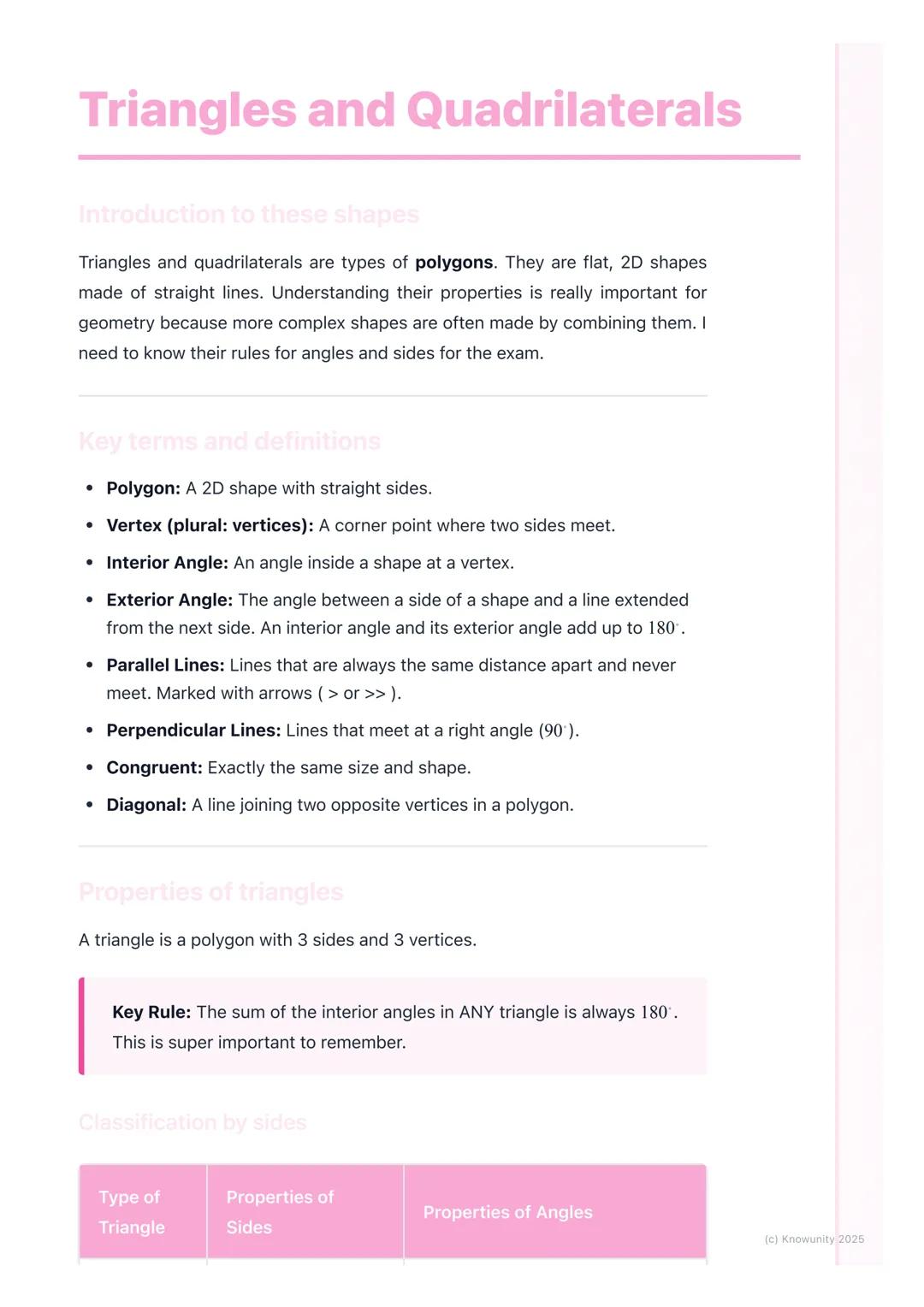
Introduction to Polygons and Key Terms
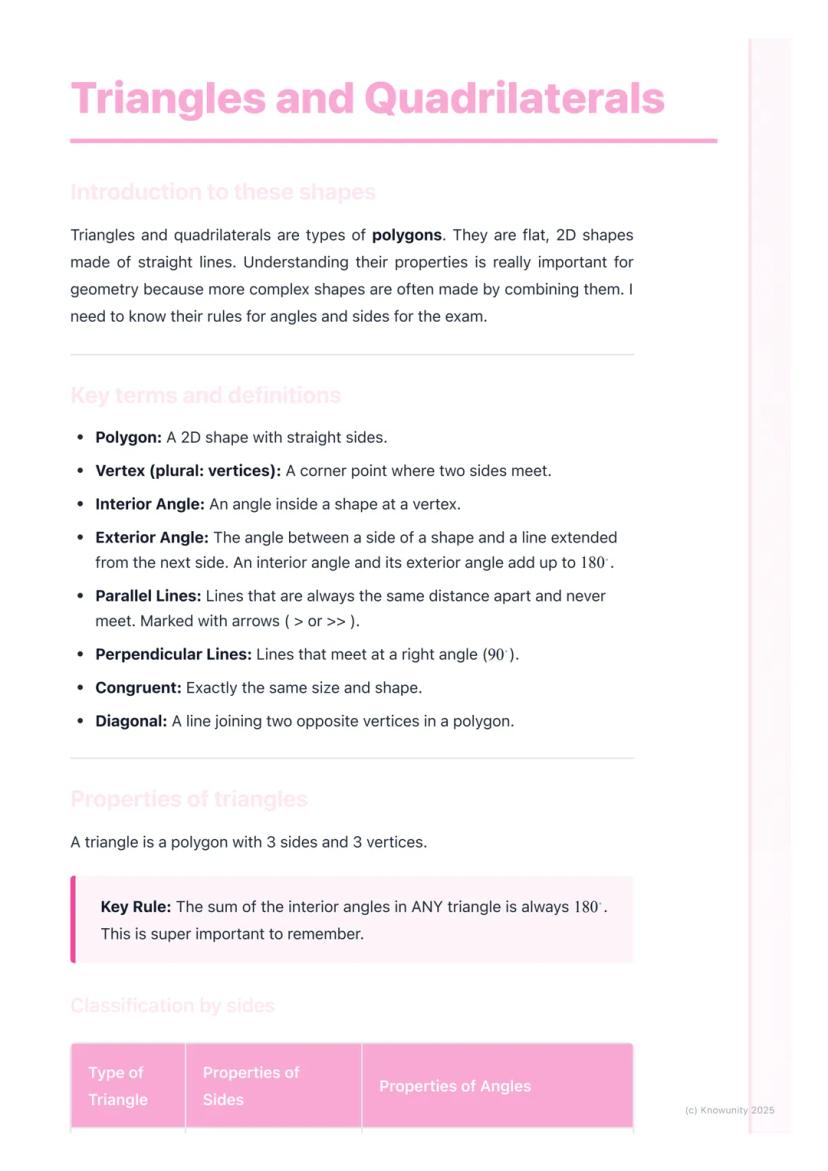
Understanding polygons is like learning the alphabet of geometry - once you know these basics, everything else makes sense. A polygon is simply a flat, 2D shape made of straight lines, and triangles and quadrilaterals are the most important ones you'll encounter.
The key terms you absolutely need to know include vertices (corner points), interior angles (angles inside the shape), and exterior angles (formed when you extend a side). Remember that an interior angle and its exterior angle always add up to 180°.
Parallel lines never meet and are marked with arrows, whilst perpendicular lines meet at 90°. When shapes are congruent, they're exactly the same size and shape - think of identical twins!
Quick Tip: Master these definitions first - they're the foundation for everything else in geometry and will save you marks in exams.
2
of 8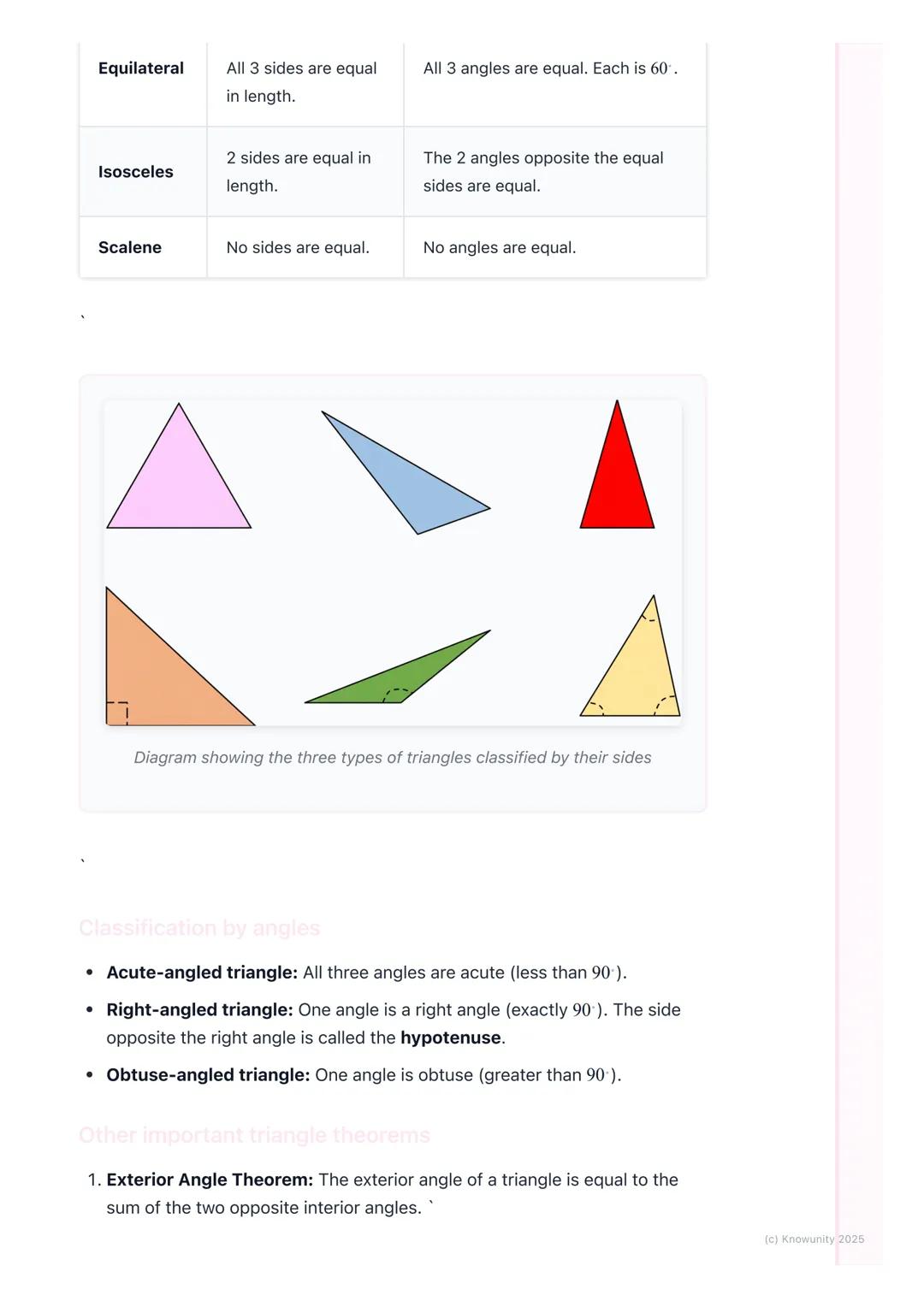
Triangle Properties and Classifications
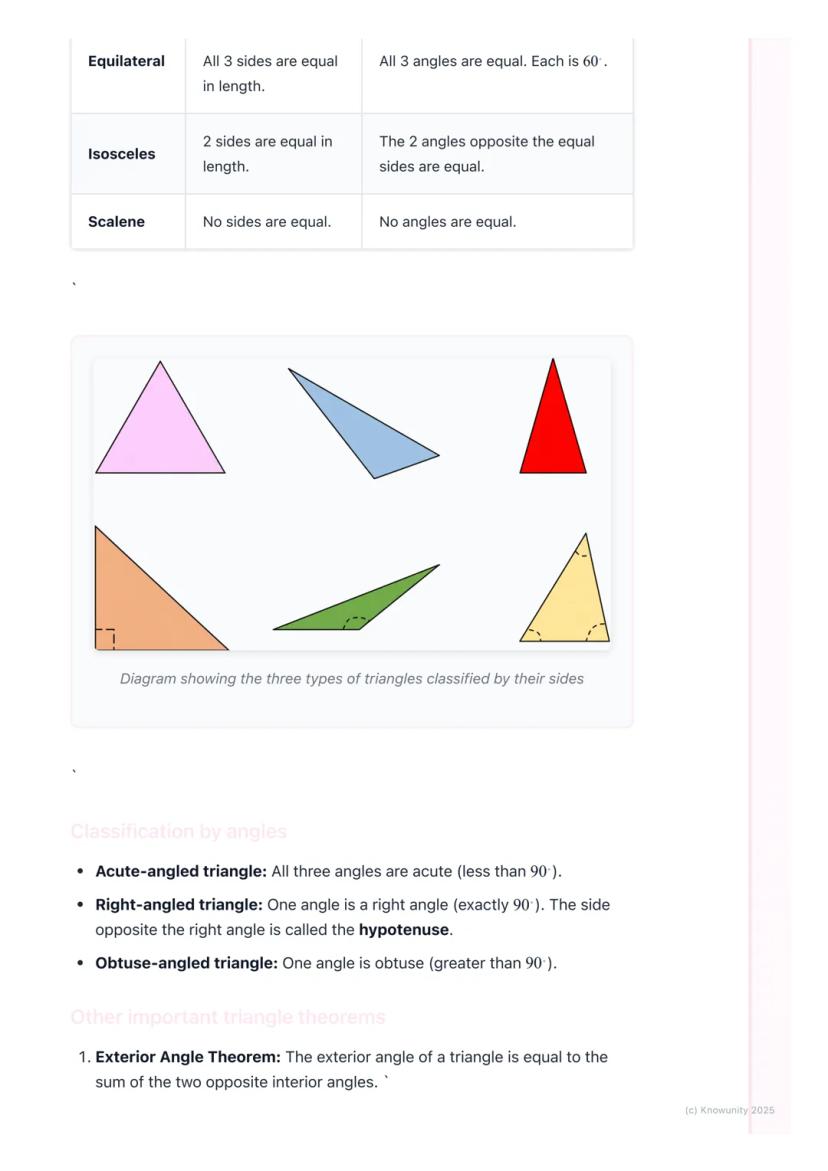
Here's the golden rule that'll save you in every triangle question: the sum of interior angles in ANY triangle is always 180°. This works whether your triangle is huge or tiny, wonky or perfect.
Triangles get sorted by their sides in three ways. Equilateral triangles have all sides equal and all angles are exactly 60°. Isosceles triangles have two equal sides, and the angles opposite those equal sides are also equal. Scalene triangles are the rebels - no sides or angles are equal.
You can also classify triangles by their angles. Acute triangles have all angles less than 90°, right-angled triangles have exactly one 90° angle, and obtuse triangles have one angle greater than 90°.
Exam Gold: In right-angled triangles, the longest side opposite the right angle is called the hypotenuse - you'll need this for Pythagoras' theorem!
3
of 8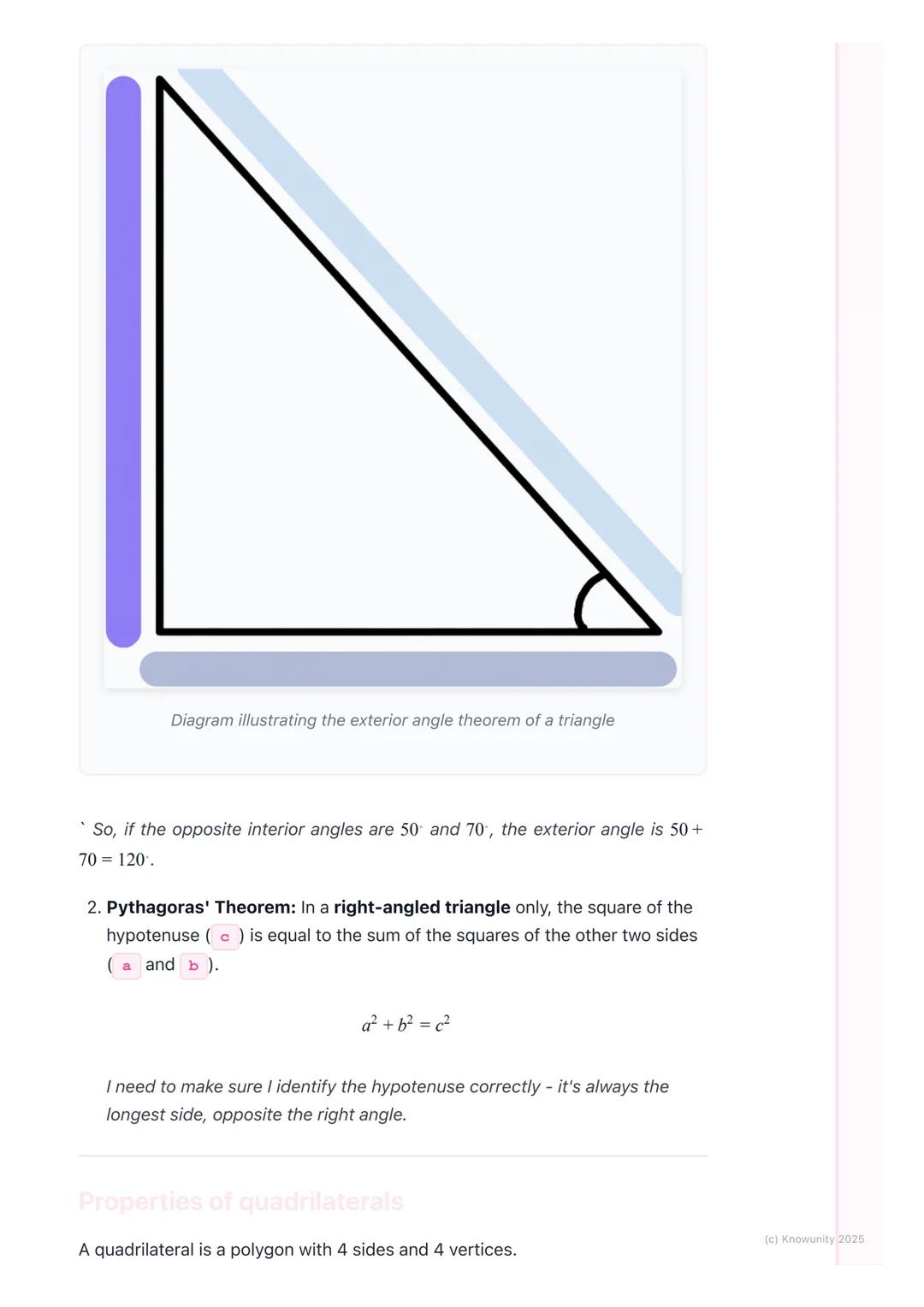
Important Triangle Theorems
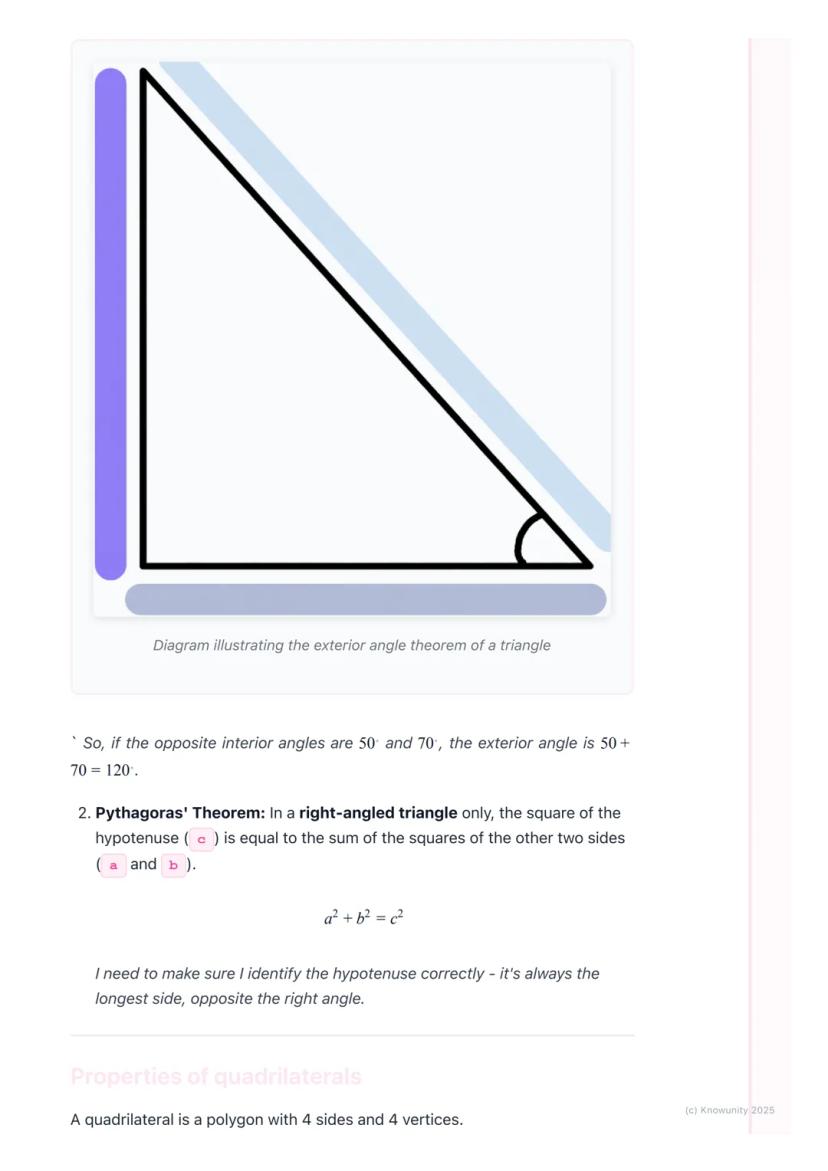
The Exterior Angle Theorem is brilliantly simple: any exterior angle of a triangle equals the sum of the two opposite interior angles. So if those opposite angles are 50° and 70°, your exterior angle is 120°. Easy!
Pythagoras' Theorem only works for right-angled triangles, but it's incredibly useful: a² + b² = c². The key is identifying the hypotenuse correctly - it's always the longest side, opposite the right angle.
These theorems aren't just random rules - they're your problem-solving toolkit. When you're stuck on a triangle question, ask yourself: "Can I use the 180° rule? Is there an exterior angle? Is this a right triangle where Pythagoras applies?"
Memory Trick: Think of Pythagoras like a recipe - you need the right ingredients for it to work!
4
of 8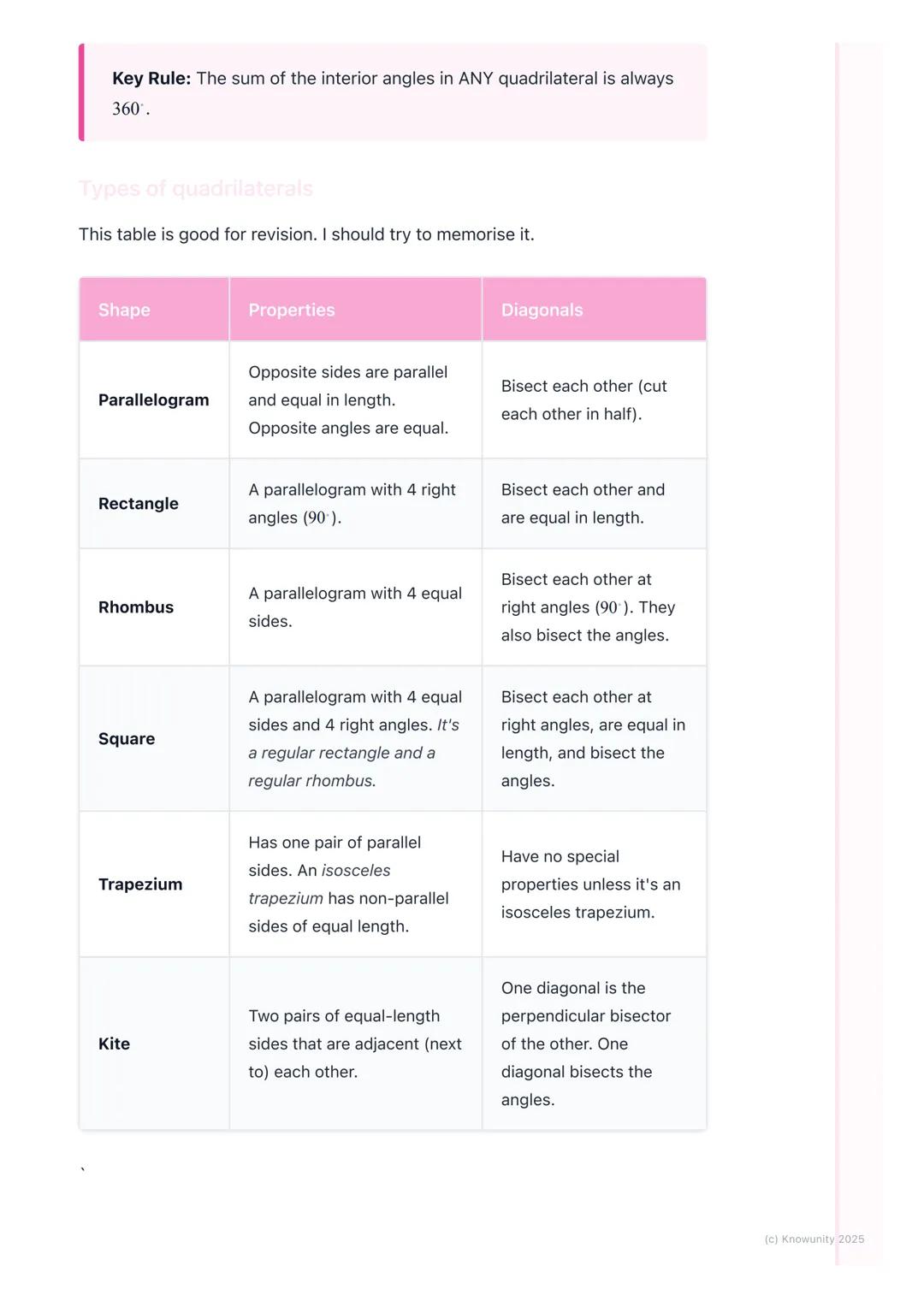
Quadrilateral Properties and Types
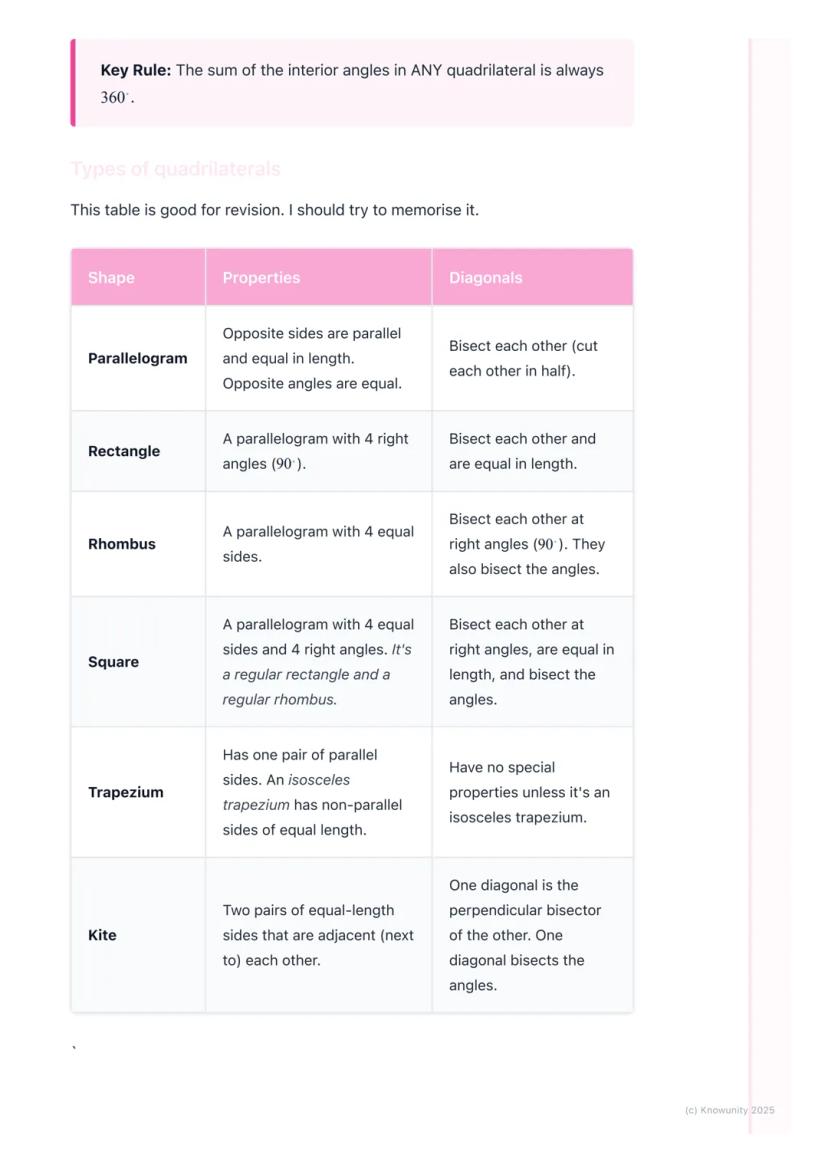
Quadrilaterals are four-sided shapes, and here's your second golden rule: the sum of interior angles in ANY quadrilateral is always 360°. Whether it's a square, rectangle, or weird wonky shape, the angles always add up to 360°.
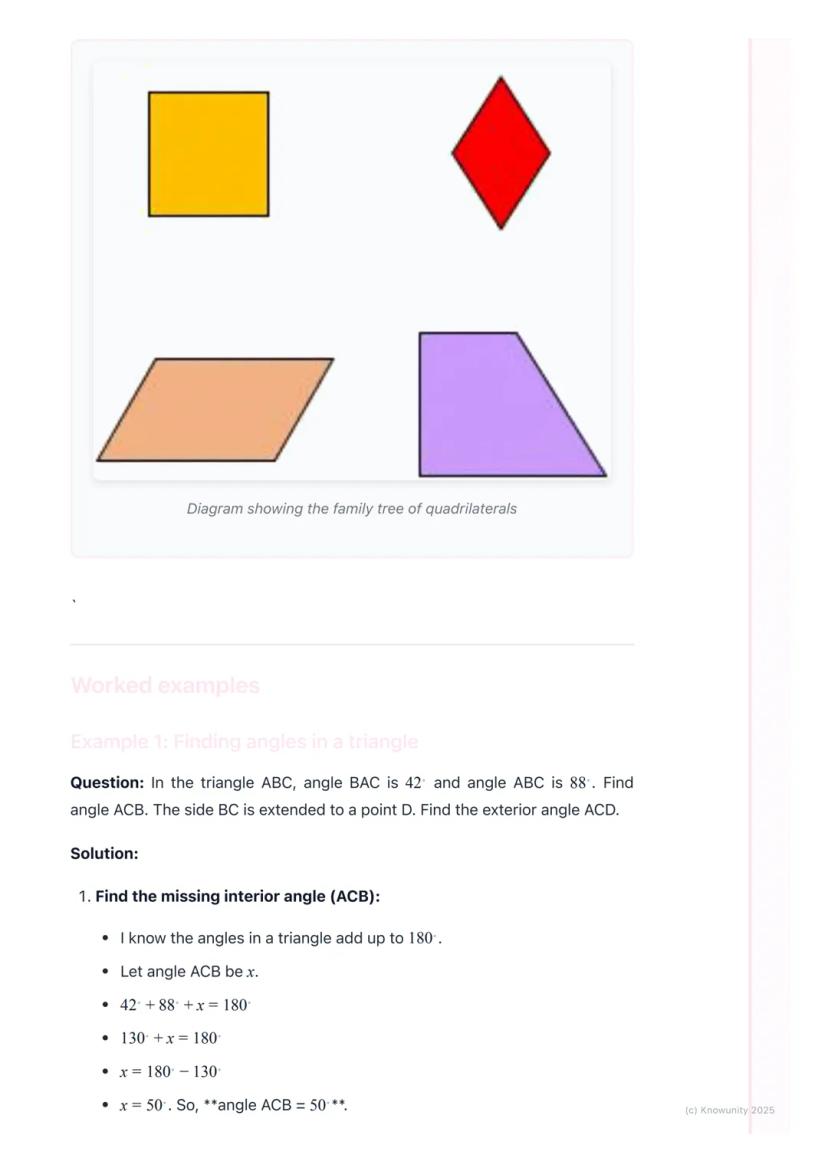
The quadrilateral family tree starts with the basic parallelogram (opposite sides parallel and equal, opposite angles equal). From there, you get rectangles (parallelograms with four right angles), rhombuses (parallelograms with four equal sides), and squares (both rectangle AND rhombus).
Don't forget about trapeziums (one pair of parallel sides) and kites (two pairs of adjacent equal sides). Each shape has its own special properties, but they all follow that 360° rule.
Exam Strategy: When tackling quadrilateral problems, always start by identifying what type of shape you're dealing with - this tells you which properties you can use!
5
of 8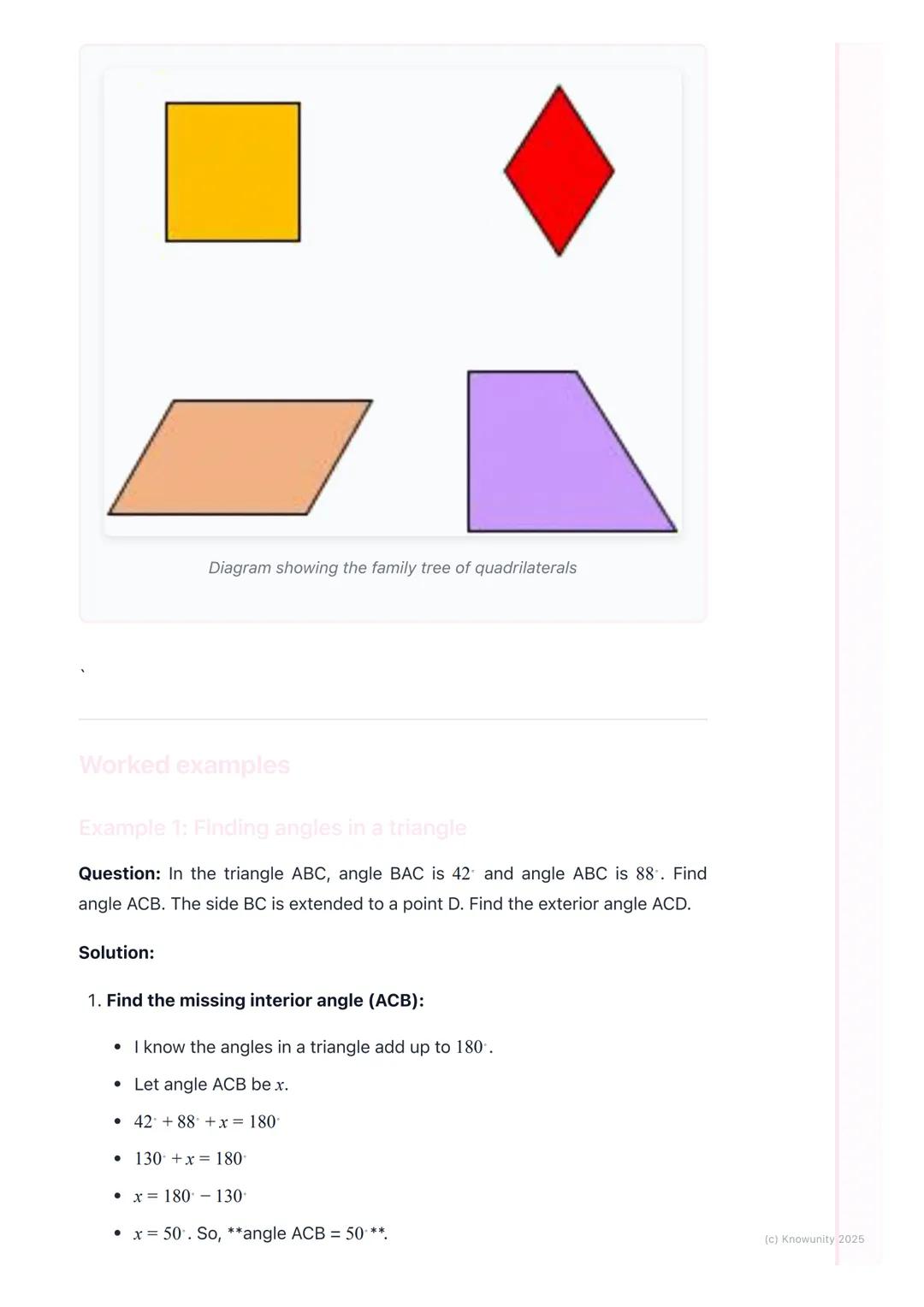
Worked Examples - Finding Triangle Angles
Let's tackle a real problem! If angle BAC is 42° and angle ABC is 88°, finding angle ACB is straightforward using the 180° rule: 42° + 88° + x = 180°, so x = 50°.
For the exterior angle ACD, you've got two methods. Method A uses the straight line rule , so ACD = 180° - 50° = 130°. Method B uses the exterior angle theorem: ACD = 42° + 88° = 130°.
Both methods give the same answer, which is brilliant for checking your work! This double-checking technique can save you marks in exams when you're unsure.
Pro Tip: Always try to solve angle problems using two different methods when possible - if you get the same answer, you know you're right!
6
of 8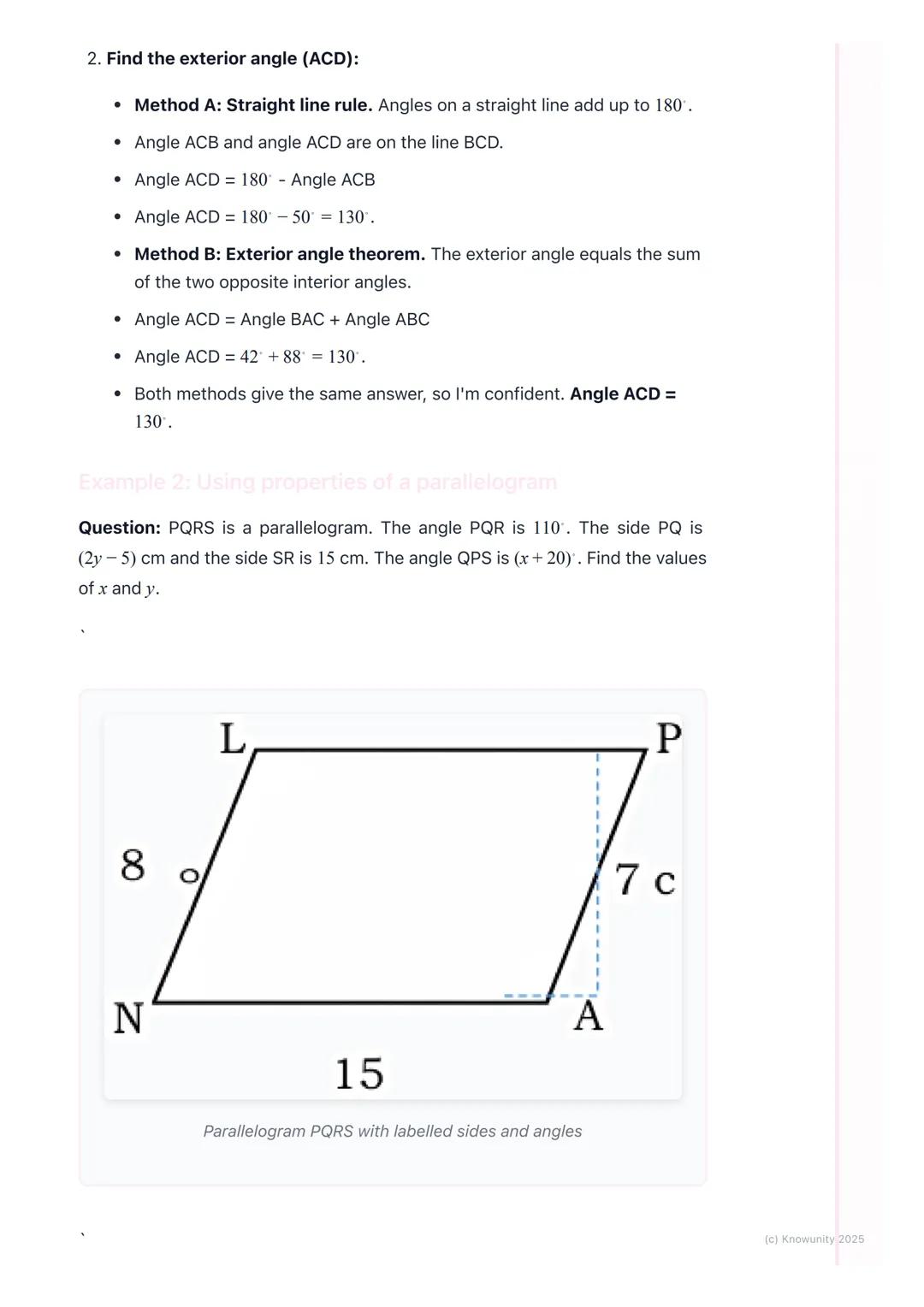
Worked Examples - Parallelogram Properties
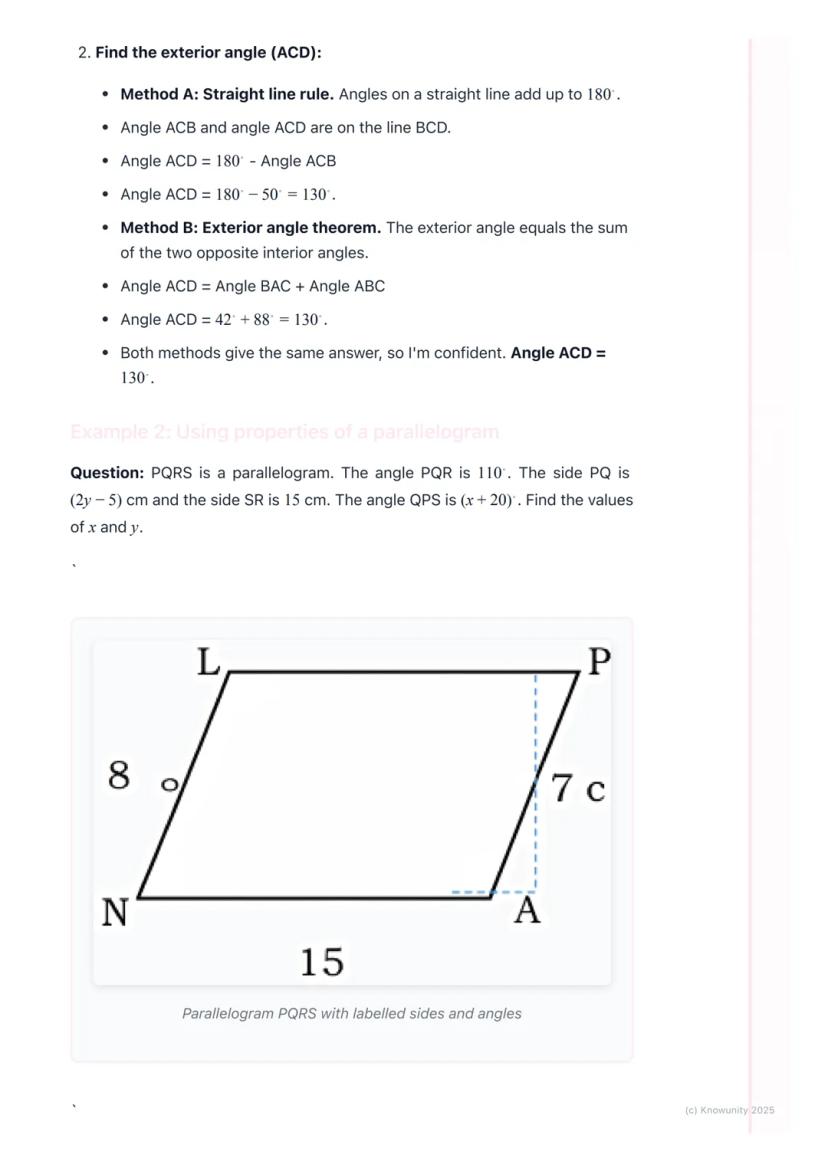
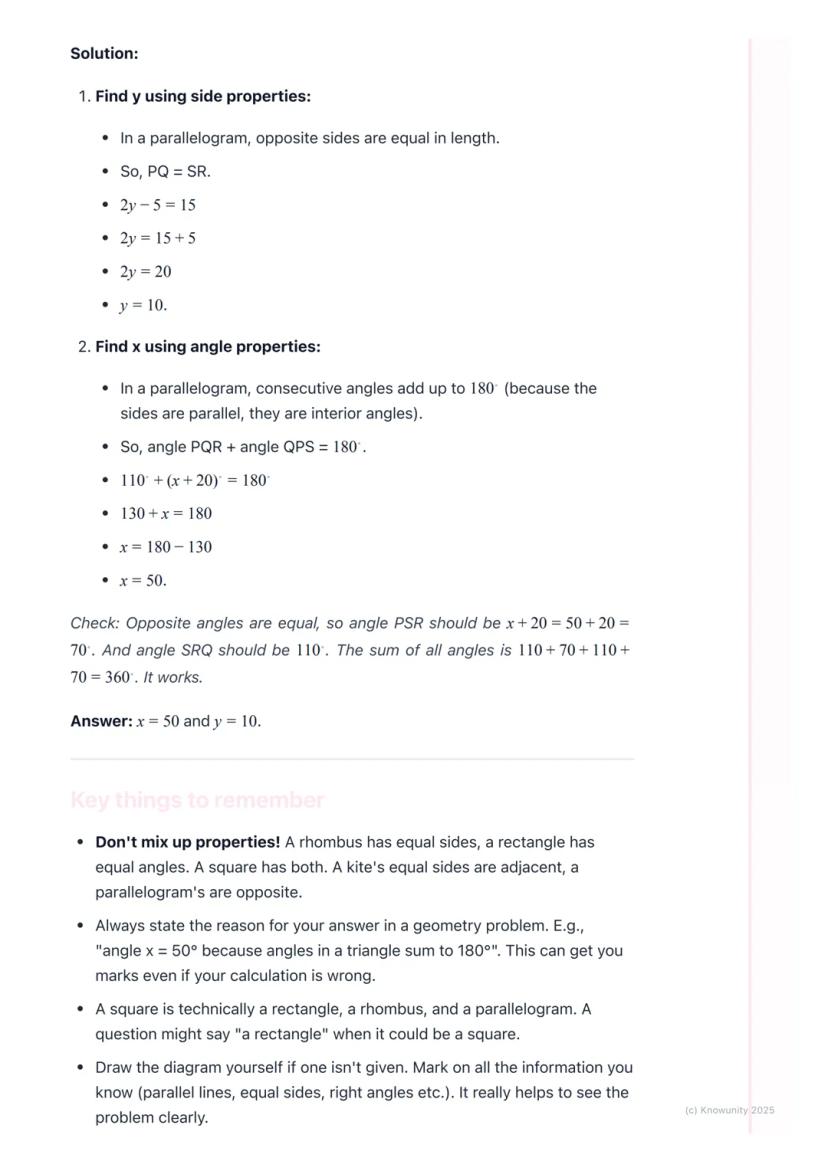
Here's a parallelogram problem that combines algebra with geometry. If PQ = cm and the opposite side SR = 15 cm, you can find y because opposite sides in parallelograms are equal.
So 2y - 5 = 15, which gives us 2y = 20, therefore y = 10. Simple algebra meets geometry!
For finding angle x, remember that consecutive angles in parallelograms add up to 180° (because the sides are parallel). If angle PQR = 110° and angle QPS = °, then 110° + ° = 180°, giving us x = 50°.
Key Insight: Parallelogram problems often mix algebra and geometry - use the shape's properties to set up equations, then solve with algebra!
7
of 8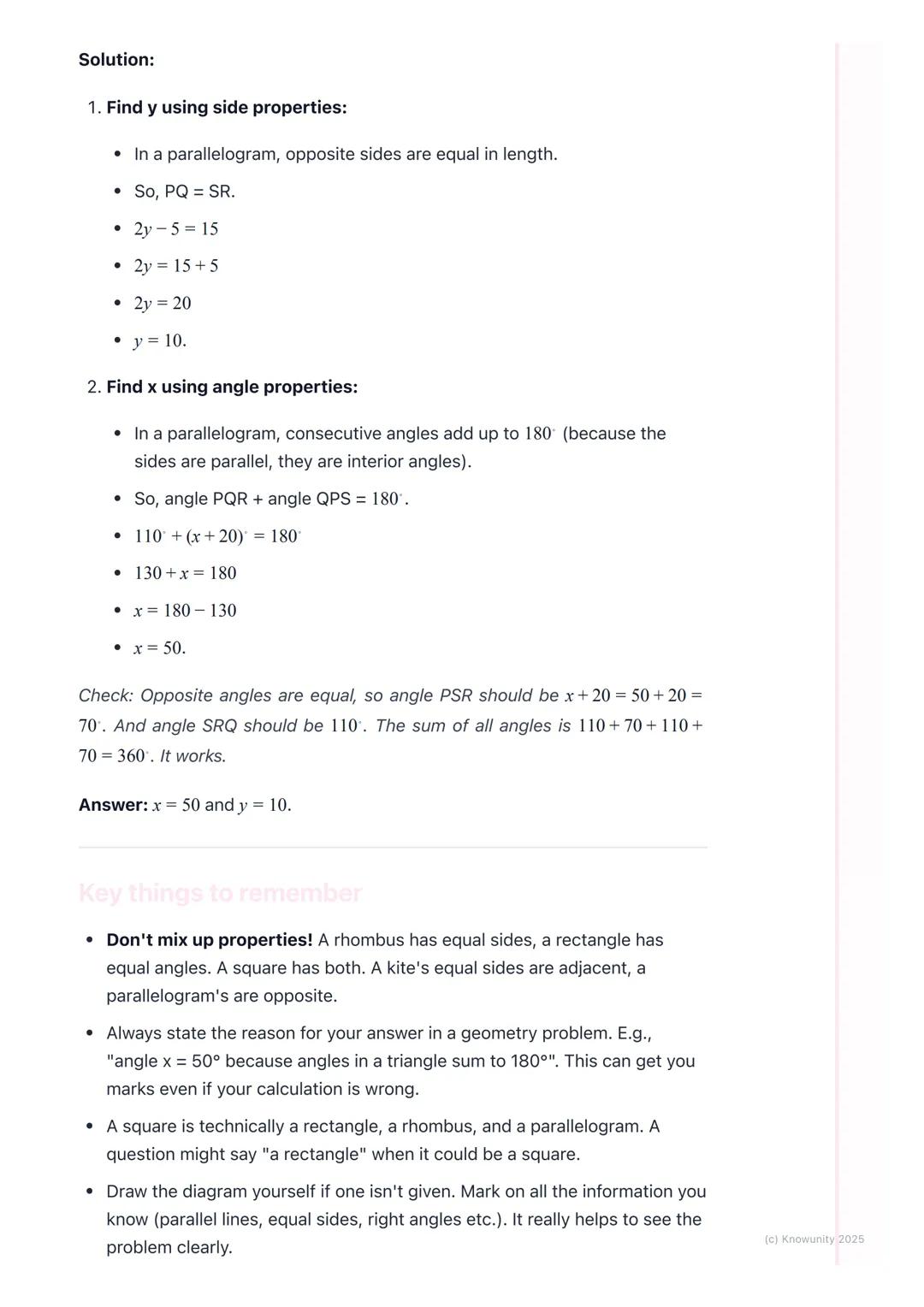
Essential Exam Tips and Common Mistakes
Don't mix up properties! A rhombus has equal sides, a rectangle has right angles, and a square has both. It's like remembering that a square is the overachiever of the quadrilateral family.
Always state your reasoning in geometry problems. Writing "angle x = 50° because angles in a triangle sum to 180°" can earn you marks even if your calculation goes wrong. Examiners love to see your thinking process.
Draw diagrams when they're not provided, and mark everything you know - parallel lines, equal sides, right angles. Visual information makes problems much clearer and prevents silly mistakes.
Exam Success: Remember that a square is technically a rectangle, rhombus, AND parallelogram - so questions about "rectangles" might actually involve squares!
8
of 8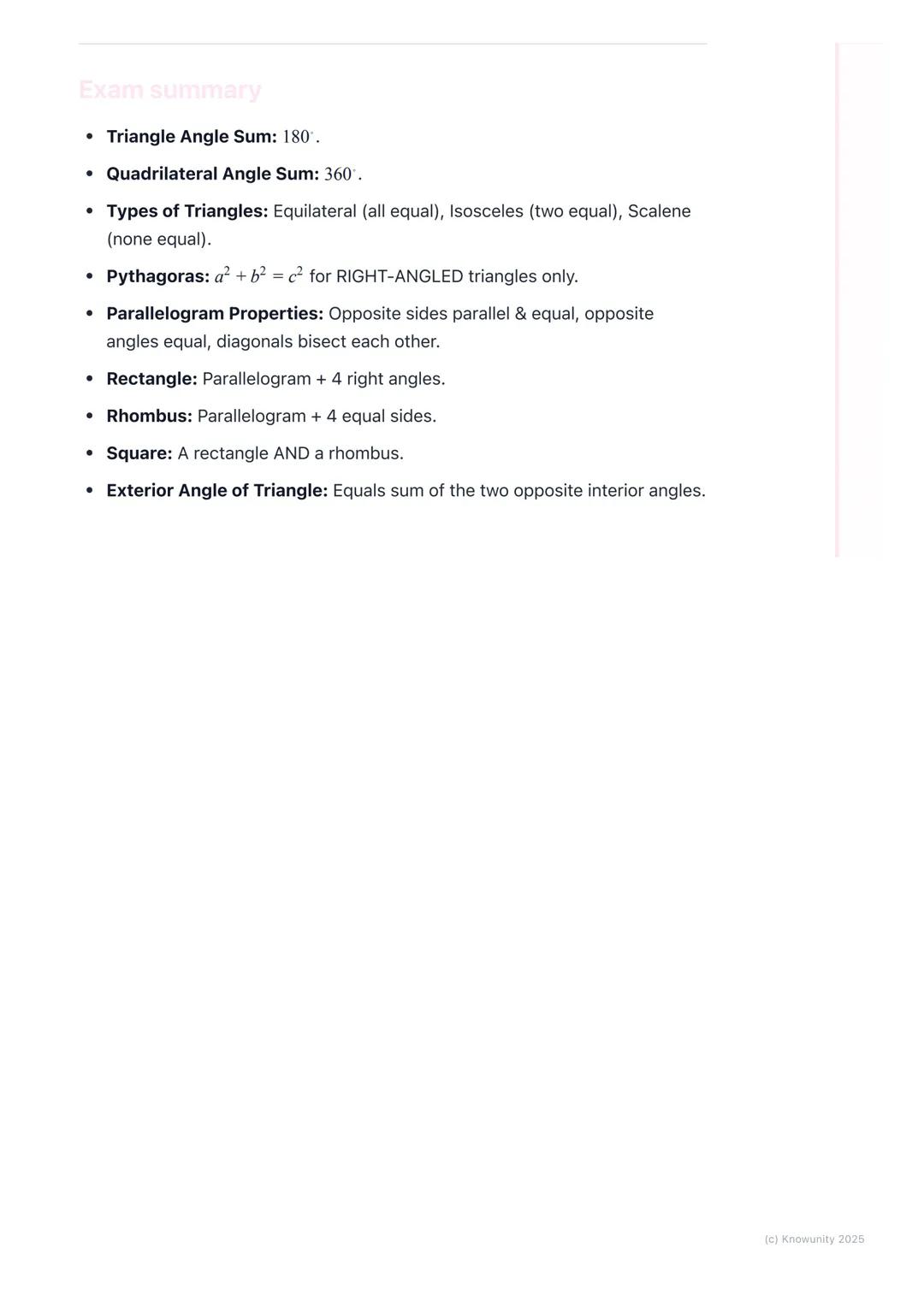
Quick Revision Summary
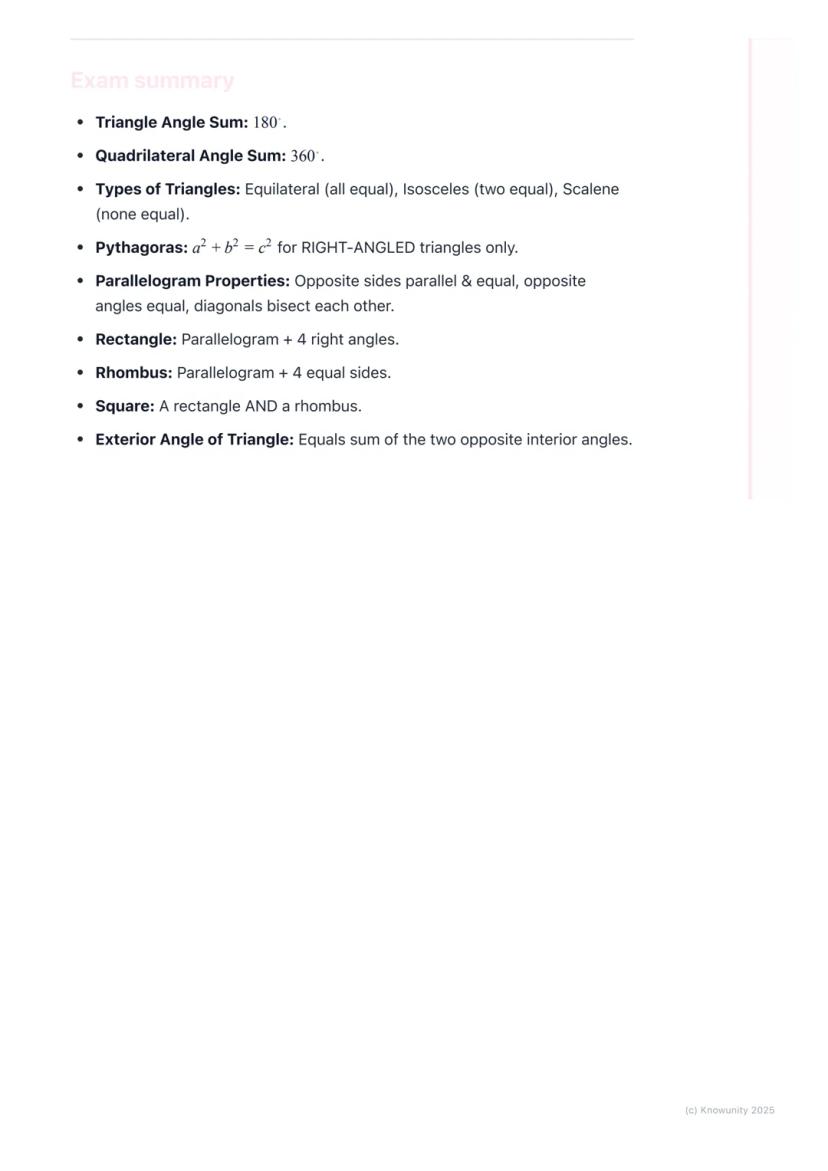
Here's your exam cheat sheet! Triangle angles sum to 180°, quadrilateral angles sum to 360°. Know your triangle types: equilateral (all equal), isosceles (two equal), scalene (none equal).
Pythagoras' theorem only works for right-angled triangles - don't try using it on other triangles! The exterior angle of a triangle equals the sum of the two opposite interior angles.
For quadrilaterals, start with parallelograms (opposite sides parallel and equal, opposite angles equal). Add right angles to get rectangles, add equal sides to get rhombuses, add both to get squares. Master these basics and you're sorted for most geometry questions!
Final Reminder: Practice identifying shape types quickly - once you know what you're dealing with, the properties follow naturally!
Azt hittük, soha nem fogod megkérdezni...
Mi a Knowunity MI társ?
MI Társunk egy diákközpontú MI eszköz, amely többet nyújt puszta válaszoknál. Millió Knowunity erőforrásra épülve releváns információkat, személyre szabott tanulási terveket, kvízeket és tartalmat biztosít közvetlenül a chatben, alkalmazkodva az egyéni tanulási utadhoz.
Honnan tudom letölteni a Knowunity appot?
Az appot letöltheted a Google Play Store-ból és az Apple App Store-ból.
Tényleg ingyenes a Knowunity?
Pontosan! Élvezd az ingyenes hozzáférést a tanulási tartalmakhoz, kapcsolódj diáktársaiddal, és kapj azonnali segítséget – mind a kezed ügyében.
Legnépszerűbb tananyagok Mathematics tantárgyból
8MathematicsAlgebra
Algebra
5th Year91
MathematicsAlgebra 2
Algebra notes focusing on the factor theorem, completing the square, -b formula, graphs of polynomials
5th Year130
MathematicsSolving Equations
This section focuses on solving one-step and two-step linear equations to find the value of an unknown variable.
1st Year131
MathematicsArithmetic sequences and series
With examples
5th Year130
MathematicsIntroduction to Probability
This topic introduces basic probability concepts, including calculating the probability of simple events and understanding the difference between experimental and theoretical probability.
2nd Year91
MathematicsMaths jc algebra
Maths jc
1st Year230
MathematicsNatural Numbers and Integers
Students will learn about positive whole numbers, zero, and negative whole numbers, and how to add, subtract, multiply, and divide them correctly.
1st Year131
MathematicsDifferential Calculus
Calculus is a topic that comes up nearly everywhere on your maths LC. This is just starter notes that could be useful end of 5th year or start of 6th year
5th Year271
Legnépszerűbb tananyagok
9 Irish
IrishIrish oral questions and answers
Questions and answers for the leaving cert oral
5th Year4264
 English
Key Quotes : Sive
Key Quotes and explanations: Sive
6th Year2842
IrishIrish oral questions
Outline of oral questions
5th Year2055
IrishIníon- le hÁine Durkin
Aine Durkin’s poem, Iníon: Themes & summary
5th Year890
IrishIrish poetry 2027
Iníon + Dínit an Bhróin
5th Year1153
IrishLC HL notes- Iníon (poem)
Includes poem in English and Irish, theme, key words & phrases
5th Year2304
EnglishCultural Context : Shawshank Redemption : Sive : Small Things Like These
Comparative Study : Cultural Context : Shawshank Redemption, Sive and Small Things Like These
6th Year1430
IrishMo Ghrá-sa (Idir Lúibíní)
Notes on mo ghrá-sa
5th Year380
IrishAn Gaeilge Aiste
Irish Language essay
6th Year1320
Nem találod amit keresel? Fedezz fel más tantárgyakat.
A diákok imádnak minket — és téged is fognak.
4.6/5App Store
4.7/5Google Play
Az alkalmazás nagyon könnyen használható és jól megtervezett. Mindent megtaláltam, amit eddig kerestem, és sokat tudtam tanulni a prezentációkból! Biztosan használni fogom az alkalmazást egy osztályfeladathoz! És persze inspirációként is nagyszerűen segít.
Stefan SiOS felhasználó
Ez az alkalmazás tényleg nagyszerű. Olyan sok tanulási jegyzet és segítség van benne [...]. Például a francia a problémás tantárgyam, és az alkalmazásban olyan sok segítség lehetőség van. Ennek az alkalmazásnak köszönhetően javult a franciám. Mindenkinek ajánlanám.
Samantha KlichAndroid felhasználó
Hű, tényleg lenyűgözött. Csak úgy kipróbáltam az alkalmazást, mert sokszor láttam reklámozva, és teljesen megdöbbentett. Ez az alkalmazás AZ A SEGÍTSÉG, amire az iskolában szükséged van, és mindenekelőtt olyan sok mindent kínál, mint például gyakorlatokat és összefoglalókat, amik nekem személyesen NAGYON hasznosak voltak.
AnnaiOS felhasználó
Mathematics4 megtekintések·Frissítve Jun 13, 2026·8 oldalUnderstanding Triangles and Quadrilaterals
Ever wondered why triangles and quadrilaterals are everywhere around you? From the roof of your house to your phone screen, these basic shapes are the building blocks of geometry and appear constantly in your maths exams!
1
of 8
Regisztrálj, hogy lásd a tartalmat. Teljesen ingyenes!
- Hozzáférés minden dokumentumhoz
- Javítsd a jegyeidet
- Csatlakozz diákok millióihoz
Introduction to Polygons and Key Terms
Understanding polygons is like learning the alphabet of geometry - once you know these basics, everything else makes sense. A polygon is simply a flat, 2D shape made of straight lines, and triangles and quadrilaterals are the most important ones you'll encounter.
The key terms you absolutely need to know include vertices (corner points), interior angles (angles inside the shape), and exterior angles (formed when you extend a side). Remember that an interior angle and its exterior angle always add up to 180°.
Parallel lines never meet and are marked with arrows, whilst perpendicular lines meet at 90°. When shapes are congruent, they're exactly the same size and shape - think of identical twins!
Quick Tip: Master these definitions first - they're the foundation for everything else in geometry and will save you marks in exams.
2
of 8Regisztrálj, hogy lásd a tartalmat. Teljesen ingyenes!
- Hozzáférés minden dokumentumhoz
- Javítsd a jegyeidet
- Csatlakozz diákok millióihoz
Triangle Properties and Classifications
Here's the golden rule that'll save you in every triangle question: the sum of interior angles in ANY triangle is always 180°. This works whether your triangle is huge or tiny, wonky or perfect.
Triangles get sorted by their sides in three ways. Equilateral triangles have all sides equal and all angles are exactly 60°. Isosceles triangles have two equal sides, and the angles opposite those equal sides are also equal. Scalene triangles are the rebels - no sides or angles are equal.
You can also classify triangles by their angles. Acute triangles have all angles less than 90°, right-angled triangles have exactly one 90° angle, and obtuse triangles have one angle greater than 90°.
Exam Gold: In right-angled triangles, the longest side opposite the right angle is called the hypotenuse - you'll need this for Pythagoras' theorem!
3
of 8Regisztrálj, hogy lásd a tartalmat. Teljesen ingyenes!
- Hozzáférés minden dokumentumhoz
- Javítsd a jegyeidet
- Csatlakozz diákok millióihoz
Important Triangle Theorems
The Exterior Angle Theorem is brilliantly simple: any exterior angle of a triangle equals the sum of the two opposite interior angles. So if those opposite angles are 50° and 70°, your exterior angle is 120°. Easy!
Pythagoras' Theorem only works for right-angled triangles, but it's incredibly useful: a² + b² = c². The key is identifying the hypotenuse correctly - it's always the longest side, opposite the right angle.
These theorems aren't just random rules - they're your problem-solving toolkit. When you're stuck on a triangle question, ask yourself: "Can I use the 180° rule? Is there an exterior angle? Is this a right triangle where Pythagoras applies?"
Memory Trick: Think of Pythagoras like a recipe - you need the right ingredients for it to work!
4
of 8Regisztrálj, hogy lásd a tartalmat. Teljesen ingyenes!
- Hozzáférés minden dokumentumhoz
- Javítsd a jegyeidet
- Csatlakozz diákok millióihoz
Quadrilateral Properties and Types
Quadrilaterals are four-sided shapes, and here's your second golden rule: the sum of interior angles in ANY quadrilateral is always 360°. Whether it's a square, rectangle, or weird wonky shape, the angles always add up to 360°.
The quadrilateral family tree starts with the basic parallelogram (opposite sides parallel and equal, opposite angles equal). From there, you get rectangles (parallelograms with four right angles), rhombuses (parallelograms with four equal sides), and squares (both rectangle AND rhombus).
Don't forget about trapeziums (one pair of parallel sides) and kites (two pairs of adjacent equal sides). Each shape has its own special properties, but they all follow that 360° rule.
Exam Strategy: When tackling quadrilateral problems, always start by identifying what type of shape you're dealing with - this tells you which properties you can use!
5
of 8Regisztrálj, hogy lásd a tartalmat. Teljesen ingyenes!
- Hozzáférés minden dokumentumhoz
- Javítsd a jegyeidet
- Csatlakozz diákok millióihoz
Worked Examples - Finding Triangle Angles
Let's tackle a real problem! If angle BAC is 42° and angle ABC is 88°, finding angle ACB is straightforward using the 180° rule: 42° + 88° + x = 180°, so x = 50°.
For the exterior angle ACD, you've got two methods. Method A uses the straight line rule , so ACD = 180° - 50° = 130°. Method B uses the exterior angle theorem: ACD = 42° + 88° = 130°.
Both methods give the same answer, which is brilliant for checking your work! This double-checking technique can save you marks in exams when you're unsure.
Pro Tip: Always try to solve angle problems using two different methods when possible - if you get the same answer, you know you're right!
6
of 8Regisztrálj, hogy lásd a tartalmat. Teljesen ingyenes!
- Hozzáférés minden dokumentumhoz
- Javítsd a jegyeidet
- Csatlakozz diákok millióihoz
Worked Examples - Parallelogram Properties
Here's a parallelogram problem that combines algebra with geometry. If PQ = cm and the opposite side SR = 15 cm, you can find y because opposite sides in parallelograms are equal.
So 2y - 5 = 15, which gives us 2y = 20, therefore y = 10. Simple algebra meets geometry!
For finding angle x, remember that consecutive angles in parallelograms add up to 180° (because the sides are parallel). If angle PQR = 110° and angle QPS = °, then 110° + ° = 180°, giving us x = 50°.
Key Insight: Parallelogram problems often mix algebra and geometry - use the shape's properties to set up equations, then solve with algebra!
7
of 8Regisztrálj, hogy lásd a tartalmat. Teljesen ingyenes!
- Hozzáférés minden dokumentumhoz
- Javítsd a jegyeidet
- Csatlakozz diákok millióihoz
Essential Exam Tips and Common Mistakes
Don't mix up properties! A rhombus has equal sides, a rectangle has right angles, and a square has both. It's like remembering that a square is the overachiever of the quadrilateral family.
Always state your reasoning in geometry problems. Writing "angle x = 50° because angles in a triangle sum to 180°" can earn you marks even if your calculation goes wrong. Examiners love to see your thinking process.
Draw diagrams when they're not provided, and mark everything you know - parallel lines, equal sides, right angles. Visual information makes problems much clearer and prevents silly mistakes.
Exam Success: Remember that a square is technically a rectangle, rhombus, AND parallelogram - so questions about "rectangles" might actually involve squares!
8
of 8Regisztrálj, hogy lásd a tartalmat. Teljesen ingyenes!
- Hozzáférés minden dokumentumhoz
- Javítsd a jegyeidet
- Csatlakozz diákok millióihoz
Quick Revision Summary
Here's your exam cheat sheet! Triangle angles sum to 180°, quadrilateral angles sum to 360°. Know your triangle types: equilateral (all equal), isosceles (two equal), scalene (none equal).
Pythagoras' theorem only works for right-angled triangles - don't try using it on other triangles! The exterior angle of a triangle equals the sum of the two opposite interior angles.
For quadrilaterals, start with parallelograms (opposite sides parallel and equal, opposite angles equal). Add right angles to get rectangles, add equal sides to get rhombuses, add both to get squares. Master these basics and you're sorted for most geometry questions!
Final Reminder: Practice identifying shape types quickly - once you know what you're dealing with, the properties follow naturally!
Azt hittük, soha nem fogod megkérdezni...
Mi a Knowunity MI társ?
MI Társunk egy diákközpontú MI eszköz, amely többet nyújt puszta válaszoknál. Millió Knowunity erőforrásra épülve releváns információkat, személyre szabott tanulási terveket, kvízeket és tartalmat biztosít közvetlenül a chatben, alkalmazkodva az egyéni tanulási utadhoz.
Honnan tudom letölteni a Knowunity appot?
Az appot letöltheted a Google Play Store-ból és az Apple App Store-ból.
Tényleg ingyenes a Knowunity?
Pontosan! Élvezd az ingyenes hozzáférést a tanulási tartalmakhoz, kapcsolódj diáktársaiddal, és kapj azonnali segítséget – mind a kezed ügyében.
Legnépszerűbb tananyagok Mathematics tantárgyból
8MathematicsAlgebra
Algebra
5th Year91
MathematicsAlgebra 2
Algebra notes focusing on the factor theorem, completing the square, -b formula, graphs of polynomials
5th Year130
MathematicsSolving Equations
This section focuses on solving one-step and two-step linear equations to find the value of an unknown variable.
1st Year131
MathematicsArithmetic sequences and series
With examples
5th Year130
MathematicsIntroduction to Probability
This topic introduces basic probability concepts, including calculating the probability of simple events and understanding the difference between experimental and theoretical probability.
2nd Year91
MathematicsMaths jc algebra
Maths jc
1st Year230
MathematicsNatural Numbers and Integers
Students will learn about positive whole numbers, zero, and negative whole numbers, and how to add, subtract, multiply, and divide them correctly.
1st Year131
MathematicsDifferential Calculus
Calculus is a topic that comes up nearly everywhere on your maths LC. This is just starter notes that could be useful end of 5th year or start of 6th year
5th Year271
Legnépszerűbb tananyagok
9IrishIrish oral questions and answers
Questions and answers for the leaving cert oral
5th Year4264
EnglishKey Quotes : Sive
Key Quotes and explanations: Sive
6th Year2842
IrishIrish oral questions
Outline of oral questions
5th Year2055
IrishIníon- le hÁine Durkin
Aine Durkin’s poem, Iníon: Themes & summary
5th Year890
IrishIrish poetry 2027
Iníon + Dínit an Bhróin
5th Year1153
IrishLC HL notes- Iníon (poem)
Includes poem in English and Irish, theme, key words & phrases
5th Year2304
EnglishCultural Context : Shawshank Redemption : Sive : Small Things Like These
Comparative Study : Cultural Context : Shawshank Redemption, Sive and Small Things Like These
6th Year1430
IrishMo Ghrá-sa (Idir Lúibíní)
Notes on mo ghrá-sa
5th Year380
IrishAn Gaeilge Aiste
Irish Language essay
6th Year1320
Nem találod amit keresel? Fedezz fel más tantárgyakat.
A diákok imádnak minket — és téged is fognak.
4.6/5App Store
4.7/5Google Play
Az alkalmazás nagyon könnyen használható és jól megtervezett. Mindent megtaláltam, amit eddig kerestem, és sokat tudtam tanulni a prezentációkból! Biztosan használni fogom az alkalmazást egy osztályfeladathoz! És persze inspirációként is nagyszerűen segít.
Stefan SiOS felhasználó
Ez az alkalmazás tényleg nagyszerű. Olyan sok tanulási jegyzet és segítség van benne [...]. Például a francia a problémás tantárgyam, és az alkalmazásban olyan sok segítség lehetőség van. Ennek az alkalmazásnak köszönhetően javult a franciám. Mindenkinek ajánlanám.
Samantha KlichAndroid felhasználó
Hű, tényleg lenyűgözött. Csak úgy kipróbáltam az alkalmazást, mert sokszor láttam reklámozva, és teljesen megdöbbentett. Ez az alkalmazás AZ A SEGÍTSÉG, amire az iskolában szükséged van, és mindenekelőtt olyan sok mindent kínál, mint például gyakorlatokat és összefoglalókat, amik nekem személyesen NAGYON hasznosak voltak.
AnnaiOS felhasználó