
Ever been to a brilliant concert or match and wanted... Továbbiak megjelenítése
 Irish1 megtekintések·Frissítve May 5, 2026·5 oldal
Ag Cur Síos ar Imeachtaí: Treoir Éasca agus Shoiléir
1 / 5
1
of 5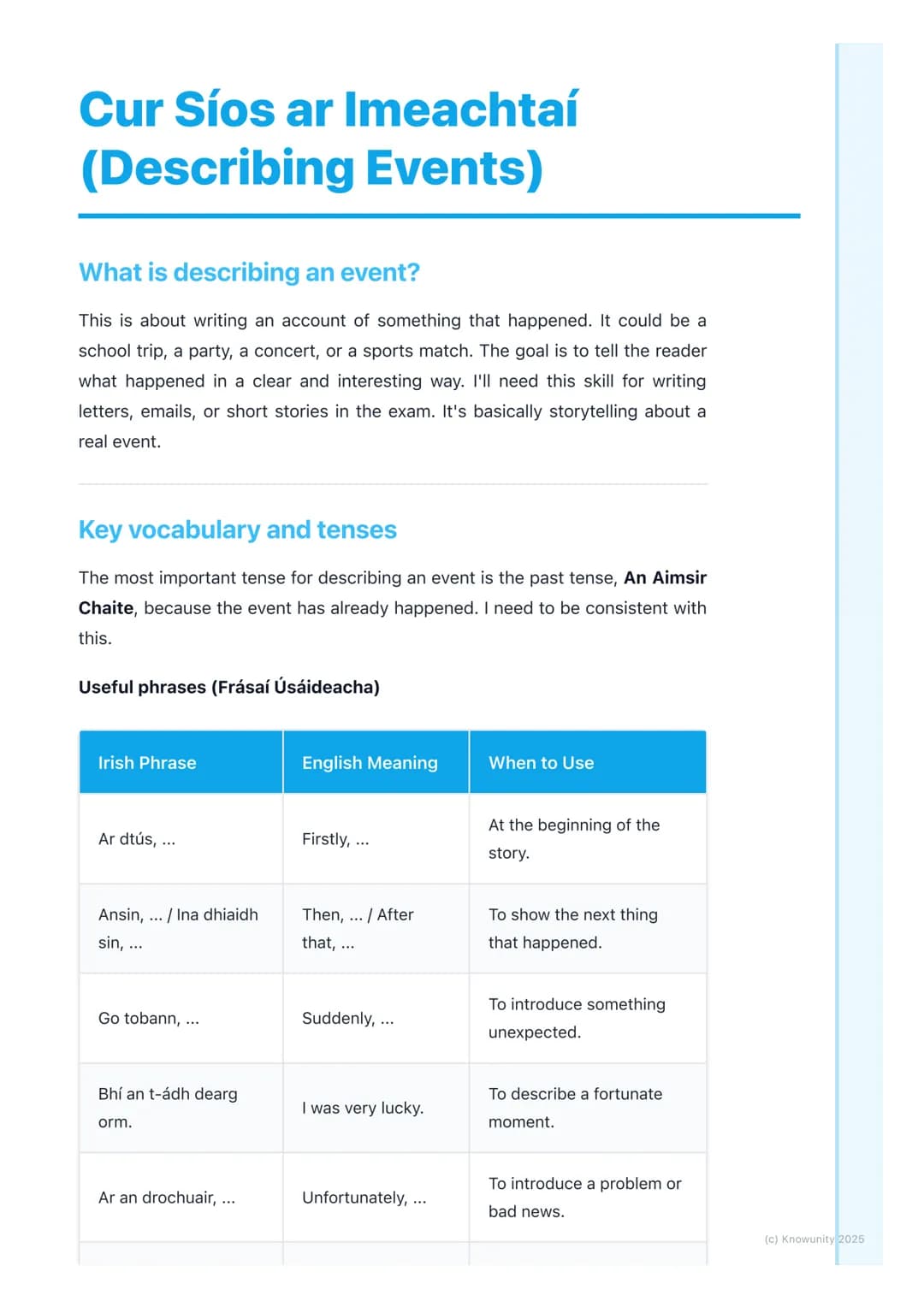
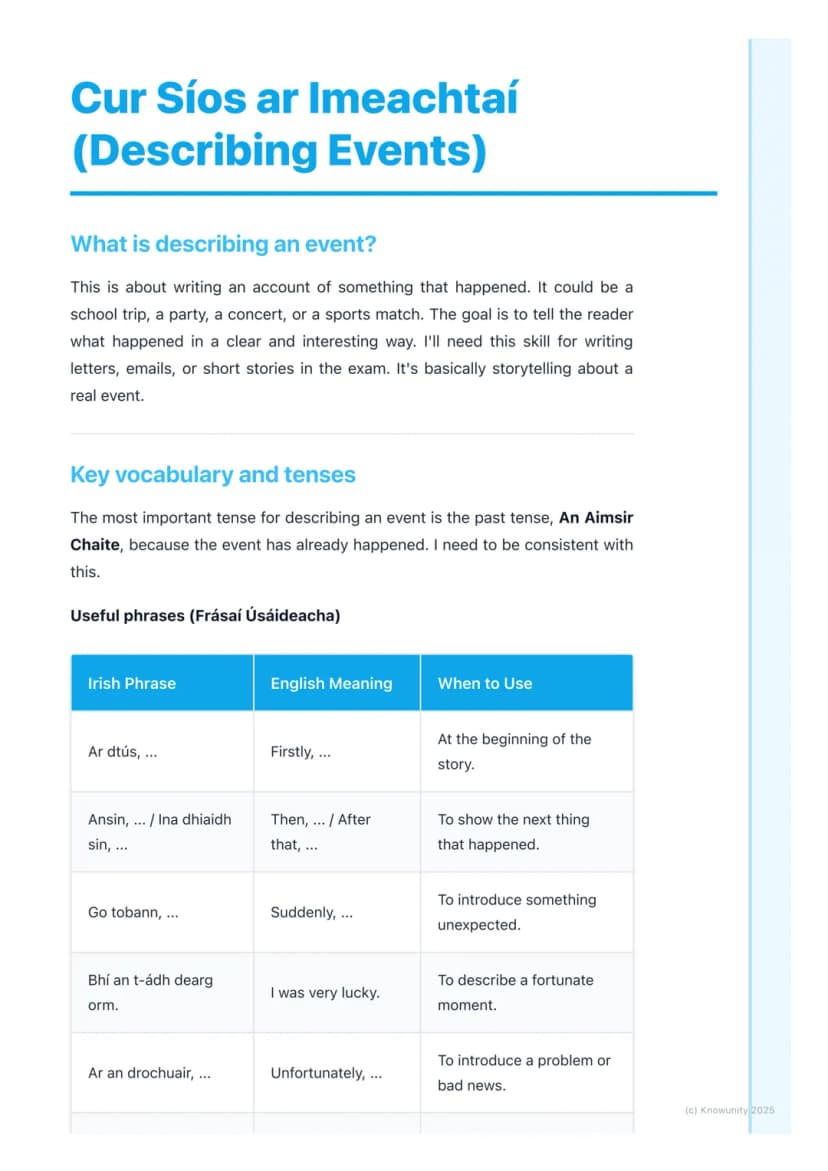
What is Describing an Event?
Think of this as storytelling about real life. Whether it's a school trip, a party, a concert, or a GAA match, you're painting a picture with words so your reader feels like they were there too.
The golden rule? Use An Aimsir Chaite (past tense) consistently since you're talking about something that already happened. No mixing tenses or you'll confuse your reader!
Essential linking phrases will make your writing flow brilliantly. Start with "Ar dtús" (firstly), move through events with "Ansin" (then), and add drama with "Go tobann" (suddenly). When things go wrong, use "Ar an drochuair" (unfortunately), and wrap up with confidence using "Gan dabht" (without a doubt).
Top Tip: Learn these phrases off by heart - they'll instantly make your writing sound more natural and sophisticated!
2
of 5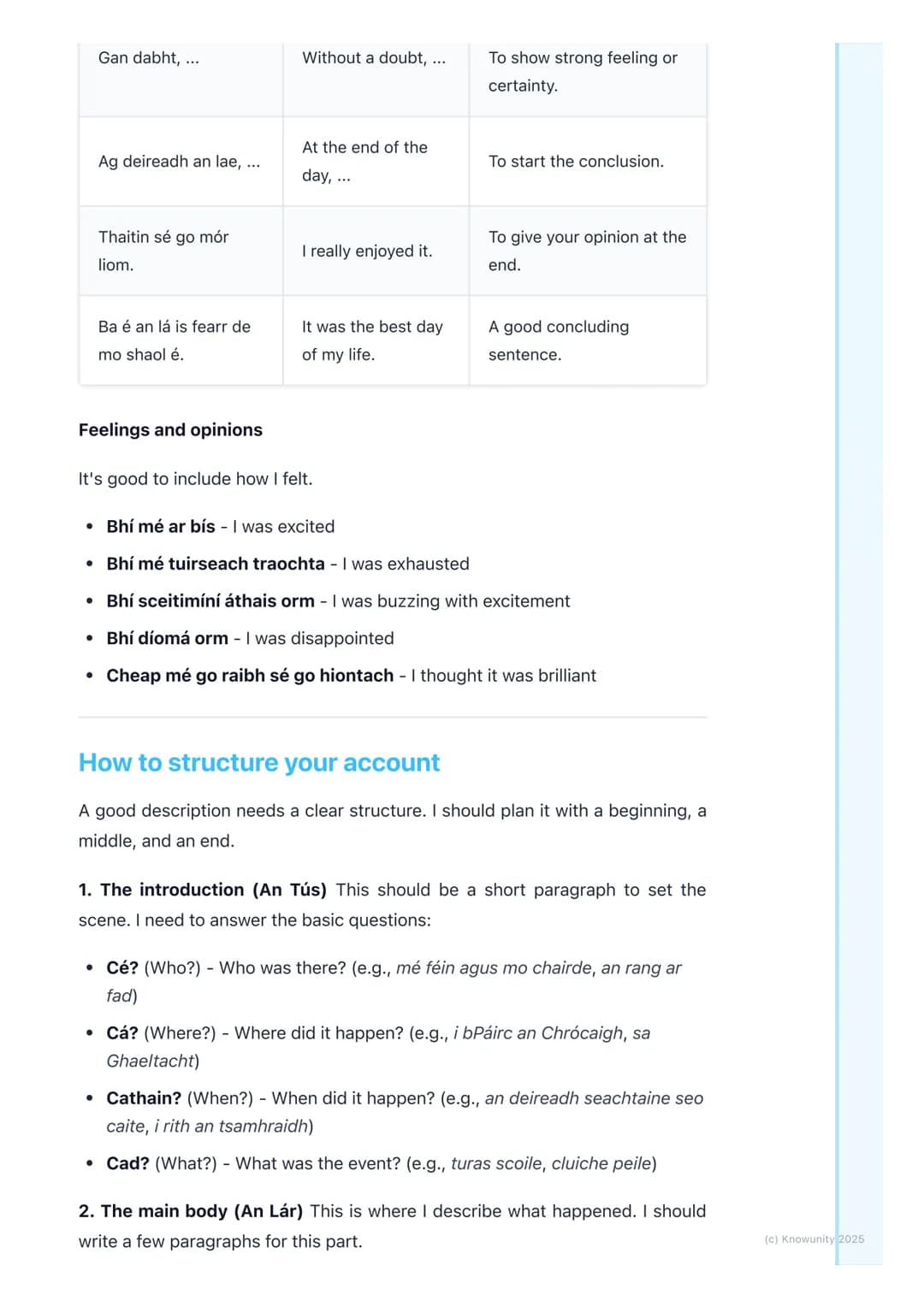
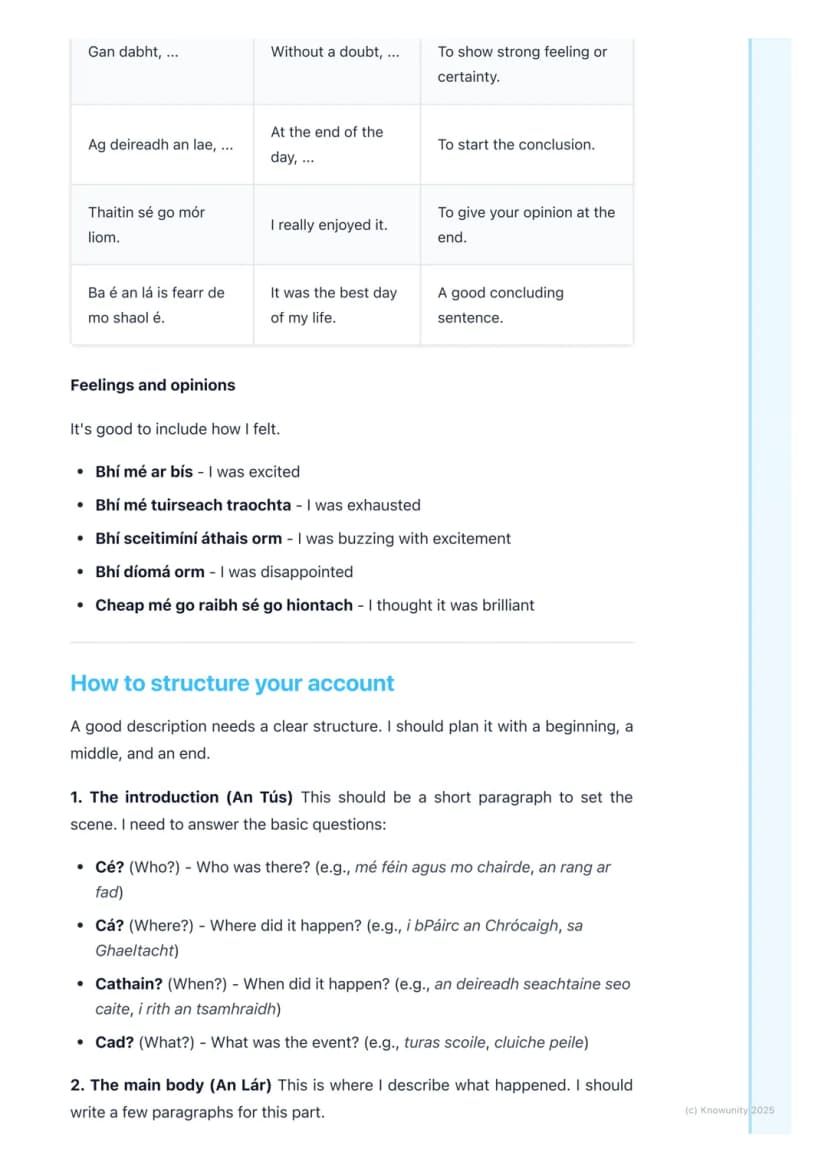
Expressing Feelings and Opinions
Don't just tell us what happened - show us how you felt! This is what transforms boring event descriptions into engaging stories that grab the examiner's attention.
Use emotional phrases like "Bhí mé ar bís" (I was excited), "Bhí sceitimíní áthais orm" (I was buzzing with excitement), or "Bhí díomá orm" (I was disappointed). These make your writing much more personal and interesting.
End with impact using phrases like "Thaitin sé go mór liom" (I really enjoyed it) or the classic "Ba é an lá is fearr de mo shaol é" (It was the best day of my life). Don't be afraid to show strong emotions - examiners love authentic, enthusiastic writing.
Your opinion matters just as much as the facts. Use "Cheap mé go raibh sé..." (I thought it was...) followed by brilliant adjectives like "iontach" (wonderful) or "ar fheabhas" (excellent).
Remember: Emotions make events memorable - both for you and your reader!
3
of 5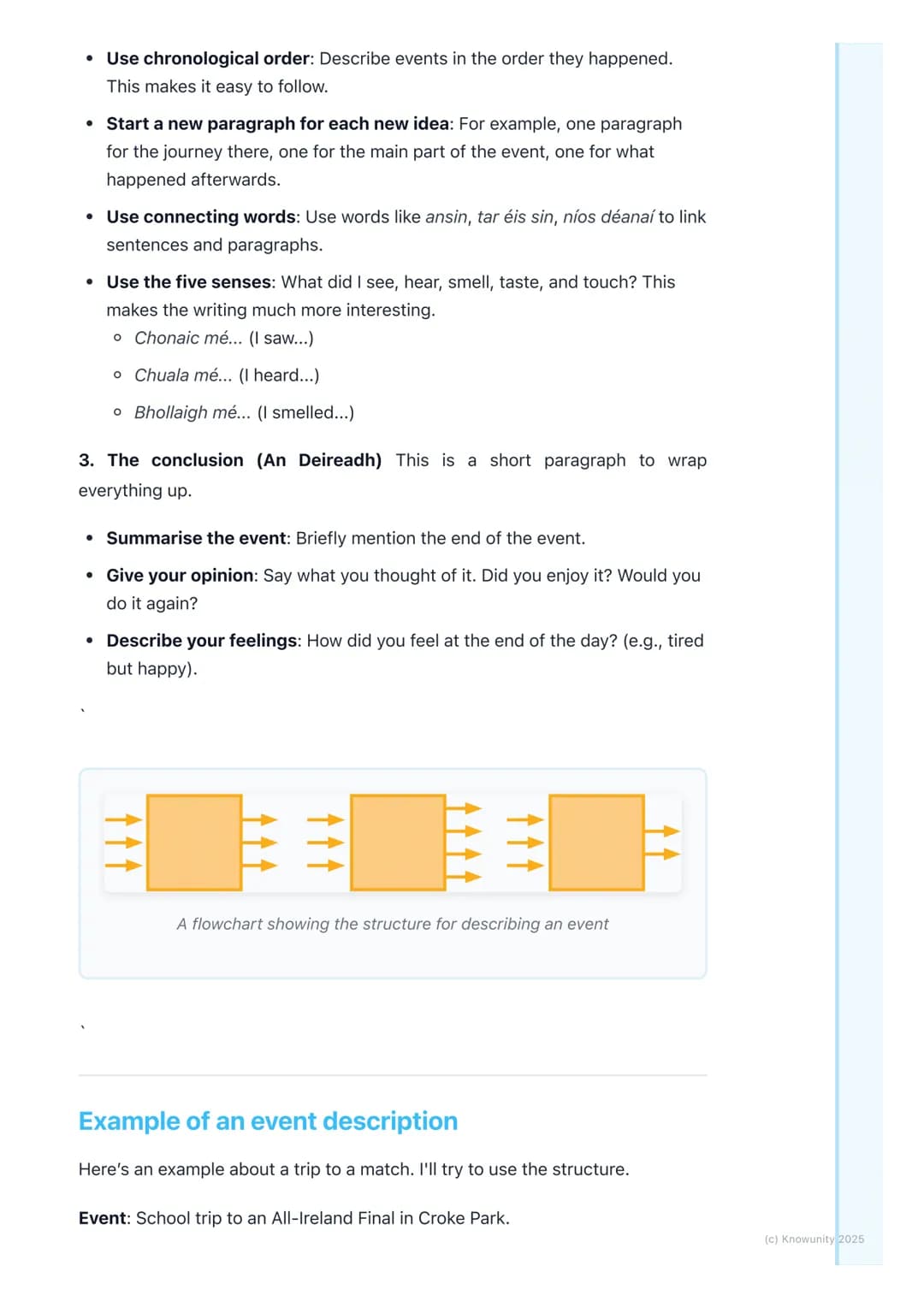
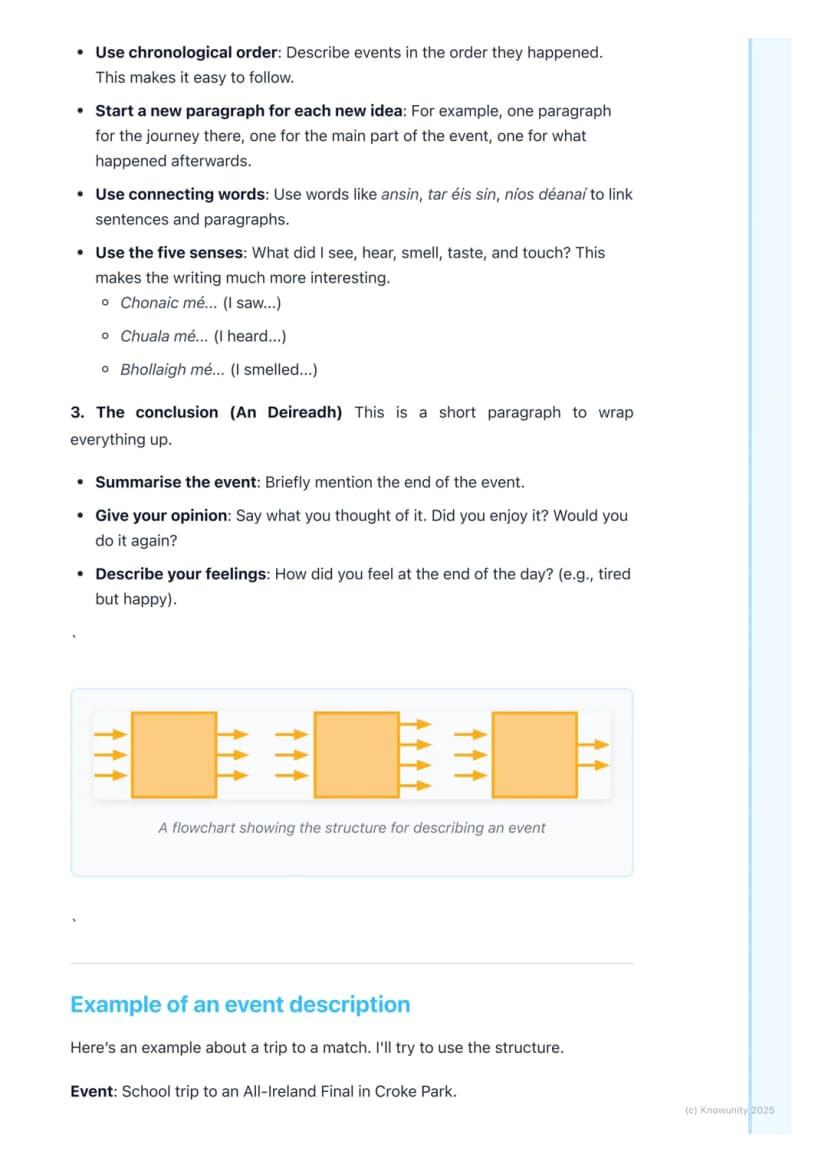
Perfect Structure: Beginning, Middle, End
Start strong with your introduction by answering the big four questions: Cé? (Who?), Cá? (Where?), Cathain? (When?), and Cad? (What?). This sets the scene perfectly in just one short paragraph.
The main body is where the magic happens. Describe events in chronological order - it's the easiest way to keep your reader engaged. Start new paragraphs for each major part of the event, like the journey there, the main event, and what happened afterwards.
Bring it alive with your five senses! What did you see, hear, smell, taste, and touch? Use "Chonaic mé..." (I saw...), "Chuala mé..." (I heard...), and "Bhollaigh mé..." (I smelled...) to create vivid descriptions.
Your conclusion should briefly summarise the event, give your final opinion, and describe how you felt at the end. Keep it short but impactful - this is your last chance to impress!
Pro Tip: Plan your three sections with bullet points before you start writing - it'll save you time and make your structure crystal clear.
4
of 5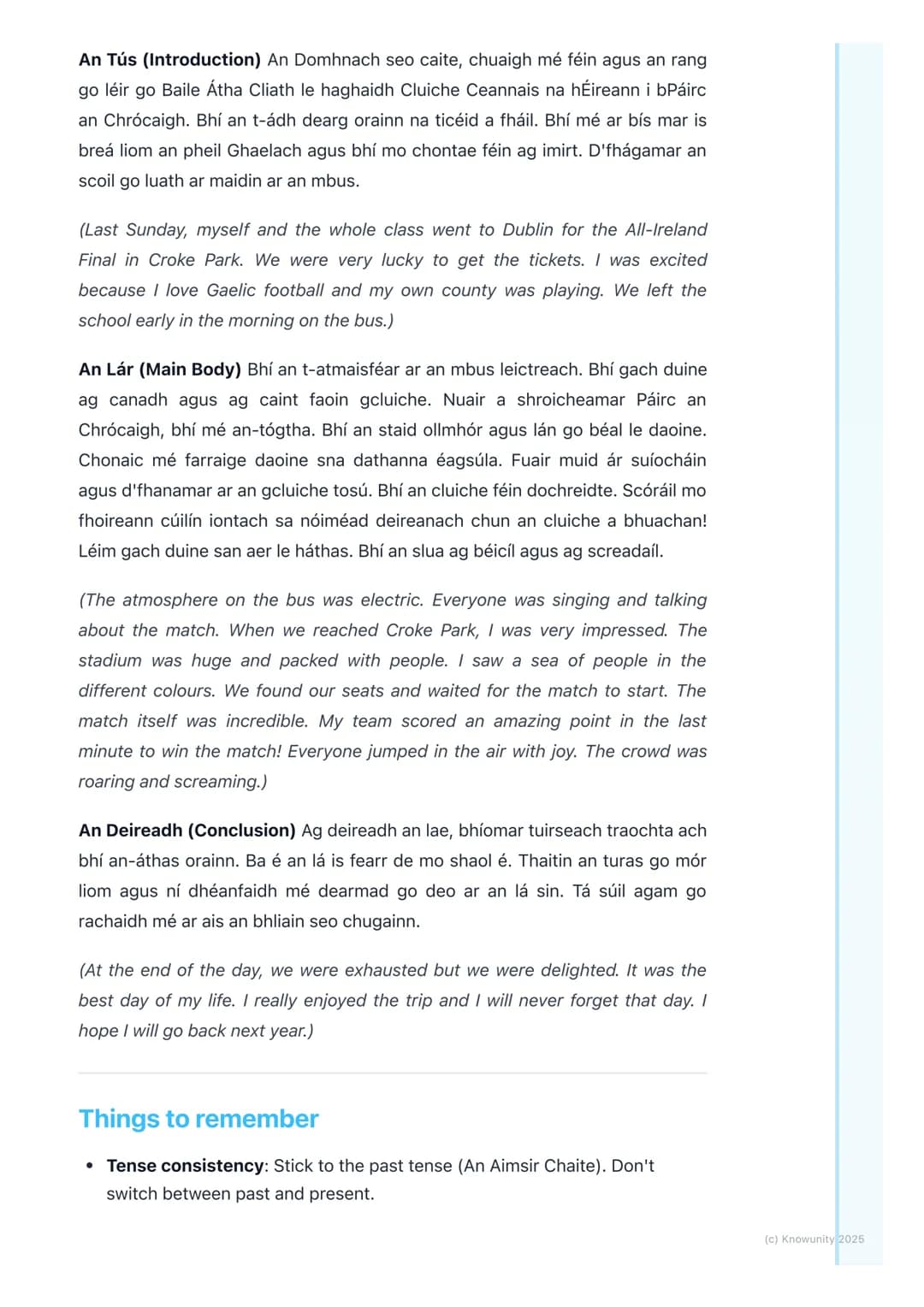
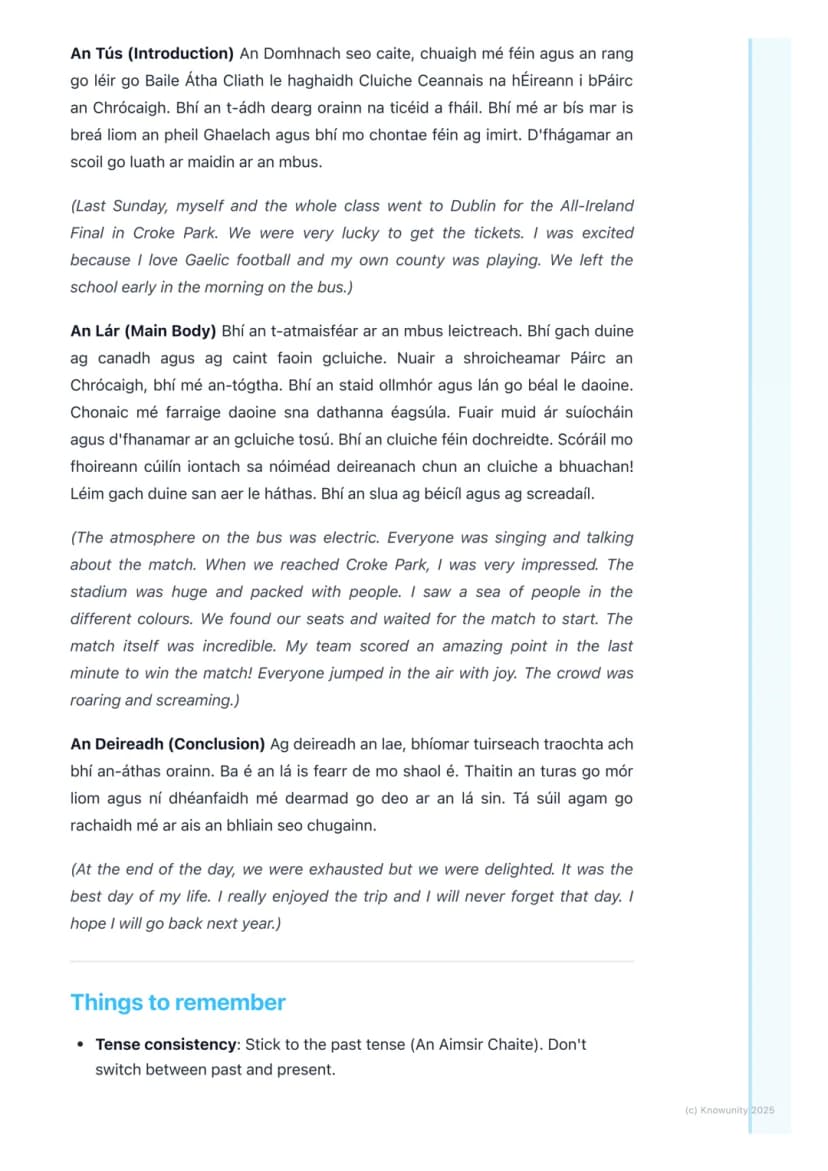
Real Example: All-Ireland Final Trip
Check out this brilliant example about a school trip to Croke Park. Notice how it follows the perfect structure and uses all those essential phrases we've learned.
An Tús sets the scene: "An Domhnah seo caite, chuaigh mé féin agus an rang go léir go Baile Átha Cliath..." It tells us who (the whole class), where , when (last Sunday), and what .
An Lár brings the excitement alive with sensory details: "Bhí an t-atmaisféar ar an mbus leictreach" and "Chonaic mé farraige daoine sna dathanna éagsúla." You can practically feel the buzz and see the colourful crowd!
An Deireadh wraps everything up perfectly with emotions and opinions: "Ba é an lá is fearr de mo shaol é" and future hopes. The writer shows they're tired but absolutely delighted.
Notice how they stick to past tense throughout and use brilliant connecting words to link everything together smoothly.
Key Insight: This example works because it balances facts with feelings - you know what happened AND how the writer felt about it.
5
of 5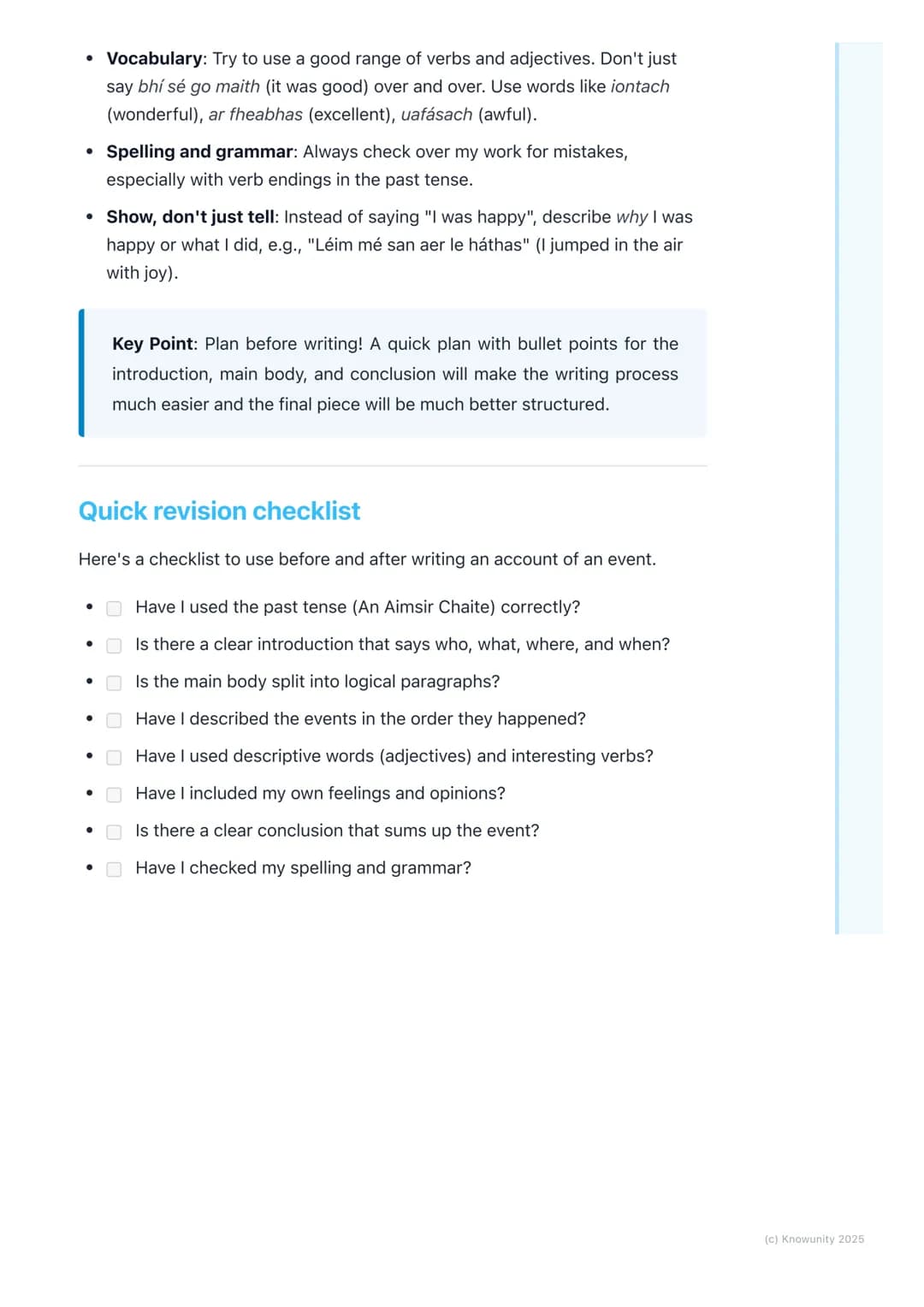
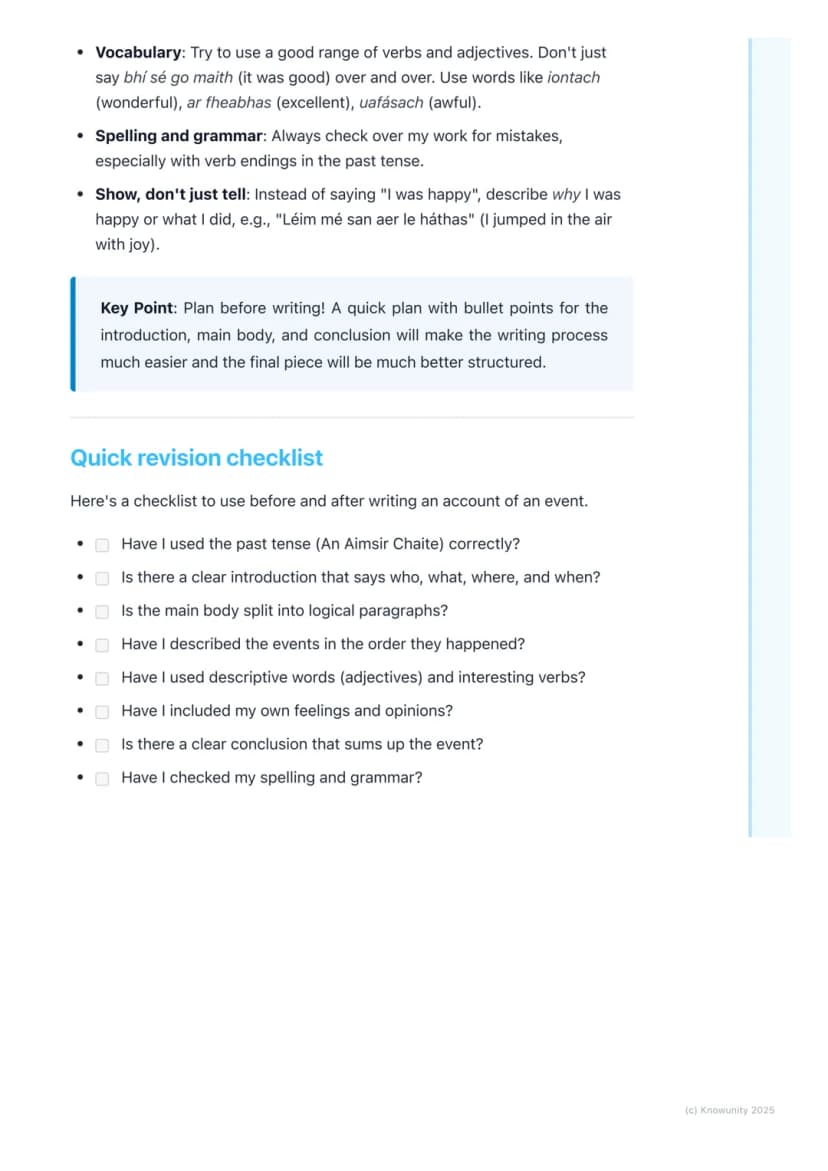
Final Tips and Quick Checklist
Show, don't just tell - instead of saying "I was happy," write "Léim mé san aer le háthas" (I jumped in the air with joy). This creates much more vivid and engaging descriptions.
Variety is crucial in your vocabulary. Don't repeat "bhí sé go maith" constantly - mix it up with "iontach," "ar fheabhas," or "dochreidte" to keep your writing fresh and impressive.
Your quick revision checklist:
- Past tense used correctly throughout?
- Clear introduction with who, what, where, when?
- Main body in logical paragraphs?
- Events described chronologically?
- Feelings and opinions included?
- Strong conclusion that sums everything up?
- Spelling and grammar checked?
Remember, planning is everything! Spend five minutes jotting down bullet points for your introduction, main body, and conclusion before you start writing. This simple step will make your final piece much stronger and easier to write.
Final Reminder: Examiners love enthusiasm and personality - let your genuine excitement about the event shine through your Irish!
Azt hittük, soha nem fogod megkérdezni...
Mi a Knowunity MI társ?
MI Társunk egy diákközpontú MI eszköz, amely többet nyújt puszta válaszoknál. Millió Knowunity erőforrásra épülve releváns információkat, személyre szabott tanulási terveket, kvízeket és tartalmat biztosít közvetlenül a chatben, alkalmazkodva az egyéni tanulási utadhoz.
Honnan tudom letölteni a Knowunity appot?
Az appot letöltheted a Google Play Store-ból és az Apple App Store-ból.
Tényleg ingyenes a Knowunity?
Pontosan! Élvezd az ingyenes hozzáférést a tanulási tartalmakhoz, kapcsolódj diáktársaiddal, és kapj azonnali segítséget – mind a kezed ügyében.
Legnépszerűbb tananyagok Irish tantárgyból
9IrishIrish oral questions and answers
Questions and answers for the leaving cert oral
5th Year4254
IrishIrish oral questions
Outline of oral questions
5th Year2055
IrishGaeilge Grammar Office
All the basics you need to know on Irish grammar.
6th Year863
IrishIrish poetry 2027
Iníon + Dínit an Bhróin
5th Year1123
IrishMé Féin & Mo Chlann (Myself & My Family)
Students will learn vocabulary to describe themselves, their family members, and daily routines. This helps in personal introductions and discussions.
TY291
IrishAn Gaeilge Aiste
Irish Language essay
6th Year1250
IrishLC HL notes- Iníon (poem)
Includes poem in English and Irish, theme, key words & phrases
5th Year2234
IrishIníon- le hÁine Durkin
Aine Durkin’s poem, Iníon: Themes & summary
5th Year840
IrishIrish notes- Drama: Gleann Alain
Includes key words from the scenes, themes, characters and exam questions
1st Year1301
Legnépszerűbb tananyagok
9IrishIrish oral questions and answers
Questions and answers for the leaving cert oral
5th Year4254
IrishIrish oral questions
Outline of oral questions
5th Year2055
IrishGaeilge Grammar Office
All the basics you need to know on Irish grammar.
6th Year863
 English
Key Quotes : Sive
Key Quotes and explanations: Sive
6th Year2131
IrishAn Gaeilge Aiste
Irish Language essay
6th Year1250
IrishIrish poetry 2027
Iníon + Dínit an Bhróin
5th Year1123
IrishMé Féin & Mo Chlann (Myself & My Family)
Students will learn vocabulary to describe themselves, their family members, and daily routines. This helps in personal introductions and discussions.
TY291
IrishLC HL notes- Iníon (poem)
Includes poem in English and Irish, theme, key words & phrases
5th Year2234
 Geography
Territory, economic activities in Paris basin
essay
6th Year80
Nem találod amit keresel? Fedezz fel más tantárgyakat.
A diákok imádnak minket — és téged is fognak.
4.6/5App Store
4.7/5Google Play
Az alkalmazás nagyon könnyen használható és jól megtervezett. Mindent megtaláltam, amit eddig kerestem, és sokat tudtam tanulni a prezentációkból! Biztosan használni fogom az alkalmazást egy osztályfeladathoz! És persze inspirációként is nagyszerűen segít.
Stefan SiOS felhasználó
Ez az alkalmazás tényleg nagyszerű. Olyan sok tanulási jegyzet és segítség van benne [...]. Például a francia a problémás tantárgyam, és az alkalmazásban olyan sok segítség lehetőség van. Ennek az alkalmazásnak köszönhetően javult a franciám. Mindenkinek ajánlanám.
Samantha KlichAndroid felhasználó
Hű, tényleg lenyűgözött. Csak úgy kipróbáltam az alkalmazást, mert sokszor láttam reklámozva, és teljesen megdöbbentett. Ez az alkalmazás AZ A SEGÍTSÉG, amire az iskolában szükséged van, és mindenekelőtt olyan sok mindent kínál, mint például gyakorlatokat és összefoglalókat, amik nekem személyesen NAGYON hasznosak voltak.
AnnaiOS felhasználó
Irish1 megtekintések·Frissítve May 5, 2026·5 oldalAg Cur Síos ar Imeachtaí: Treoir Éasca agus Shoiléir
Ever been to a brilliant concert or match and wanted to write about it in Irish? Describing events (Cur Síos ar Imeachtaí) is all about telling the story of something that happened in a clear, engaging way. You'll use this... Továbbiak megjelenítése
1
of 5Regisztrálj, hogy lásd a tartalmat. Teljesen ingyenes!
- Hozzáférés minden dokumentumhoz
- Javítsd a jegyeidet
- Csatlakozz diákok millióihoz
What is Describing an Event?
Think of this as storytelling about real life. Whether it's a school trip, a party, a concert, or a GAA match, you're painting a picture with words so your reader feels like they were there too.
The golden rule? Use An Aimsir Chaite (past tense) consistently since you're talking about something that already happened. No mixing tenses or you'll confuse your reader!
Essential linking phrases will make your writing flow brilliantly. Start with "Ar dtús" (firstly), move through events with "Ansin" (then), and add drama with "Go tobann" (suddenly). When things go wrong, use "Ar an drochuair" (unfortunately), and wrap up with confidence using "Gan dabht" (without a doubt).
Top Tip: Learn these phrases off by heart - they'll instantly make your writing sound more natural and sophisticated!
2
of 5Regisztrálj, hogy lásd a tartalmat. Teljesen ingyenes!
- Hozzáférés minden dokumentumhoz
- Javítsd a jegyeidet
- Csatlakozz diákok millióihoz
Expressing Feelings and Opinions
Don't just tell us what happened - show us how you felt! This is what transforms boring event descriptions into engaging stories that grab the examiner's attention.
Use emotional phrases like "Bhí mé ar bís" (I was excited), "Bhí sceitimíní áthais orm" (I was buzzing with excitement), or "Bhí díomá orm" (I was disappointed). These make your writing much more personal and interesting.
End with impact using phrases like "Thaitin sé go mór liom" (I really enjoyed it) or the classic "Ba é an lá is fearr de mo shaol é" (It was the best day of my life). Don't be afraid to show strong emotions - examiners love authentic, enthusiastic writing.
Your opinion matters just as much as the facts. Use "Cheap mé go raibh sé..." (I thought it was...) followed by brilliant adjectives like "iontach" (wonderful) or "ar fheabhas" (excellent).
Remember: Emotions make events memorable - both for you and your reader!
3
of 5Regisztrálj, hogy lásd a tartalmat. Teljesen ingyenes!
- Hozzáférés minden dokumentumhoz
- Javítsd a jegyeidet
- Csatlakozz diákok millióihoz
Perfect Structure: Beginning, Middle, End
Start strong with your introduction by answering the big four questions: Cé? (Who?), Cá? (Where?), Cathain? (When?), and Cad? (What?). This sets the scene perfectly in just one short paragraph.
The main body is where the magic happens. Describe events in chronological order - it's the easiest way to keep your reader engaged. Start new paragraphs for each major part of the event, like the journey there, the main event, and what happened afterwards.
Bring it alive with your five senses! What did you see, hear, smell, taste, and touch? Use "Chonaic mé..." (I saw...), "Chuala mé..." (I heard...), and "Bhollaigh mé..." (I smelled...) to create vivid descriptions.
Your conclusion should briefly summarise the event, give your final opinion, and describe how you felt at the end. Keep it short but impactful - this is your last chance to impress!
Pro Tip: Plan your three sections with bullet points before you start writing - it'll save you time and make your structure crystal clear.
4
of 5Regisztrálj, hogy lásd a tartalmat. Teljesen ingyenes!
- Hozzáférés minden dokumentumhoz
- Javítsd a jegyeidet
- Csatlakozz diákok millióihoz
Real Example: All-Ireland Final Trip
Check out this brilliant example about a school trip to Croke Park. Notice how it follows the perfect structure and uses all those essential phrases we've learned.
An Tús sets the scene: "An Domhnah seo caite, chuaigh mé féin agus an rang go léir go Baile Átha Cliath..." It tells us who (the whole class), where , when (last Sunday), and what .
An Lár brings the excitement alive with sensory details: "Bhí an t-atmaisféar ar an mbus leictreach" and "Chonaic mé farraige daoine sna dathanna éagsúla." You can practically feel the buzz and see the colourful crowd!
An Deireadh wraps everything up perfectly with emotions and opinions: "Ba é an lá is fearr de mo shaol é" and future hopes. The writer shows they're tired but absolutely delighted.
Notice how they stick to past tense throughout and use brilliant connecting words to link everything together smoothly.
Key Insight: This example works because it balances facts with feelings - you know what happened AND how the writer felt about it.
5
of 5Regisztrálj, hogy lásd a tartalmat. Teljesen ingyenes!
- Hozzáférés minden dokumentumhoz
- Javítsd a jegyeidet
- Csatlakozz diákok millióihoz
Final Tips and Quick Checklist
Show, don't just tell - instead of saying "I was happy," write "Léim mé san aer le háthas" (I jumped in the air with joy). This creates much more vivid and engaging descriptions.
Variety is crucial in your vocabulary. Don't repeat "bhí sé go maith" constantly - mix it up with "iontach," "ar fheabhas," or "dochreidte" to keep your writing fresh and impressive.
Your quick revision checklist:
- Past tense used correctly throughout?
- Clear introduction with who, what, where, when?
- Main body in logical paragraphs?
- Events described chronologically?
- Feelings and opinions included?
- Strong conclusion that sums everything up?
- Spelling and grammar checked?
Remember, planning is everything! Spend five minutes jotting down bullet points for your introduction, main body, and conclusion before you start writing. This simple step will make your final piece much stronger and easier to write.
Final Reminder: Examiners love enthusiasm and personality - let your genuine excitement about the event shine through your Irish!
Azt hittük, soha nem fogod megkérdezni...
Mi a Knowunity MI társ?
MI Társunk egy diákközpontú MI eszköz, amely többet nyújt puszta válaszoknál. Millió Knowunity erőforrásra épülve releváns információkat, személyre szabott tanulási terveket, kvízeket és tartalmat biztosít közvetlenül a chatben, alkalmazkodva az egyéni tanulási utadhoz.
Honnan tudom letölteni a Knowunity appot?
Az appot letöltheted a Google Play Store-ból és az Apple App Store-ból.
Tényleg ingyenes a Knowunity?
Pontosan! Élvezd az ingyenes hozzáférést a tanulási tartalmakhoz, kapcsolódj diáktársaiddal, és kapj azonnali segítséget – mind a kezed ügyében.
Legnépszerűbb tananyagok Irish tantárgyból
9IrishIrish oral questions and answers
Questions and answers for the leaving cert oral
5th Year4254
IrishIrish oral questions
Outline of oral questions
5th Year2055
IrishGaeilge Grammar Office
All the basics you need to know on Irish grammar.
6th Year863
IrishIrish poetry 2027
Iníon + Dínit an Bhróin
5th Year1123
IrishMé Féin & Mo Chlann (Myself & My Family)
Students will learn vocabulary to describe themselves, their family members, and daily routines. This helps in personal introductions and discussions.
TY291
IrishAn Gaeilge Aiste
Irish Language essay
6th Year1250
IrishLC HL notes- Iníon (poem)
Includes poem in English and Irish, theme, key words & phrases
5th Year2234
IrishIníon- le hÁine Durkin
Aine Durkin’s poem, Iníon: Themes & summary
5th Year840
IrishIrish notes- Drama: Gleann Alain
Includes key words from the scenes, themes, characters and exam questions
1st Year1301
Legnépszerűbb tananyagok
9IrishIrish oral questions and answers
Questions and answers for the leaving cert oral
5th Year4254
IrishIrish oral questions
Outline of oral questions
5th Year2055
IrishGaeilge Grammar Office
All the basics you need to know on Irish grammar.
6th Year863
EnglishKey Quotes : Sive
Key Quotes and explanations: Sive
6th Year2131
IrishAn Gaeilge Aiste
Irish Language essay
6th Year1250
IrishIrish poetry 2027
Iníon + Dínit an Bhróin
5th Year1123
IrishMé Féin & Mo Chlann (Myself & My Family)
Students will learn vocabulary to describe themselves, their family members, and daily routines. This helps in personal introductions and discussions.
TY291
IrishLC HL notes- Iníon (poem)
Includes poem in English and Irish, theme, key words & phrases
5th Year2234
GeographyTerritory, economic activities in Paris basin
essay
6th Year80
Nem találod amit keresel? Fedezz fel más tantárgyakat.
A diákok imádnak minket — és téged is fognak.
4.6/5App Store
4.7/5Google Play
Az alkalmazás nagyon könnyen használható és jól megtervezett. Mindent megtaláltam, amit eddig kerestem, és sokat tudtam tanulni a prezentációkból! Biztosan használni fogom az alkalmazást egy osztályfeladathoz! És persze inspirációként is nagyszerűen segít.
Stefan SiOS felhasználó
Ez az alkalmazás tényleg nagyszerű. Olyan sok tanulási jegyzet és segítség van benne [...]. Például a francia a problémás tantárgyam, és az alkalmazásban olyan sok segítség lehetőség van. Ennek az alkalmazásnak köszönhetően javult a franciám. Mindenkinek ajánlanám.
Samantha KlichAndroid felhasználó
Hű, tényleg lenyűgözött. Csak úgy kipróbáltam az alkalmazást, mert sokszor láttam reklámozva, és teljesen megdöbbentett. Ez az alkalmazás AZ A SEGÍTSÉG, amire az iskolában szükséged van, és mindenekelőtt olyan sok mindent kínál, mint például gyakorlatokat és összefoglalókat, amik nekem személyesen NAGYON hasznosak voltak.
AnnaiOS felhasználó