
The Renaissance was one of the most exciting periods in... Továbbiak megjelenítése
 History14 megtekintések·Frissítve Jun 13, 2026·5 oldal
The Renaissance: Europe's Age of Rebirth
1 / 5
1
of 5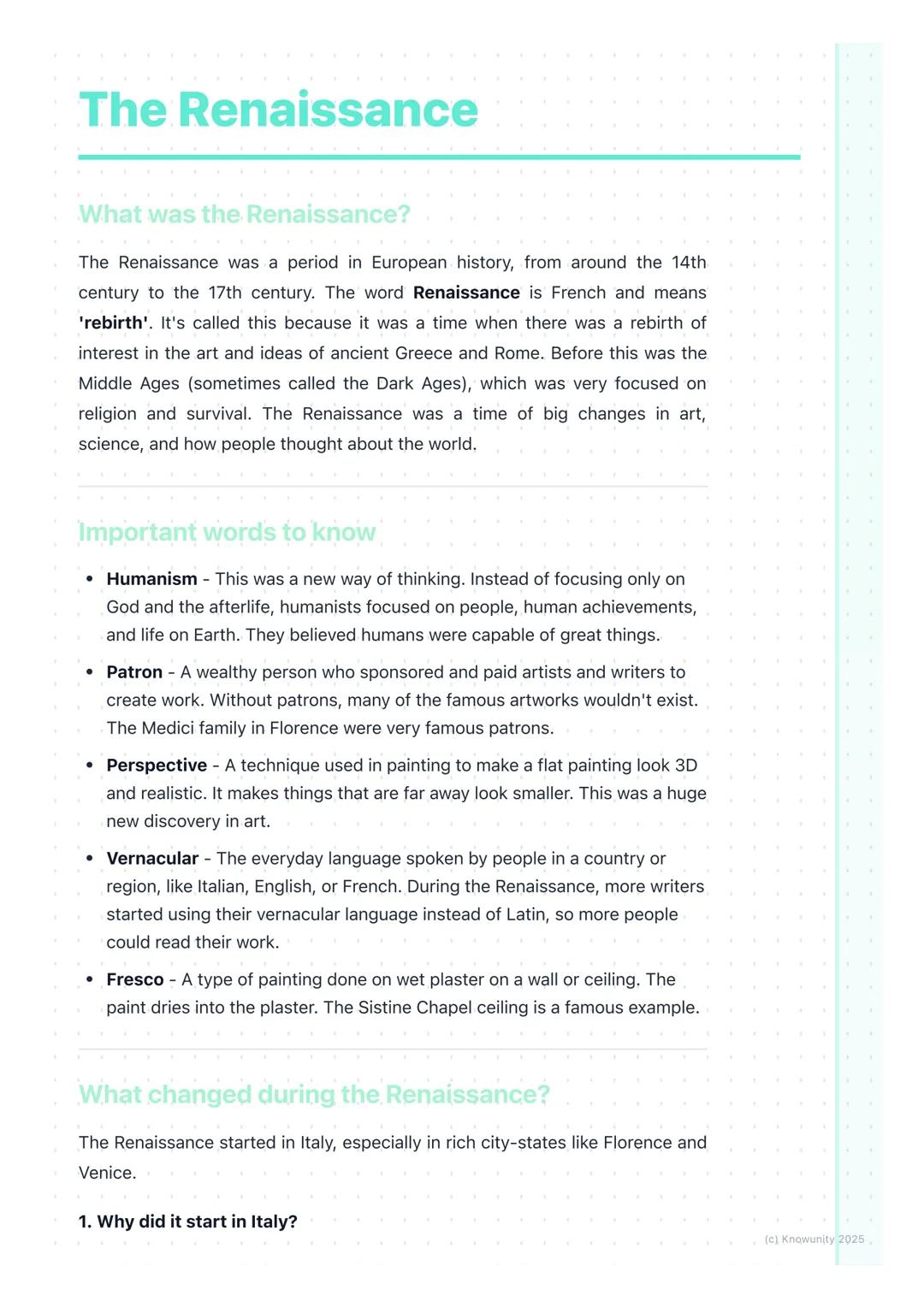
What Was the Renaissance?
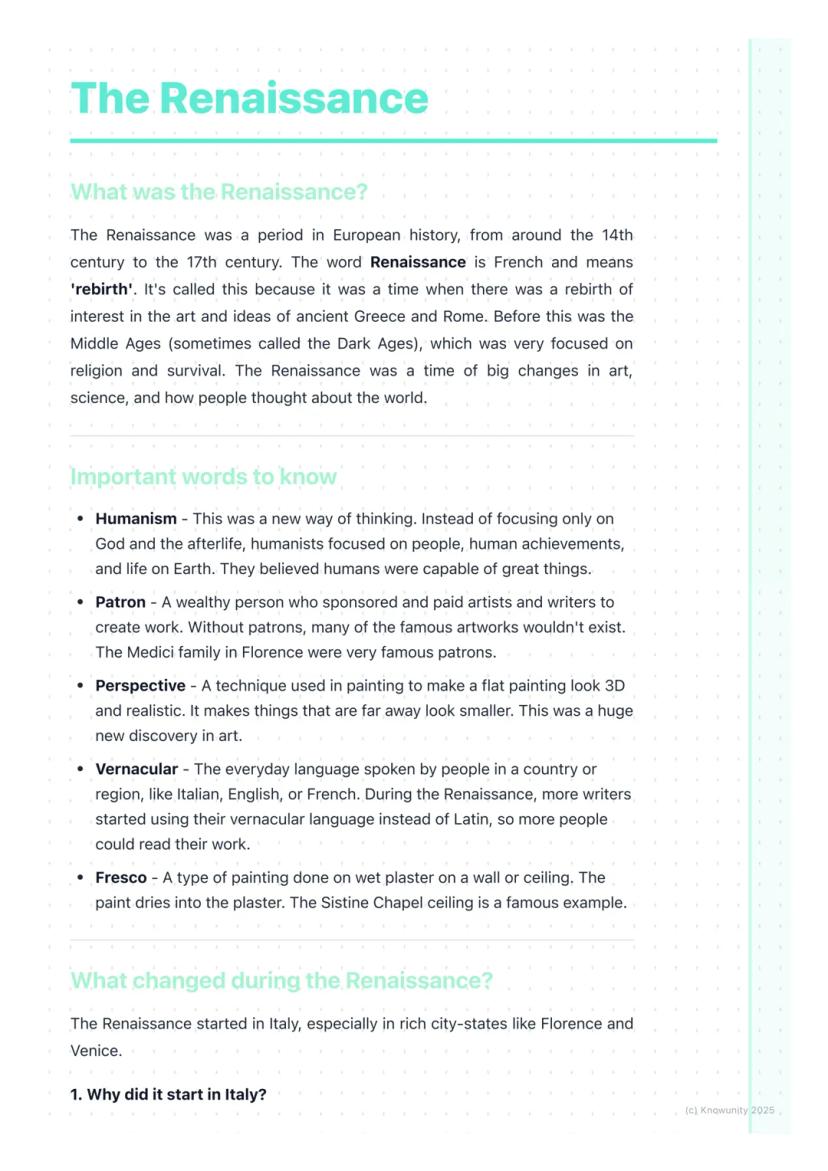
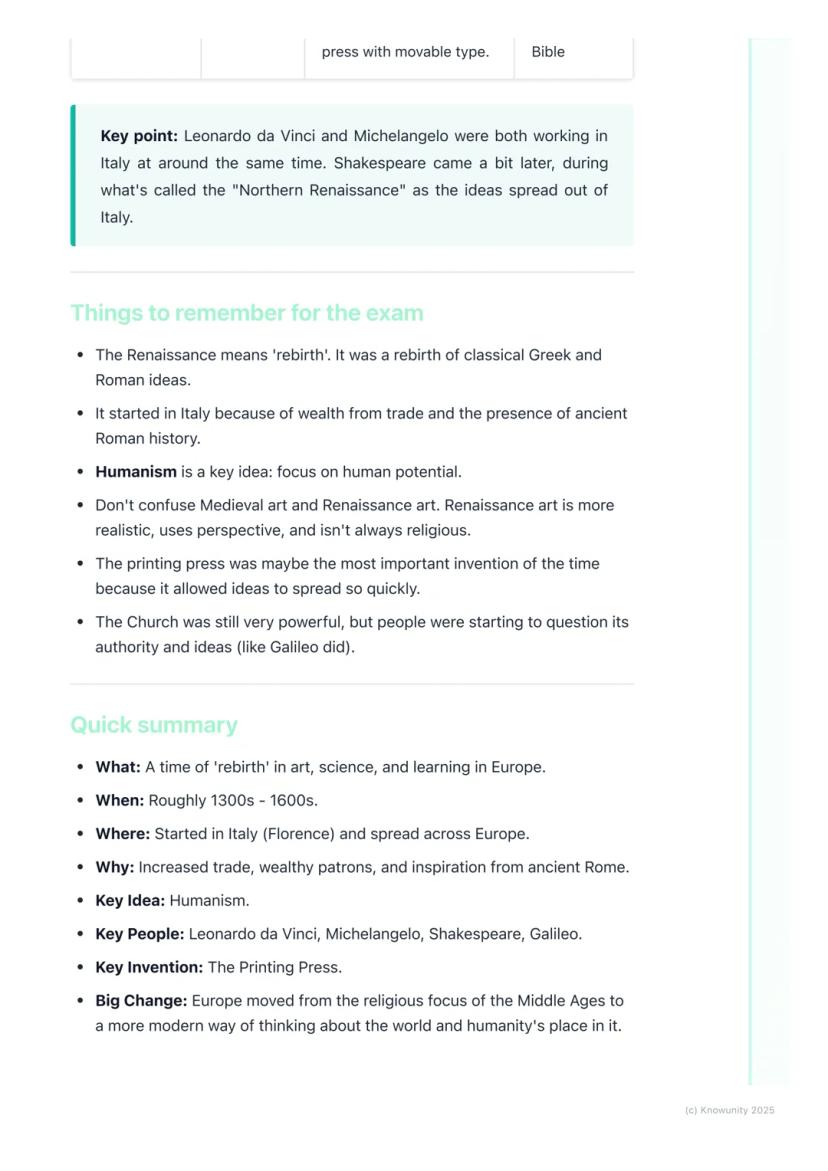
Think of the Renaissance as Europe's greatest glow-up! The word literally means 'rebirth' in French, and that's exactly what happened - people rediscovered the amazing art and ideas from ancient Greece and Rome.
This period marked a huge shift from the Middle Ages, when life was all about religion and just surviving. Instead, Renaissance folk became fascinated with human achievements and what people could accomplish on Earth, not just in the afterlife.
Humanism became the new trendy way of thinking - basically believing that humans are capable of incredible things. Meanwhile, wealthy patrons (think rich sponsors) like the famous Medici family paid artists to create masterpieces, whilst painters discovered perspective to make their flat artwork look amazingly 3D.
Quick Tip: Remember that vernacular means everyday language - so when writers started using Italian or English instead of Latin, ordinary people could finally understand books!
2
of 5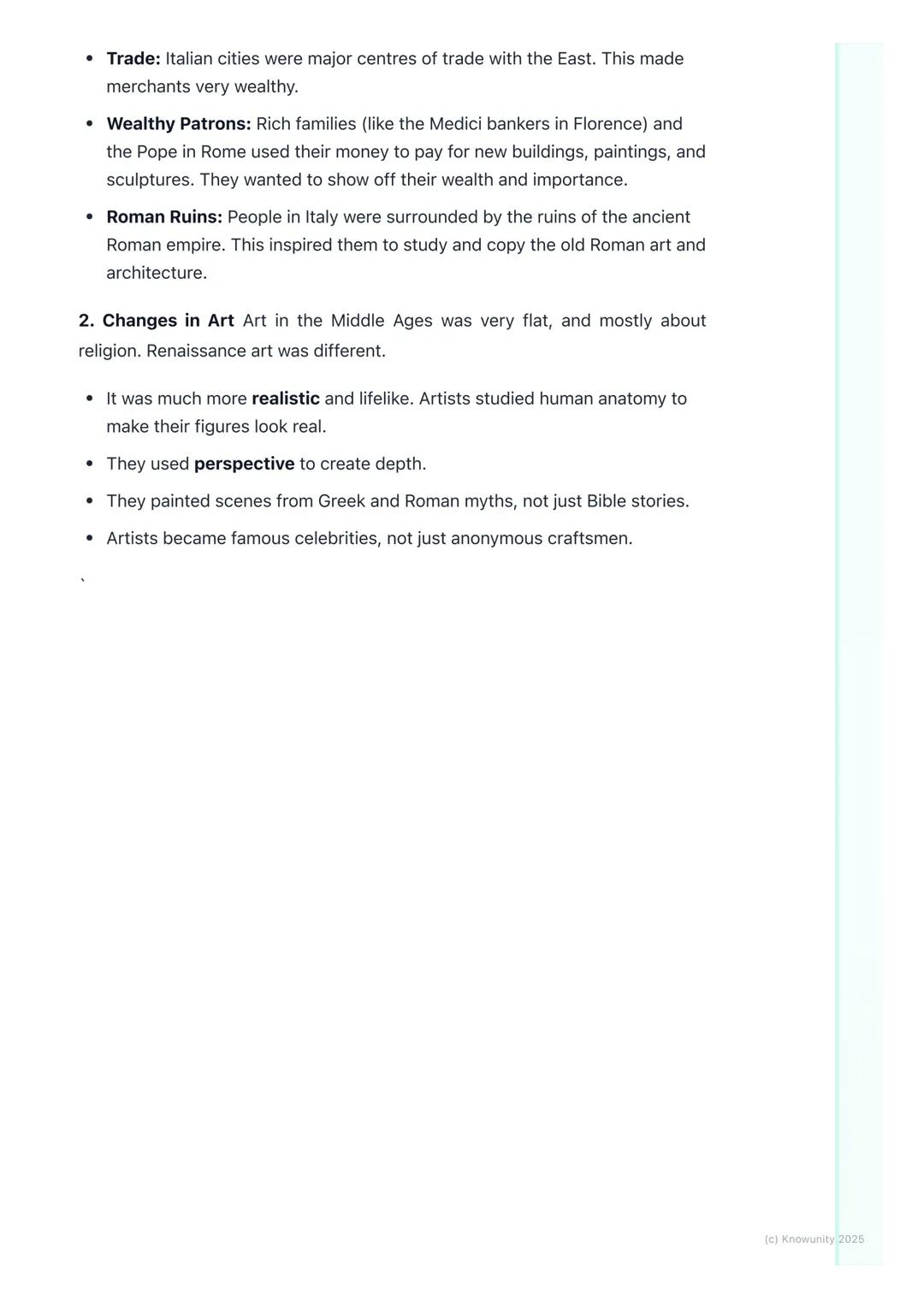
Why Italy Started It All
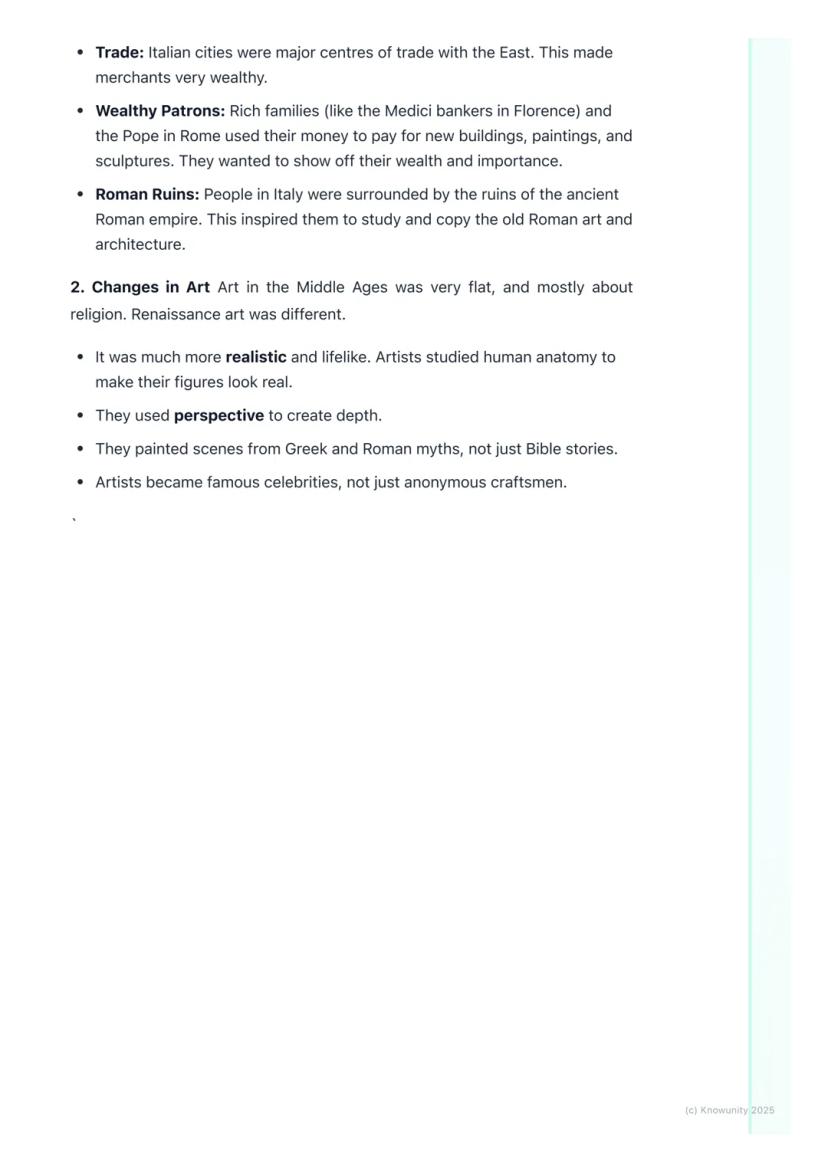
Italy was basically the perfect place for the Renaissance to kick off, and it's not hard to see why! Italian cities like Florence and Venice were absolutely loaded with cash from trading with the East.
Wealthy patrons were everywhere - rich merchant families and even the Pope had money to burn on fancy art and buildings. They wanted to show off their wealth and power, so they hired the best artists around.
Plus, Italians were literally surrounded by ancient Roman ruins every day. Walking past crumbling Roman temples and statues naturally got people thinking about the 'good old days' of classical art and architecture.
The city-states of Italy were also independent and competitive, each trying to outdo the others with the most impressive art and buildings. This created the perfect environment for creativity to flourish.
Did You Know: Florence was basically the Renaissance equivalent of Silicon Valley - the place where all the innovation happened!
3
of 5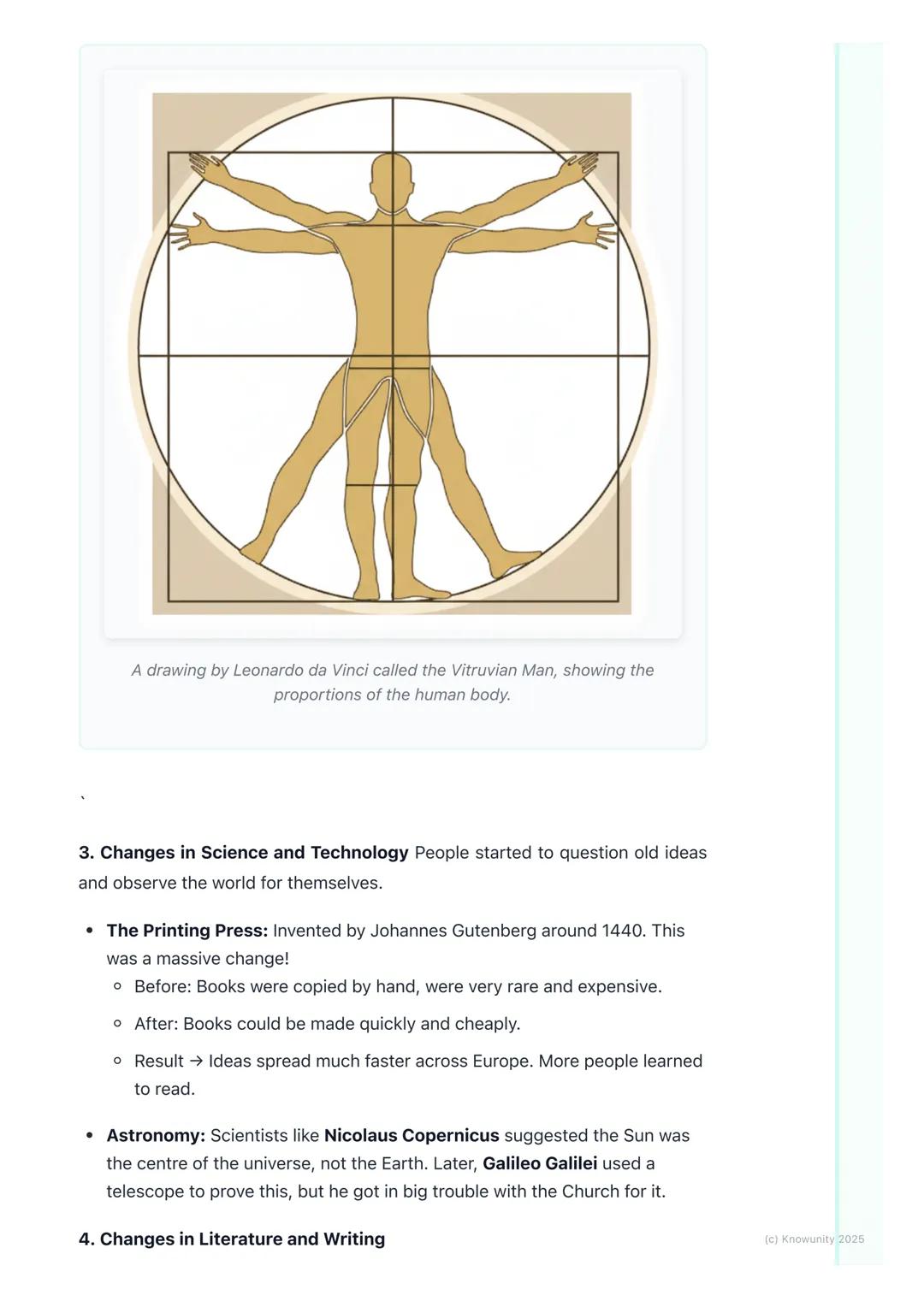
Revolutionary Changes in Art and Science
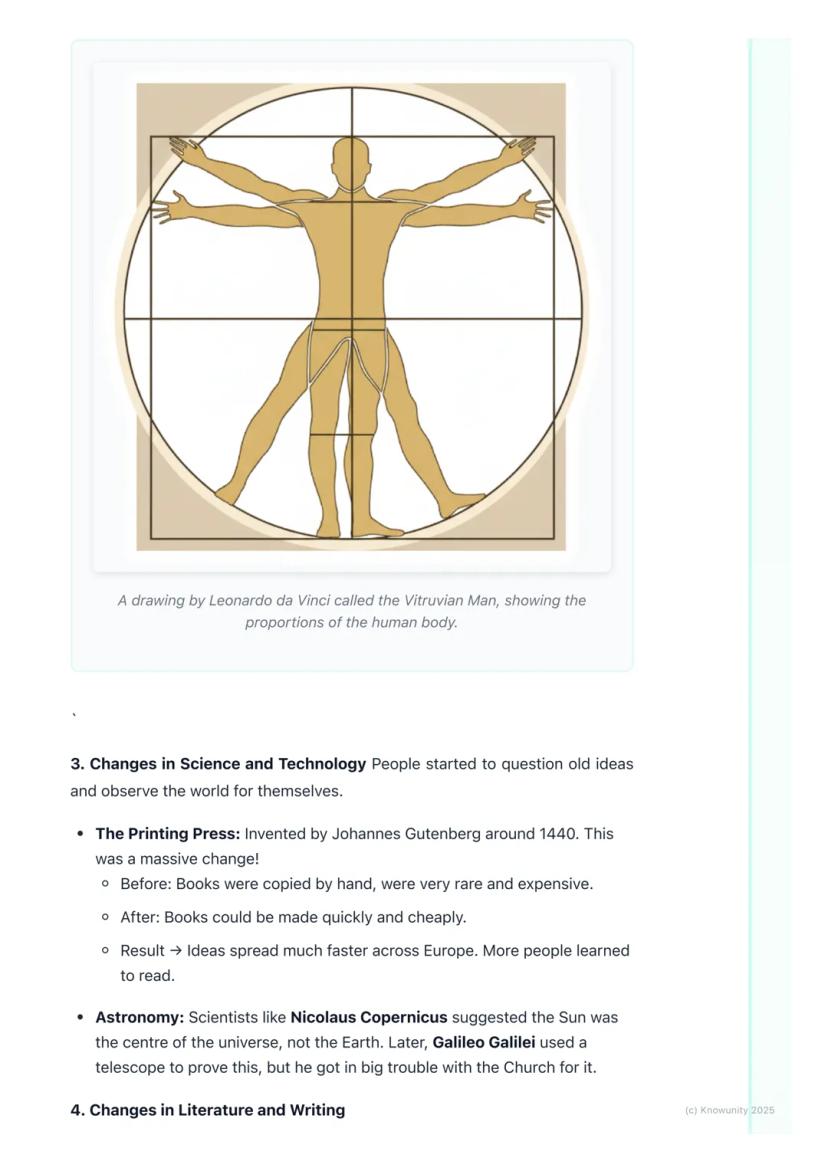
Renaissance art was a complete game-changer compared to the flat, purely religious paintings of the Middle Ages. Artists suddenly became obsessed with making everything look realistic - they even studied dead bodies to understand human anatomy properly!
Perspective became their secret weapon for creating depth, and artists started painting Greek and Roman myths alongside Bible stories. Plus, artists went from being anonymous craftsmen to actual celebrities - imagine being as famous as a pop star just for painting!
The printing press, invented by Johannes Gutenberg around 1440, was probably the most important invention ever. Before this, books were copied by hand and cost a fortune - afterwards, ideas could spread across Europe at lightning speed.
Scientists like Copernicus and Galileo started questioning everything, even suggesting that the Sun (not Earth) was the centre of the universe. Galileo got into serious trouble with the Church for this, but he was right!
Game Changer: The printing press meant more people could learn to read, and revolutionary ideas spread faster than ever before.
4
of 5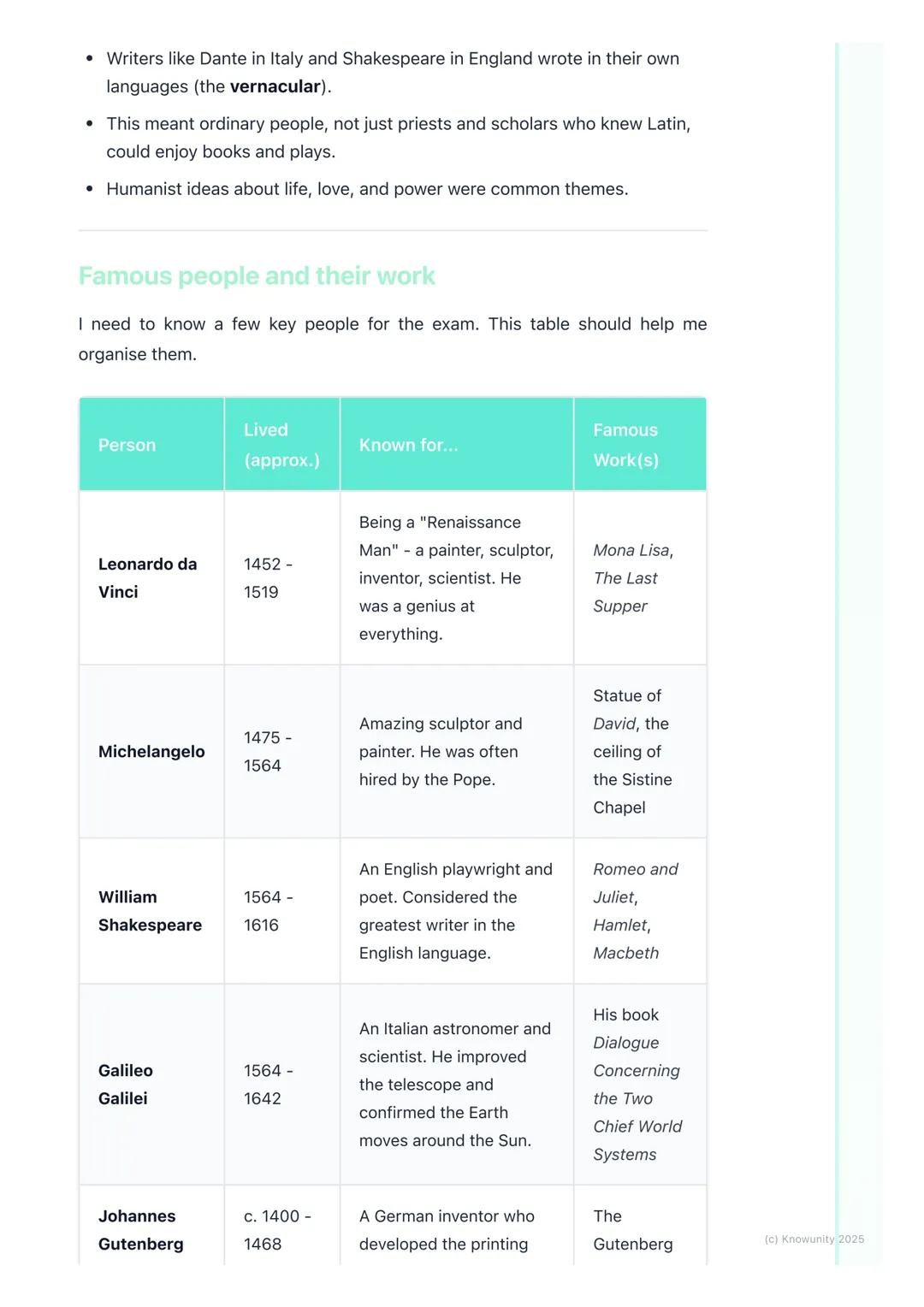
Renaissance Superstars You Need to Know
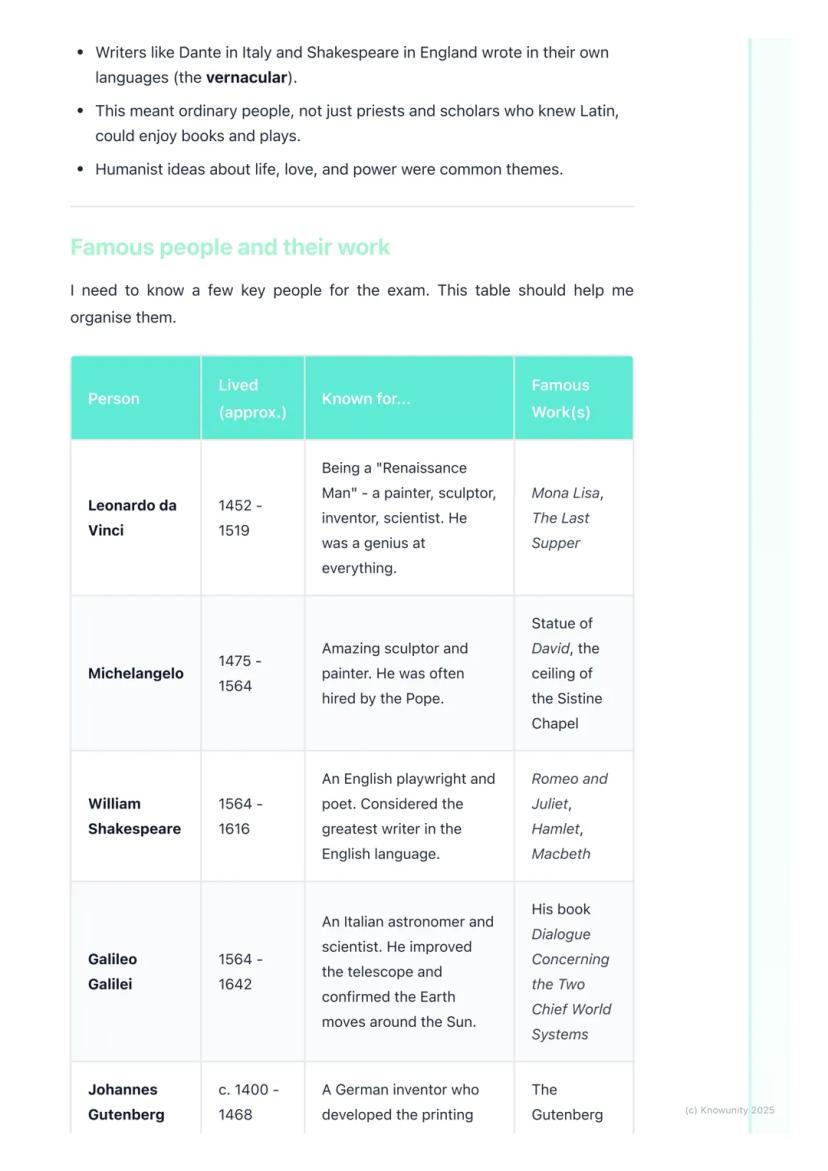
Leonardo da Vinci (1452-1519) was the ultimate Renaissance man - painter, inventor, scientist, you name it! He created the Mona Lisa and The Last Supper, plus designed flying machines centuries before planes existed.
Michelangelo (1475-1564) was the master sculptor and painter who gave us the incredible David statue and painted the entire ceiling of the Sistine Chapel. The Pope was basically his biggest fan and customer.
William Shakespeare (1564-1616) brought the Northern Renaissance to England with plays like Romeo and Juliet and Hamlet. He wrote in English vernacular, making his works accessible to everyone, not just Latin scholars.
Galileo Galilei (1564-1642) improved the telescope and proved that Earth really does move around the Sun, even though the Church wasn't happy about it. His discoveries changed how we see our place in the universe.
Fun Fact: Leonardo and Michelangelo were actually rivals working in Italy at the same time - talk about an artistic showdown!
5
of 5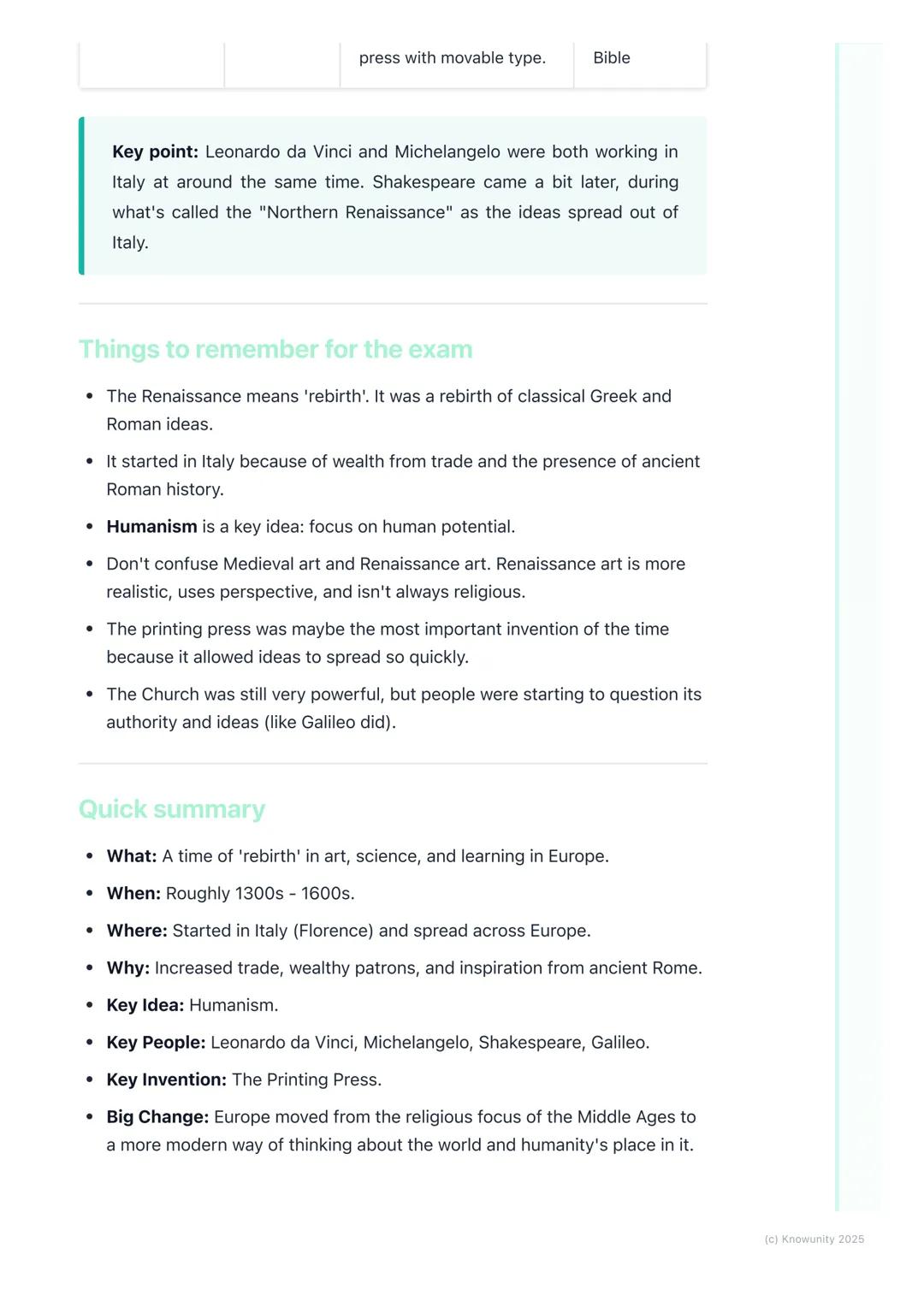
Azt hittük, soha nem fogod megkérdezni...
Mi a Knowunity MI társ?
MI Társunk egy diákközpontú MI eszköz, amely többet nyújt puszta válaszoknál. Millió Knowunity erőforrásra épülve releváns információkat, személyre szabott tanulási terveket, kvízeket és tartalmat biztosít közvetlenül a chatben, alkalmazkodva az egyéni tanulási utadhoz.
Honnan tudom letölteni a Knowunity appot?
Az appot letöltheted a Google Play Store-ból és az Apple App Store-ból.
Tényleg ingyenes a Knowunity?
Pontosan! Élvezd az ingyenes hozzáférést a tanulási tartalmakhoz, kapcsolódj diáktársaiddal, és kapj azonnali segítséget – mind a kezed ügyében.
Legnépszerűbb tananyagok History tantárgyból
9HistoryThe Great Famine (An Gorta Mór)
Students will learn about the causes, devastating impact, and long-term consequences of the potato famine on Irish population and society.
2nd Year282
HistoryThe renaissance
junior cert renaissance summary
1st Year361
HistoryCauses and Consequences of World War II
This subtopic covers the origins of the Second World War, its global scale, and its devastating human and political consequences, including the atomic bomb.
3rd Year152
HistoryThe 1798 Rebellion in Ireland
Learning about the causes, events, and aftermath of the United Irishmen's rebellion against British rule, inspired by revolutionary ideals.
3rd Year211
HistoryAmerican revolution
junior cert american revolution summary
1st Year442
HistoryThe Great Famine (An Gorta Mór)
This critical subtopic examines the causes, devastating impact, and long-term consequences of the potato famine on Irish society, population, and emigration.
3rd Year140
History1916 Rising Revison Sheet
revision sheet
3rd Year211
HistoryThe Reformation in Europe
Students will learn about the causes and key figures of the Protestant Reformation and its impact on European society and politics.
3rd Year110
HistoryAncient Rome
Discovering the Roman Empire, its powerful army, impressive cities, and how it influenced laws and culture across Europe.
1st Year211
Legnépszerűbb tananyagok
9 Irish
IrishIrish oral questions and answers
Questions and answers for the leaving cert oral
5th Year4264
 English
Key Quotes : Sive
Key Quotes and explanations: Sive
6th Year2842
IrishIrish oral questions
Outline of oral questions
5th Year2055
IrishIníon- le hÁine Durkin
Aine Durkin’s poem, Iníon: Themes & summary
5th Year850
IrishIrish poetry 2027
Iníon + Dínit an Bhróin
5th Year1133
IrishLC HL notes- Iníon (poem)
Includes poem in English and Irish, theme, key words & phrases
5th Year2284
EnglishCultural Context : Shawshank Redemption : Sive : Small Things Like These
Comparative Study : Cultural Context : Shawshank Redemption, Sive and Small Things Like These
6th Year1430
IrishMo Ghrá-sa (Idir Lúibíní)
Notes on mo ghrá-sa
5th Year380
IrishAn Gaeilge Aiste
Irish Language essay
6th Year1320
Nem találod amit keresel? Fedezz fel más tantárgyakat.
A diákok imádnak minket — és téged is fognak.
4.6/5App Store
4.7/5Google Play
Az alkalmazás nagyon könnyen használható és jól megtervezett. Mindent megtaláltam, amit eddig kerestem, és sokat tudtam tanulni a prezentációkból! Biztosan használni fogom az alkalmazást egy osztályfeladathoz! És persze inspirációként is nagyszerűen segít.
Stefan SiOS felhasználó
Ez az alkalmazás tényleg nagyszerű. Olyan sok tanulási jegyzet és segítség van benne [...]. Például a francia a problémás tantárgyam, és az alkalmazásban olyan sok segítség lehetőség van. Ennek az alkalmazásnak köszönhetően javult a franciám. Mindenkinek ajánlanám.
Samantha KlichAndroid felhasználó
Hű, tényleg lenyűgözött. Csak úgy kipróbáltam az alkalmazást, mert sokszor láttam reklámozva, és teljesen megdöbbentett. Ez az alkalmazás AZ A SEGÍTSÉG, amire az iskolában szükséged van, és mindenekelőtt olyan sok mindent kínál, mint például gyakorlatokat és összefoglalókat, amik nekem személyesen NAGYON hasznosak voltak.
AnnaiOS felhasználó
History14 megtekintések·Frissítve Jun 13, 2026·5 oldalThe Renaissance: Europe's Age of Rebirth
The Renaissance was one of the most exciting periods in European history - imagine a time when everything changed! From around the 1300s to 1600s, Europe experienced a massive 'rebirth' of art, science, and thinking that transformed the world from... Továbbiak megjelenítése
1
of 5Regisztrálj, hogy lásd a tartalmat. Teljesen ingyenes!
- Hozzáférés minden dokumentumhoz
- Javítsd a jegyeidet
- Csatlakozz diákok millióihoz
What Was the Renaissance?
Think of the Renaissance as Europe's greatest glow-up! The word literally means 'rebirth' in French, and that's exactly what happened - people rediscovered the amazing art and ideas from ancient Greece and Rome.
This period marked a huge shift from the Middle Ages, when life was all about religion and just surviving. Instead, Renaissance folk became fascinated with human achievements and what people could accomplish on Earth, not just in the afterlife.
Humanism became the new trendy way of thinking - basically believing that humans are capable of incredible things. Meanwhile, wealthy patrons (think rich sponsors) like the famous Medici family paid artists to create masterpieces, whilst painters discovered perspective to make their flat artwork look amazingly 3D.
Quick Tip: Remember that vernacular means everyday language - so when writers started using Italian or English instead of Latin, ordinary people could finally understand books!
2
of 5Regisztrálj, hogy lásd a tartalmat. Teljesen ingyenes!
- Hozzáférés minden dokumentumhoz
- Javítsd a jegyeidet
- Csatlakozz diákok millióihoz
Why Italy Started It All
Italy was basically the perfect place for the Renaissance to kick off, and it's not hard to see why! Italian cities like Florence and Venice were absolutely loaded with cash from trading with the East.
Wealthy patrons were everywhere - rich merchant families and even the Pope had money to burn on fancy art and buildings. They wanted to show off their wealth and power, so they hired the best artists around.
Plus, Italians were literally surrounded by ancient Roman ruins every day. Walking past crumbling Roman temples and statues naturally got people thinking about the 'good old days' of classical art and architecture.
The city-states of Italy were also independent and competitive, each trying to outdo the others with the most impressive art and buildings. This created the perfect environment for creativity to flourish.
Did You Know: Florence was basically the Renaissance equivalent of Silicon Valley - the place where all the innovation happened!
3
of 5Regisztrálj, hogy lásd a tartalmat. Teljesen ingyenes!
- Hozzáférés minden dokumentumhoz
- Javítsd a jegyeidet
- Csatlakozz diákok millióihoz
Revolutionary Changes in Art and Science
Renaissance art was a complete game-changer compared to the flat, purely religious paintings of the Middle Ages. Artists suddenly became obsessed with making everything look realistic - they even studied dead bodies to understand human anatomy properly!
Perspective became their secret weapon for creating depth, and artists started painting Greek and Roman myths alongside Bible stories. Plus, artists went from being anonymous craftsmen to actual celebrities - imagine being as famous as a pop star just for painting!
The printing press, invented by Johannes Gutenberg around 1440, was probably the most important invention ever. Before this, books were copied by hand and cost a fortune - afterwards, ideas could spread across Europe at lightning speed.
Scientists like Copernicus and Galileo started questioning everything, even suggesting that the Sun (not Earth) was the centre of the universe. Galileo got into serious trouble with the Church for this, but he was right!
Game Changer: The printing press meant more people could learn to read, and revolutionary ideas spread faster than ever before.
4
of 5Regisztrálj, hogy lásd a tartalmat. Teljesen ingyenes!
- Hozzáférés minden dokumentumhoz
- Javítsd a jegyeidet
- Csatlakozz diákok millióihoz
Renaissance Superstars You Need to Know
Leonardo da Vinci (1452-1519) was the ultimate Renaissance man - painter, inventor, scientist, you name it! He created the Mona Lisa and The Last Supper, plus designed flying machines centuries before planes existed.
Michelangelo (1475-1564) was the master sculptor and painter who gave us the incredible David statue and painted the entire ceiling of the Sistine Chapel. The Pope was basically his biggest fan and customer.
William Shakespeare (1564-1616) brought the Northern Renaissance to England with plays like Romeo and Juliet and Hamlet. He wrote in English vernacular, making his works accessible to everyone, not just Latin scholars.
Galileo Galilei (1564-1642) improved the telescope and proved that Earth really does move around the Sun, even though the Church wasn't happy about it. His discoveries changed how we see our place in the universe.
Fun Fact: Leonardo and Michelangelo were actually rivals working in Italy at the same time - talk about an artistic showdown!
5
of 5Regisztrálj, hogy lásd a tartalmat. Teljesen ingyenes!
- Hozzáférés minden dokumentumhoz
- Javítsd a jegyeidet
- Csatlakozz diákok millióihoz
Azt hittük, soha nem fogod megkérdezni...
Mi a Knowunity MI társ?
MI Társunk egy diákközpontú MI eszköz, amely többet nyújt puszta válaszoknál. Millió Knowunity erőforrásra épülve releváns információkat, személyre szabott tanulási terveket, kvízeket és tartalmat biztosít közvetlenül a chatben, alkalmazkodva az egyéni tanulási utadhoz.
Honnan tudom letölteni a Knowunity appot?
Az appot letöltheted a Google Play Store-ból és az Apple App Store-ból.
Tényleg ingyenes a Knowunity?
Pontosan! Élvezd az ingyenes hozzáférést a tanulási tartalmakhoz, kapcsolódj diáktársaiddal, és kapj azonnali segítséget – mind a kezed ügyében.
Legnépszerűbb tananyagok History tantárgyból
9HistoryThe Great Famine (An Gorta Mór)
Students will learn about the causes, devastating impact, and long-term consequences of the potato famine on Irish population and society.
2nd Year282
HistoryThe renaissance
junior cert renaissance summary
1st Year361
HistoryCauses and Consequences of World War II
This subtopic covers the origins of the Second World War, its global scale, and its devastating human and political consequences, including the atomic bomb.
3rd Year152
HistoryThe 1798 Rebellion in Ireland
Learning about the causes, events, and aftermath of the United Irishmen's rebellion against British rule, inspired by revolutionary ideals.
3rd Year211
HistoryAmerican revolution
junior cert american revolution summary
1st Year442
HistoryThe Great Famine (An Gorta Mór)
This critical subtopic examines the causes, devastating impact, and long-term consequences of the potato famine on Irish society, population, and emigration.
3rd Year140
History1916 Rising Revison Sheet
revision sheet
3rd Year211
HistoryThe Reformation in Europe
Students will learn about the causes and key figures of the Protestant Reformation and its impact on European society and politics.
3rd Year110
HistoryAncient Rome
Discovering the Roman Empire, its powerful army, impressive cities, and how it influenced laws and culture across Europe.
1st Year211
Legnépszerűbb tananyagok
9IrishIrish oral questions and answers
Questions and answers for the leaving cert oral
5th Year4264
EnglishKey Quotes : Sive
Key Quotes and explanations: Sive
6th Year2842
IrishIrish oral questions
Outline of oral questions
5th Year2055
IrishIníon- le hÁine Durkin
Aine Durkin’s poem, Iníon: Themes & summary
5th Year850
IrishIrish poetry 2027
Iníon + Dínit an Bhróin
5th Year1133
IrishLC HL notes- Iníon (poem)
Includes poem in English and Irish, theme, key words & phrases
5th Year2284
EnglishCultural Context : Shawshank Redemption : Sive : Small Things Like These
Comparative Study : Cultural Context : Shawshank Redemption, Sive and Small Things Like These
6th Year1430
IrishMo Ghrá-sa (Idir Lúibíní)
Notes on mo ghrá-sa
5th Year380
IrishAn Gaeilge Aiste
Irish Language essay
6th Year1320
Nem találod amit keresel? Fedezz fel más tantárgyakat.
A diákok imádnak minket — és téged is fognak.
4.6/5App Store
4.7/5Google Play
Az alkalmazás nagyon könnyen használható és jól megtervezett. Mindent megtaláltam, amit eddig kerestem, és sokat tudtam tanulni a prezentációkból! Biztosan használni fogom az alkalmazást egy osztályfeladathoz! És persze inspirációként is nagyszerűen segít.
Stefan SiOS felhasználó
Ez az alkalmazás tényleg nagyszerű. Olyan sok tanulási jegyzet és segítség van benne [...]. Például a francia a problémás tantárgyam, és az alkalmazásban olyan sok segítség lehetőség van. Ennek az alkalmazásnak köszönhetően javult a franciám. Mindenkinek ajánlanám.
Samantha KlichAndroid felhasználó
Hű, tényleg lenyűgözött. Csak úgy kipróbáltam az alkalmazást, mert sokszor láttam reklámozva, és teljesen megdöbbentett. Ez az alkalmazás AZ A SEGÍTSÉG, amire az iskolában szükséged van, és mindenekelőtt olyan sok mindent kínál, mint például gyakorlatokat és összefoglalókat, amik nekem személyesen NAGYON hasznosak voltak.
AnnaiOS felhasználó