
Ever wondered how to say "I am" or "you are"...
 German6 megtekintések·Frissítve May 30, 2026·4 oldal
Mastering the German Verb 'sein' - Conjugation Made Simple
1 / 4
1
of 4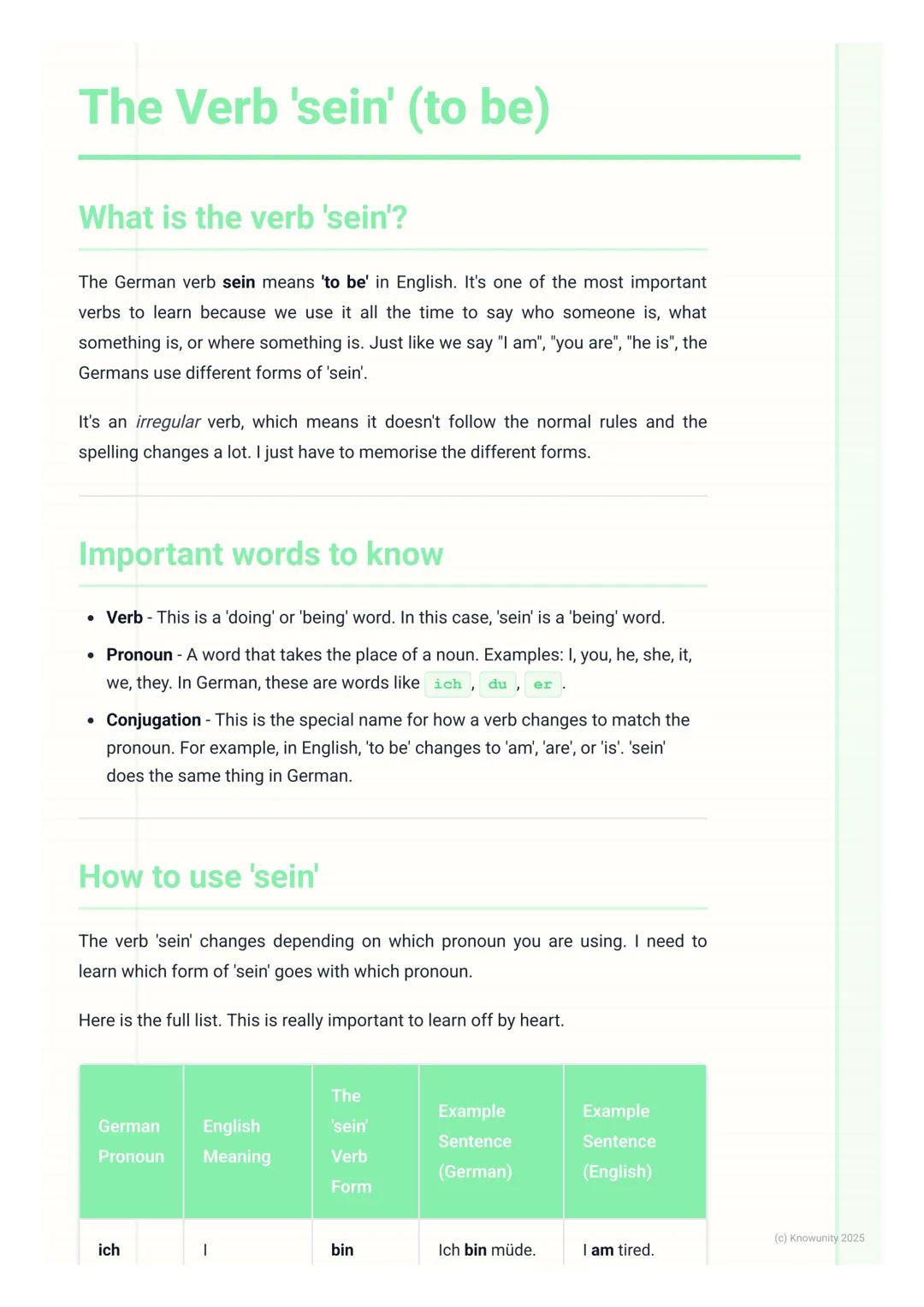
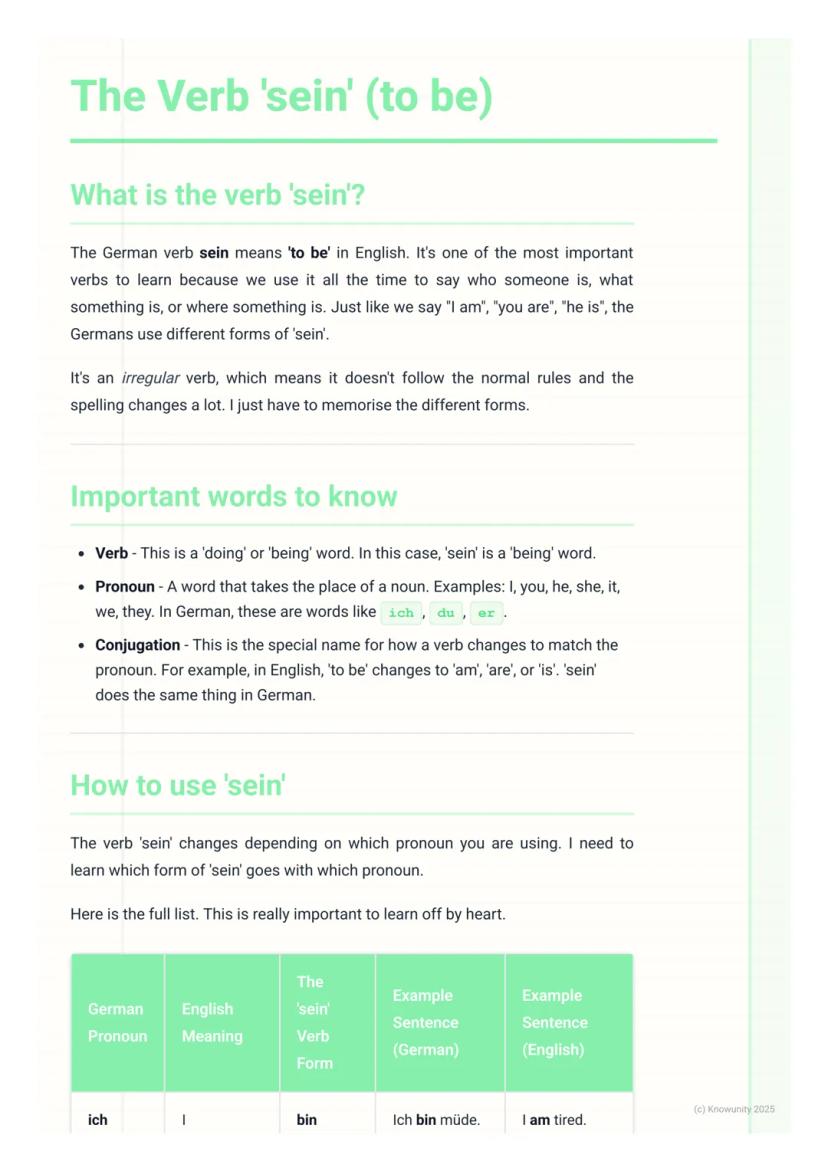
Understanding the Verb 'sein'
Think of sein as the building block of German - you'll use it constantly to describe yourself, others, and everything around you. Just like English changes "to be" into "am", "are", and "is", German does the same thing with sein, but with its own special patterns.
Here's the tricky bit: sein is an irregular verb, which means it doesn't follow normal rules and changes quite dramatically. There's no clever shortcut here - you've got to memorise each form, but once you do, you'll be chatting away in German!
💡 Quick tip: Don't worry about understanding why the forms change so much - even native German speakers just memorise them as children. Focus on learning the patterns rather than the grammar rules.
The key terms you need to know are conjugation (how verbs change to match different people) and pronouns (words like "I", "you", "he" that replace names).
2
of 4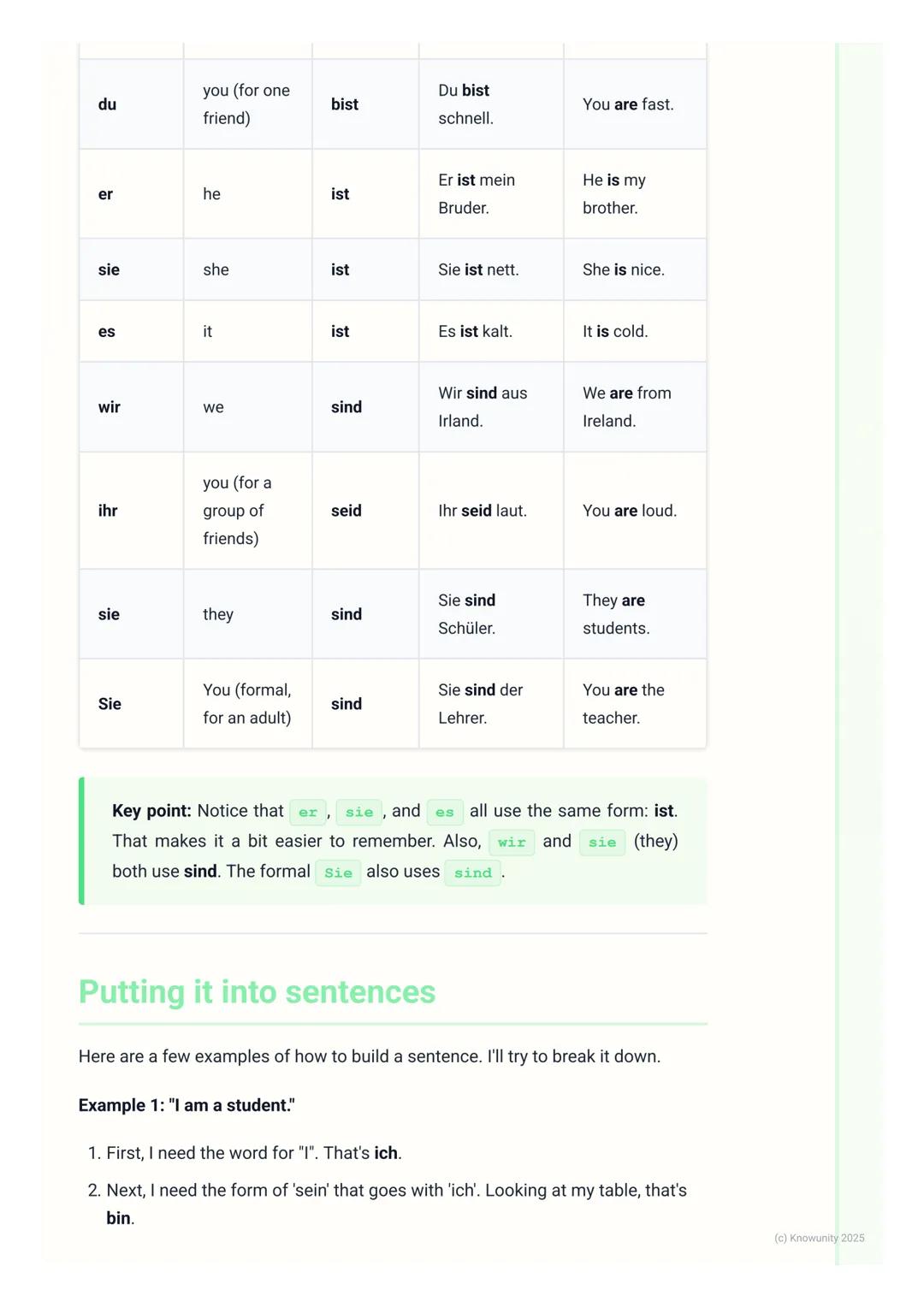
The Complete sein Table
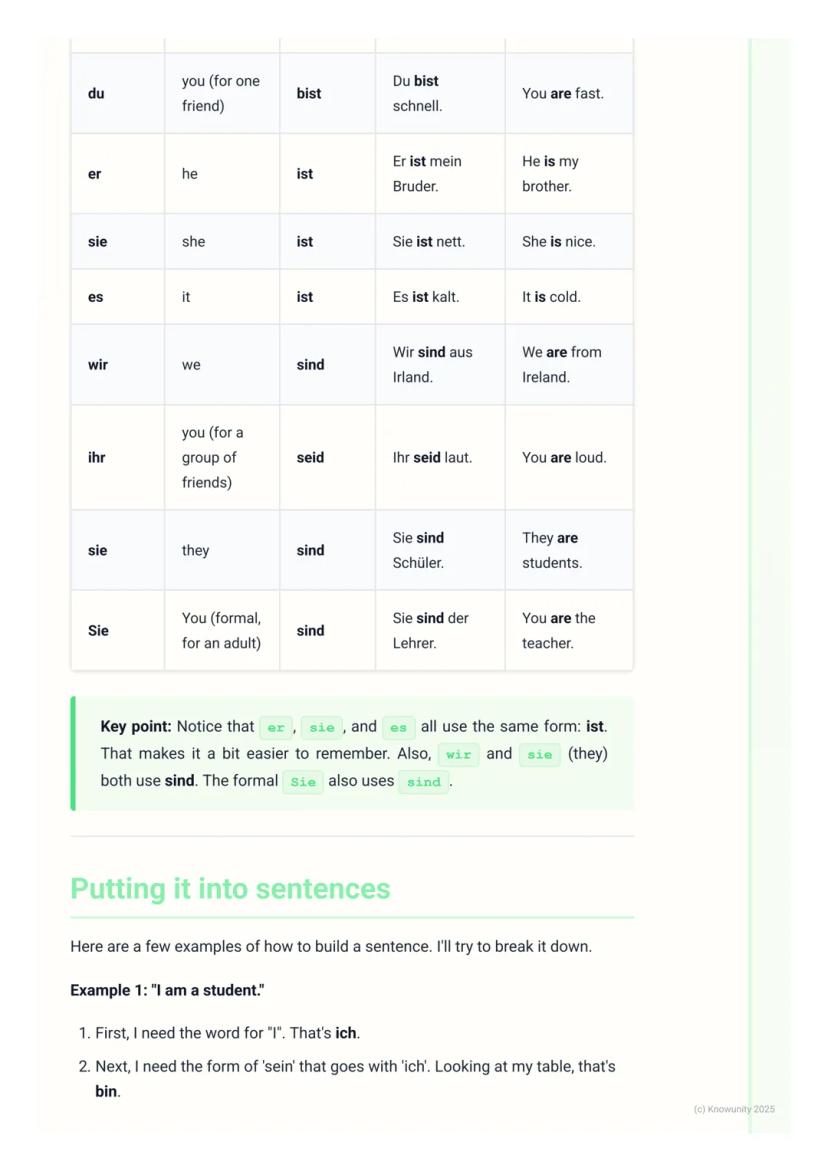
Here's the essential table you need to memorise - think of it as your German survival kit! Each German pronoun pairs with its specific form of sein, and there's no wiggling around this.
The good news? There are some helpful patterns hidden in the chaos. Notice that er, sie, and es all use ist - that's three pronouns sorted with one word. Similarly, wir and sie (they) both use sind, making your memorisation job a bit easier.
💡 Remember this: The formal Sie (for adults) also uses sind and always has a capital S, so you can spot it easily in writing.
Watch out for the trickiest pair: sind vs seid. Most students mix these up, but here's the secret - sind goes with "we" and "they", whilst seid is only for groups of friends (ihr).
3
of 4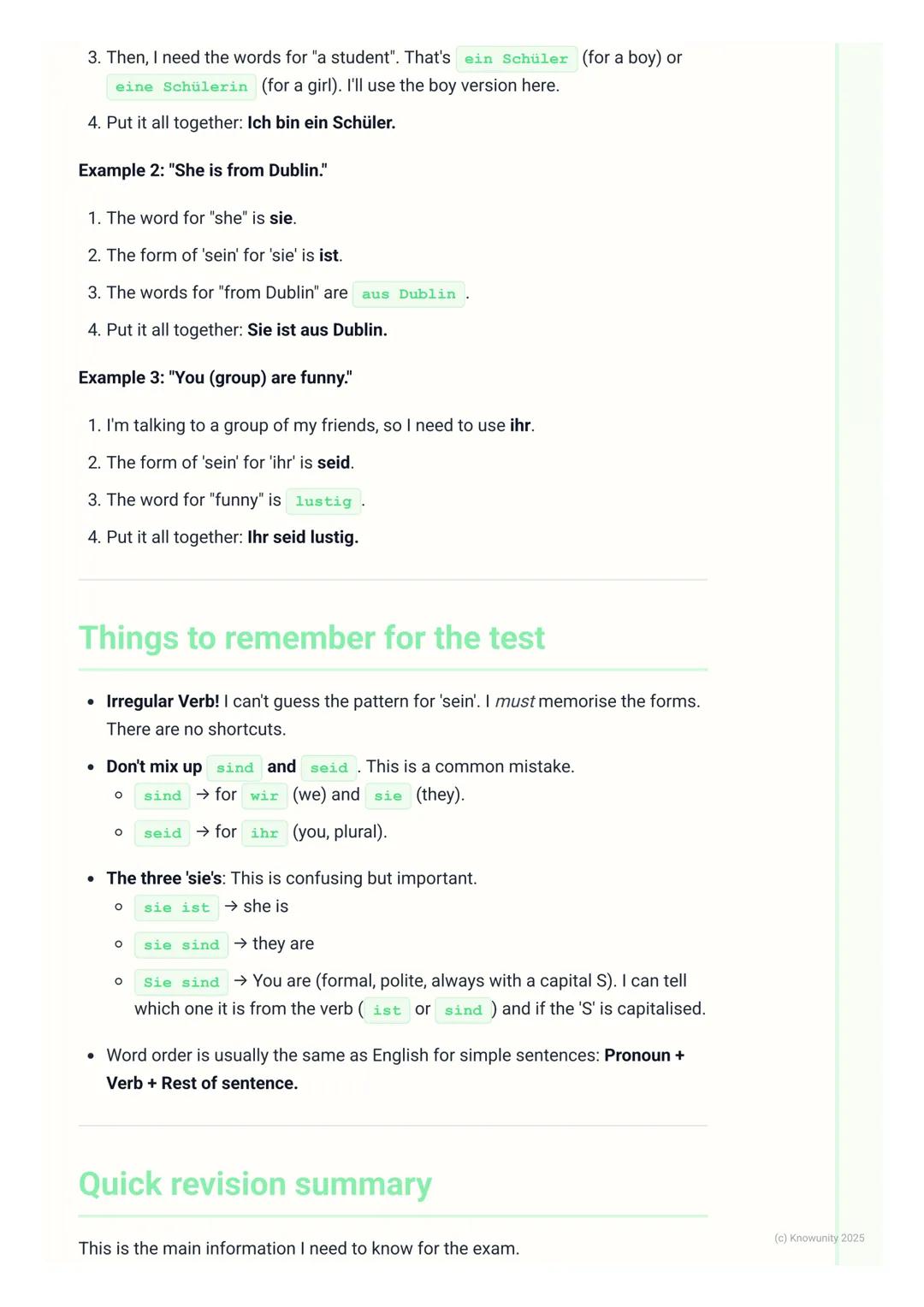
Building Your First German Sentences
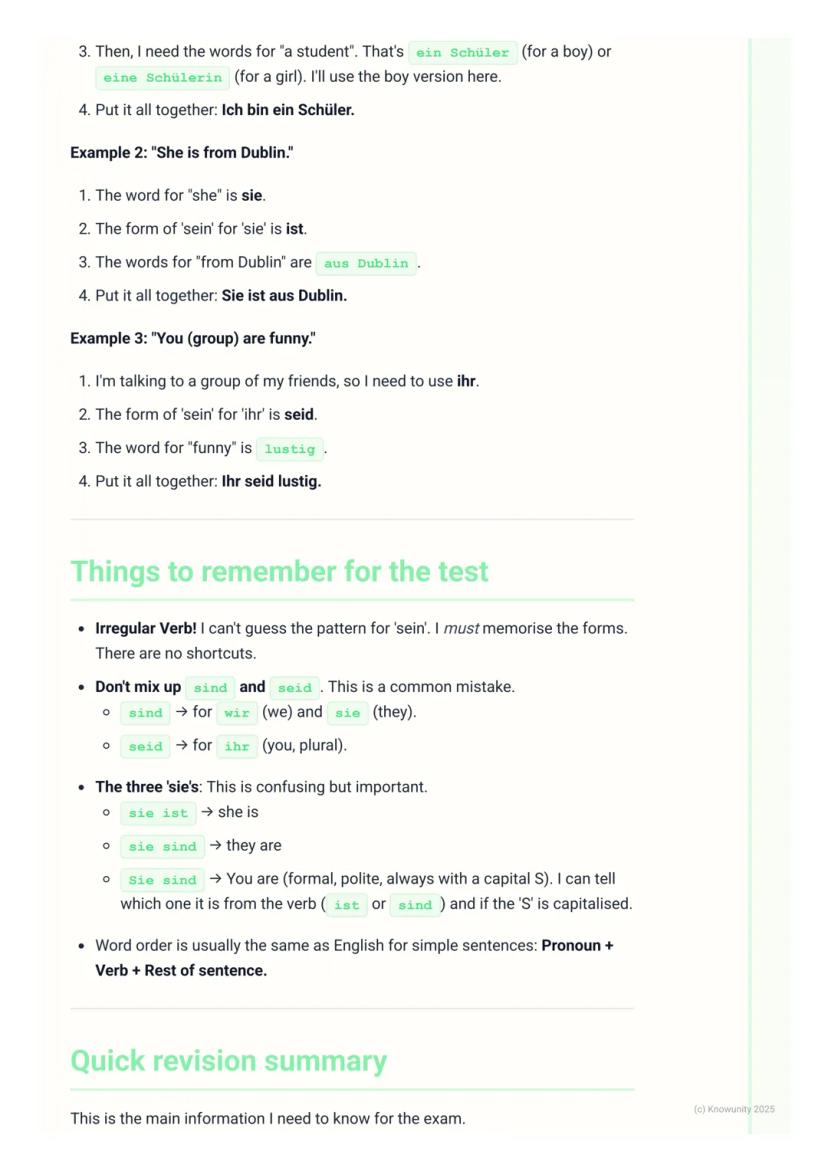
Now comes the fun part - putting your knowledge into action! German sentence structure follows the same pattern as English for basic sentences: pronoun + verb + rest of sentence.
Let's break down "Ich bin müde" (I am tired). Start with ich (I), add the matching form bin, then finish with müde (tired). See how straightforward that is?
For "Sie ist aus Dublin" (She is from Dublin), you follow the same pattern: sie (she) + ist (the form for she) + aus Dublin (from Dublin). Once you know the sein forms, sentence building becomes quite logical.
💡 Pro tip: Practice with simple sentences first. Don't worry about complex grammar yet - master the basic pattern and you'll gain confidence quickly.
4
of 4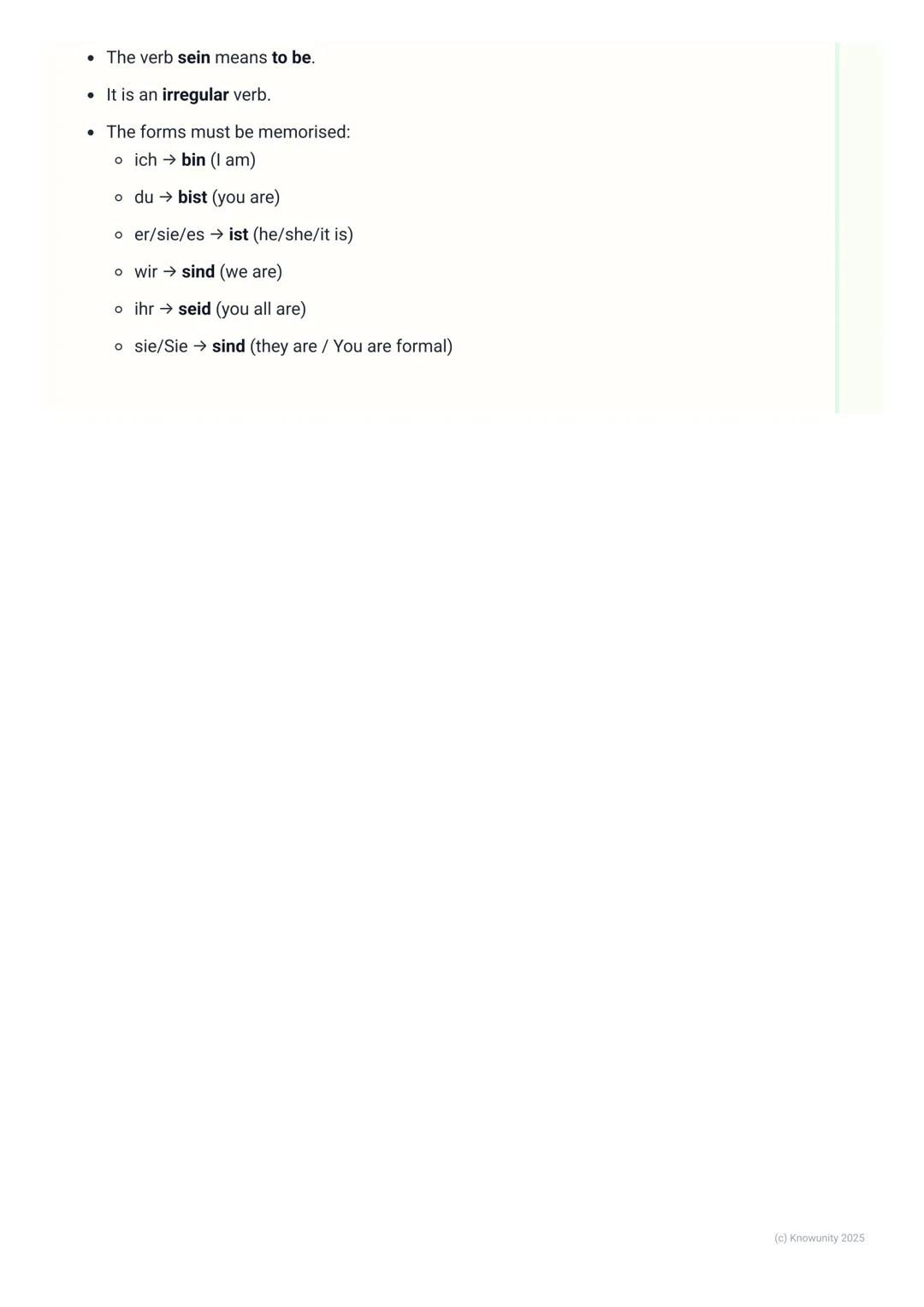
Test Success Strategies
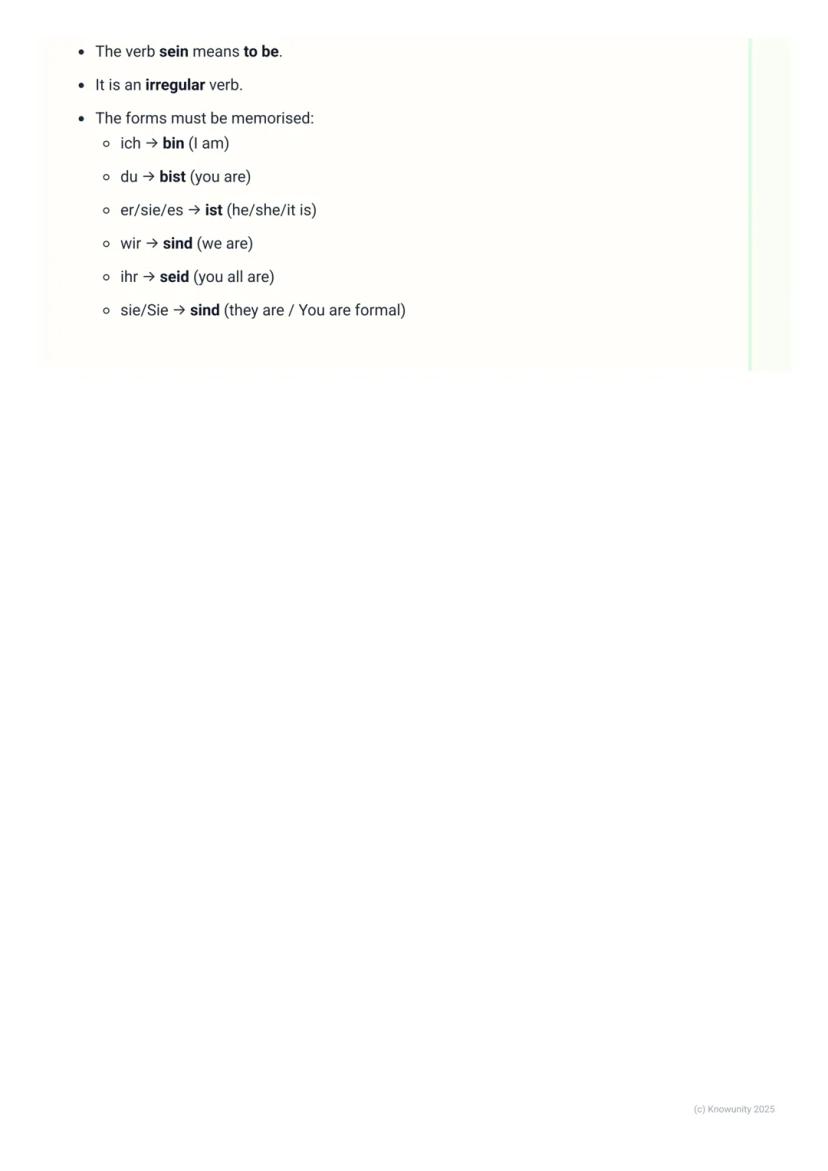
Your exam success depends on memorising those sein forms perfectly - there's simply no way around it. Create flashcards, practice daily, or make up silly songs, but make sure you know ich bin, du bist, er/sie/es ist, wir sind, ihr seid, sie/Sie sind by heart.
The biggest test trap is confusing the different meanings of sie. Remember: sie ist means "she is", sie sind means "they are", and Sie sind (capital S) means "You are" in formal situations.
💡 Final reminder: Don't panic if this feels overwhelming at first. Every German speaker has mastered these forms, and with consistent practice, you absolutely can too. Focus on one pronoun at a time and build up gradually.
Word order in basic sentences mirrors English, so you're already halfway there!
Azt hittük, soha nem fogod megkérdezni...
Mi a Knowunity MI társ?
MI Társunk egy diákközpontú MI eszköz, amely többet nyújt puszta válaszoknál. Millió Knowunity erőforrásra épülve releváns információkat, személyre szabott tanulási terveket, kvízeket és tartalmat biztosít közvetlenül a chatben, alkalmazkodva az egyéni tanulási utadhoz.
Honnan tudom letölteni a Knowunity appot?
Az appot letöltheted a Google Play Store-ból és az Apple App Store-ból.
Tényleg ingyenes a Knowunity?
Pontosan! Élvezd az ingyenes hozzáférést a tanulási tartalmakhoz, kapcsolódj diáktársaiddal, és kapj azonnali segítséget – mind a kezed ügyében.
Legnépszerűbb tananyagok German tantárgyból
2Legnépszerűbb tananyagok
9Nem találod amit keresel? Fedezz fel más tantárgyakat.
A diákok imádnak minket — és téged is fognak.
4.6/5App Store
4.7/5Google Play
Az alkalmazás nagyon könnyen használható és jól megtervezett. Mindent megtaláltam, amit eddig kerestem, és sokat tudtam tanulni a prezentációkból! Biztosan használni fogom az alkalmazást egy osztályfeladathoz! És persze inspirációként is nagyszerűen segít.
Stefan SiOS felhasználó
Ez az alkalmazás tényleg nagyszerű. Olyan sok tanulási jegyzet és segítség van benne [...]. Például a francia a problémás tantárgyam, és az alkalmazásban olyan sok segítség lehetőség van. Ennek az alkalmazásnak köszönhetően javult a franciám. Mindenkinek ajánlanám.
Samantha KlichAndroid felhasználó
Hű, tényleg lenyűgözött. Csak úgy kipróbáltam az alkalmazást, mert sokszor láttam reklámozva, és teljesen megdöbbentett. Ez az alkalmazás AZ A SEGÍTSÉG, amire az iskolában szükséged van, és mindenekelőtt olyan sok mindent kínál, mint például gyakorlatokat és összefoglalókat, amik nekem személyesen NAGYON hasznosak voltak.
AnnaiOS felhasználó
German6 megtekintések·Frissítve May 30, 2026·4 oldalMastering the German Verb 'sein' - Conjugation Made Simple
Ever wondered how to say "I am" or "you are" in German? The verb sein (to be) is your gateway to building basic German sentences and it's absolutely essential for any conversation.
1
of 4
Regisztrálj, hogy lásd a tartalmat. Teljesen ingyenes!
- Hozzáférés minden dokumentumhoz
- Javítsd a jegyeidet
- Csatlakozz diákok millióihoz
Understanding the Verb 'sein'
Think of sein as the building block of German - you'll use it constantly to describe yourself, others, and everything around you. Just like English changes "to be" into "am", "are", and "is", German does the same thing with sein, but with its own special patterns.
Here's the tricky bit: sein is an irregular verb, which means it doesn't follow normal rules and changes quite dramatically. There's no clever shortcut here - you've got to memorise each form, but once you do, you'll be chatting away in German!
💡 Quick tip: Don't worry about understanding why the forms change so much - even native German speakers just memorise them as children. Focus on learning the patterns rather than the grammar rules.
The key terms you need to know are conjugation (how verbs change to match different people) and pronouns (words like "I", "you", "he" that replace names).
2
of 4Regisztrálj, hogy lásd a tartalmat. Teljesen ingyenes!
- Hozzáférés minden dokumentumhoz
- Javítsd a jegyeidet
- Csatlakozz diákok millióihoz
The Complete sein Table
Here's the essential table you need to memorise - think of it as your German survival kit! Each German pronoun pairs with its specific form of sein, and there's no wiggling around this.
The good news? There are some helpful patterns hidden in the chaos. Notice that er, sie, and es all use ist - that's three pronouns sorted with one word. Similarly, wir and sie (they) both use sind, making your memorisation job a bit easier.
💡 Remember this: The formal Sie (for adults) also uses sind and always has a capital S, so you can spot it easily in writing.
Watch out for the trickiest pair: sind vs seid. Most students mix these up, but here's the secret - sind goes with "we" and "they", whilst seid is only for groups of friends (ihr).
3
of 4Regisztrálj, hogy lásd a tartalmat. Teljesen ingyenes!
- Hozzáférés minden dokumentumhoz
- Javítsd a jegyeidet
- Csatlakozz diákok millióihoz
Building Your First German Sentences
Now comes the fun part - putting your knowledge into action! German sentence structure follows the same pattern as English for basic sentences: pronoun + verb + rest of sentence.
Let's break down "Ich bin müde" (I am tired). Start with ich (I), add the matching form bin, then finish with müde (tired). See how straightforward that is?
For "Sie ist aus Dublin" (She is from Dublin), you follow the same pattern: sie (she) + ist (the form for she) + aus Dublin (from Dublin). Once you know the sein forms, sentence building becomes quite logical.
💡 Pro tip: Practice with simple sentences first. Don't worry about complex grammar yet - master the basic pattern and you'll gain confidence quickly.
4
of 4Regisztrálj, hogy lásd a tartalmat. Teljesen ingyenes!
- Hozzáférés minden dokumentumhoz
- Javítsd a jegyeidet
- Csatlakozz diákok millióihoz
Test Success Strategies
Your exam success depends on memorising those sein forms perfectly - there's simply no way around it. Create flashcards, practice daily, or make up silly songs, but make sure you know ich bin, du bist, er/sie/es ist, wir sind, ihr seid, sie/Sie sind by heart.
The biggest test trap is confusing the different meanings of sie. Remember: sie ist means "she is", sie sind means "they are", and Sie sind (capital S) means "You are" in formal situations.
💡 Final reminder: Don't panic if this feels overwhelming at first. Every German speaker has mastered these forms, and with consistent practice, you absolutely can too. Focus on one pronoun at a time and build up gradually.
Word order in basic sentences mirrors English, so you're already halfway there!
Azt hittük, soha nem fogod megkérdezni...
Mi a Knowunity MI társ?
MI Társunk egy diákközpontú MI eszköz, amely többet nyújt puszta válaszoknál. Millió Knowunity erőforrásra épülve releváns információkat, személyre szabott tanulási terveket, kvízeket és tartalmat biztosít közvetlenül a chatben, alkalmazkodva az egyéni tanulási utadhoz.
Honnan tudom letölteni a Knowunity appot?
Az appot letöltheted a Google Play Store-ból és az Apple App Store-ból.
Tényleg ingyenes a Knowunity?
Pontosan! Élvezd az ingyenes hozzáférést a tanulási tartalmakhoz, kapcsolódj diáktársaiddal, és kapj azonnali segítséget – mind a kezed ügyében.
Legnépszerűbb tananyagok German tantárgyból
2Legnépszerűbb tananyagok
9Nem találod amit keresel? Fedezz fel más tantárgyakat.
A diákok imádnak minket — és téged is fognak.
4.6/5App Store
4.7/5Google Play
Az alkalmazás nagyon könnyen használható és jól megtervezett. Mindent megtaláltam, amit eddig kerestem, és sokat tudtam tanulni a prezentációkból! Biztosan használni fogom az alkalmazást egy osztályfeladathoz! És persze inspirációként is nagyszerűen segít.
Stefan SiOS felhasználó
Ez az alkalmazás tényleg nagyszerű. Olyan sok tanulási jegyzet és segítség van benne [...]. Például a francia a problémás tantárgyam, és az alkalmazásban olyan sok segítség lehetőség van. Ennek az alkalmazásnak köszönhetően javult a franciám. Mindenkinek ajánlanám.
Samantha KlichAndroid felhasználó
Hű, tényleg lenyűgözött. Csak úgy kipróbáltam az alkalmazást, mert sokszor láttam reklámozva, és teljesen megdöbbentett. Ez az alkalmazás AZ A SEGÍTSÉG, amire az iskolában szükséged van, és mindenekelőtt olyan sok mindent kínál, mint például gyakorlatokat és összefoglalókat, amik nekem személyesen NAGYON hasznosak voltak.
AnnaiOS felhasználó