
Learning the German verb 'haben' (to have) is absolutely essential...
 German4 megtekintések·Frissítve Jun 7, 2026·4 oldal
Mastering the German Verb 'haben' (to have)


1 / 4
1
of 4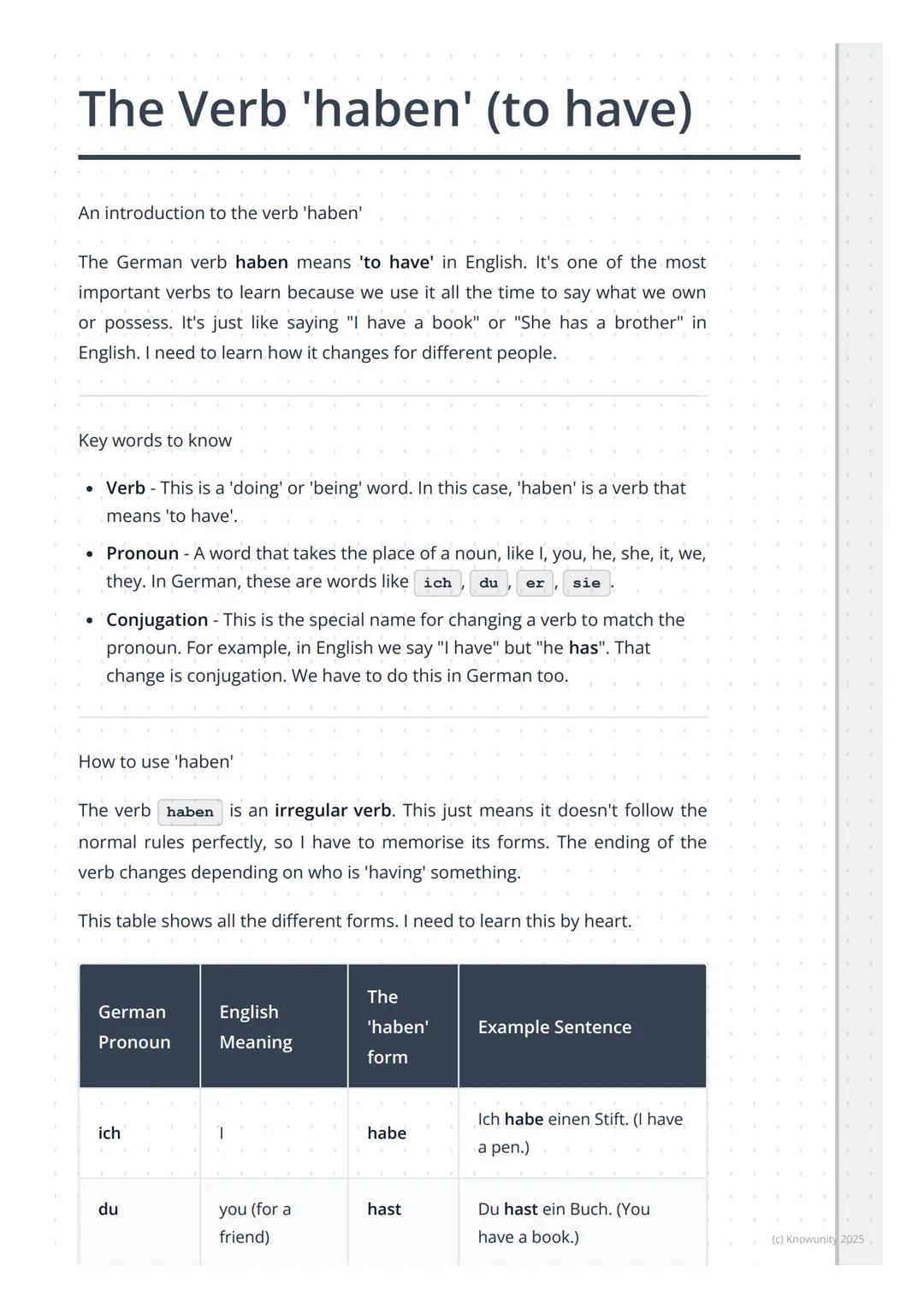
What is 'haben' and why does it matter?
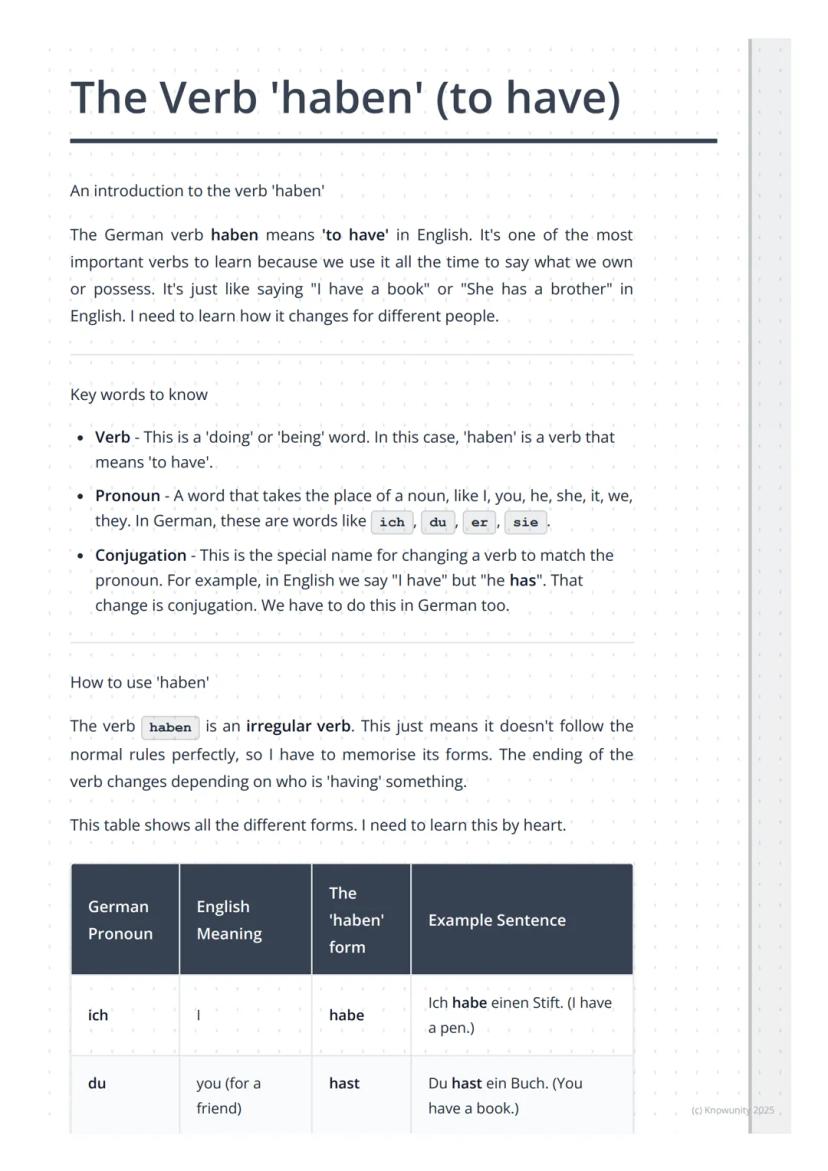
The German verb haben means 'to have' in English, and you'll use it loads to talk about what you own or possess. Think "I have a phone" or "My mate has a new bike" - that's haben in action!
Here's the thing though - haben is an irregular verb. This means it doesn't follow the normal patterns, so you can't just guess the endings. You've got to memorise how it changes for different people.
The key terms you need to know are conjugation (when verbs change to match different people) and pronouns (words like I, you, he, she). In German, these are ich, du, er, sie, and so on.
Quick Tip: Don't worry if this feels tricky at first - even native German speakers had to learn these patterns when they were young!
2
of 4
The haben forms you absolutely must know
The three most important forms are the irregular ones that break the rules. Let's focus on these first: ich habe (I have), du hast (you have), and er/sie/es hat .
Notice how 'du hast' loses the 'b' completely - it's not 'du habst'! And 'hat' is super short compared to the original 'haben'. These two are the trickiest because they're so different.
The easier ones to remember are wir haben (we have) and sie haben (they have) because they stay the same as the original verb. There's also ihr habt (you all have), which just adds a 't' on the end.
Memory Trick: Think "Du HAST to remember this one!" for the du form - it's the most common mistake students make.
3
of 4
Building sentences with haben
Let's put this into practice with real examples you might actually use! When saying "I have a cat", start with ich (I), then habe (have), then eine Katze (a cat). Simple as that: "Ich habe eine Katze."
For questions, flip the order around. Instead of "Du hast einen Stift" (You have a pen), ask "Hast du einen Stift?" (Do you have a pen?). The verb jumps to the front in German questions.
When talking about someone else, like "She has a brother", use sie hat einen Bruder. Remember, it's 'hat' not 'hast' because you're talking about her, not to her directly.
Pro Tip: Practice by describing what people in your class have - "Emma hat ein neues Handy" or "Wir haben Mathe heute."
4
of 4
Avoiding the most common mistakes
The biggest mistake is mixing up du hast and er hat. Remember: if you're talking TO someone (like your mate), use 'hast'. If you're talking ABOUT someone (like your teacher), use 'hat'.
Don't confuse ihr habt (you all have) with er hat (he has) either. 'Ihr' is when you're talking to a whole group of friends, whilst 'er' is just one person you're talking about.
Here's your quick revision list: ich habe, du hast, er/sie/es hat, wir haben, ihr habt, sie haben. The irregular ones (hast and hat) are your priority - get these rock solid first!
Test Prep: Make flashcards with just the tricky forms and quiz yourself daily until they're automatic.
Azt hittük, soha nem fogod megkérdezni...
Mi a Knowunity MI társ?
MI Társunk egy diákközpontú MI eszköz, amely többet nyújt puszta válaszoknál. Millió Knowunity erőforrásra épülve releváns információkat, személyre szabott tanulási terveket, kvízeket és tartalmat biztosít közvetlenül a chatben, alkalmazkodva az egyéni tanulási utadhoz.
Honnan tudom letölteni a Knowunity appot?
Az appot letöltheted a Google Play Store-ból és az Apple App Store-ból.
Tényleg ingyenes a Knowunity?
Pontosan! Élvezd az ingyenes hozzáférést a tanulási tartalmakhoz, kapcsolódj diáktársaiddal, és kapj azonnali segítséget – mind a kezed ügyében.
Legnépszerűbb tananyagok German tantárgyból
2Legnépszerűbb tananyagok
9 Irish
IrishIrish oral questions and answers
Questions and answers for the leaving cert oral
5th Year4264
 English
Key Quotes : Sive
Key Quotes and explanations: Sive
6th Year2842
IrishIrish oral questions
Outline of oral questions
5th Year2055
IrishIníon- le hÁine Durkin
Aine Durkin’s poem, Iníon: Themes & summary
5th Year890
IrishIrish poetry 2027
Iníon + Dínit an Bhróin
5th Year1153
IrishLC HL notes- Iníon (poem)
Includes poem in English and Irish, theme, key words & phrases
5th Year2304
EnglishCultural Context : Shawshank Redemption : Sive : Small Things Like These
Comparative Study : Cultural Context : Shawshank Redemption, Sive and Small Things Like These
6th Year1430
IrishMo Ghrá-sa (Idir Lúibíní)
Notes on mo ghrá-sa
5th Year380
IrishAn Gaeilge Aiste
Irish Language essay
6th Year1320
Nem találod amit keresel? Fedezz fel más tantárgyakat.
A diákok imádnak minket — és téged is fognak.
4.6/5App Store
4.7/5Google Play
Az alkalmazás nagyon könnyen használható és jól megtervezett. Mindent megtaláltam, amit eddig kerestem, és sokat tudtam tanulni a prezentációkból! Biztosan használni fogom az alkalmazást egy osztályfeladathoz! És persze inspirációként is nagyszerűen segít.
Stefan SiOS felhasználó
Ez az alkalmazás tényleg nagyszerű. Olyan sok tanulási jegyzet és segítség van benne [...]. Például a francia a problémás tantárgyam, és az alkalmazásban olyan sok segítség lehetőség van. Ennek az alkalmazásnak köszönhetően javult a franciám. Mindenkinek ajánlanám.
Samantha KlichAndroid felhasználó
Hű, tényleg lenyűgözött. Csak úgy kipróbáltam az alkalmazást, mert sokszor láttam reklámozva, és teljesen megdöbbentett. Ez az alkalmazás AZ A SEGÍTSÉG, amire az iskolában szükséged van, és mindenekelőtt olyan sok mindent kínál, mint például gyakorlatokat és összefoglalókat, amik nekem személyesen NAGYON hasznosak voltak.
AnnaiOS felhasználó
German4 megtekintések·Frissítve Jun 7, 2026·4 oldalMastering the German Verb 'haben' (to have)
Learning the German verb 'haben' (to have) is absolutely essential - you'll use it constantly! Just like in English where we say "I have" but "she has", German verbs change their endings depending on who's doing the action.
1
of 4
Regisztrálj, hogy lásd a tartalmat. Teljesen ingyenes!
- Hozzáférés minden dokumentumhoz
- Javítsd a jegyeidet
- Csatlakozz diákok millióihoz
What is 'haben' and why does it matter?
The German verb haben means 'to have' in English, and you'll use it loads to talk about what you own or possess. Think "I have a phone" or "My mate has a new bike" - that's haben in action!
Here's the thing though - haben is an irregular verb. This means it doesn't follow the normal patterns, so you can't just guess the endings. You've got to memorise how it changes for different people.
The key terms you need to know are conjugation (when verbs change to match different people) and pronouns (words like I, you, he, she). In German, these are ich, du, er, sie, and so on.
Quick Tip: Don't worry if this feels tricky at first - even native German speakers had to learn these patterns when they were young!
2
of 4Regisztrálj, hogy lásd a tartalmat. Teljesen ingyenes!
- Hozzáférés minden dokumentumhoz
- Javítsd a jegyeidet
- Csatlakozz diákok millióihoz
The haben forms you absolutely must know
The three most important forms are the irregular ones that break the rules. Let's focus on these first: ich habe (I have), du hast (you have), and er/sie/es hat .
Notice how 'du hast' loses the 'b' completely - it's not 'du habst'! And 'hat' is super short compared to the original 'haben'. These two are the trickiest because they're so different.
The easier ones to remember are wir haben (we have) and sie haben (they have) because they stay the same as the original verb. There's also ihr habt (you all have), which just adds a 't' on the end.
Memory Trick: Think "Du HAST to remember this one!" for the du form - it's the most common mistake students make.
3
of 4Regisztrálj, hogy lásd a tartalmat. Teljesen ingyenes!
- Hozzáférés minden dokumentumhoz
- Javítsd a jegyeidet
- Csatlakozz diákok millióihoz
Building sentences with haben
Let's put this into practice with real examples you might actually use! When saying "I have a cat", start with ich (I), then habe (have), then eine Katze (a cat). Simple as that: "Ich habe eine Katze."
For questions, flip the order around. Instead of "Du hast einen Stift" (You have a pen), ask "Hast du einen Stift?" (Do you have a pen?). The verb jumps to the front in German questions.
When talking about someone else, like "She has a brother", use sie hat einen Bruder. Remember, it's 'hat' not 'hast' because you're talking about her, not to her directly.
Pro Tip: Practice by describing what people in your class have - "Emma hat ein neues Handy" or "Wir haben Mathe heute."
4
of 4Regisztrálj, hogy lásd a tartalmat. Teljesen ingyenes!
- Hozzáférés minden dokumentumhoz
- Javítsd a jegyeidet
- Csatlakozz diákok millióihoz
Avoiding the most common mistakes
The biggest mistake is mixing up du hast and er hat. Remember: if you're talking TO someone (like your mate), use 'hast'. If you're talking ABOUT someone (like your teacher), use 'hat'.
Don't confuse ihr habt (you all have) with er hat (he has) either. 'Ihr' is when you're talking to a whole group of friends, whilst 'er' is just one person you're talking about.
Here's your quick revision list: ich habe, du hast, er/sie/es hat, wir haben, ihr habt, sie haben. The irregular ones (hast and hat) are your priority - get these rock solid first!
Test Prep: Make flashcards with just the tricky forms and quiz yourself daily until they're automatic.
Azt hittük, soha nem fogod megkérdezni...
Mi a Knowunity MI társ?
MI Társunk egy diákközpontú MI eszköz, amely többet nyújt puszta válaszoknál. Millió Knowunity erőforrásra épülve releváns információkat, személyre szabott tanulási terveket, kvízeket és tartalmat biztosít közvetlenül a chatben, alkalmazkodva az egyéni tanulási utadhoz.
Honnan tudom letölteni a Knowunity appot?
Az appot letöltheted a Google Play Store-ból és az Apple App Store-ból.
Tényleg ingyenes a Knowunity?
Pontosan! Élvezd az ingyenes hozzáférést a tanulási tartalmakhoz, kapcsolódj diáktársaiddal, és kapj azonnali segítséget – mind a kezed ügyében.
Legnépszerűbb tananyagok German tantárgyból
2Legnépszerűbb tananyagok
9IrishIrish oral questions and answers
Questions and answers for the leaving cert oral
5th Year4264
EnglishKey Quotes : Sive
Key Quotes and explanations: Sive
6th Year2842
IrishIrish oral questions
Outline of oral questions
5th Year2055
IrishIníon- le hÁine Durkin
Aine Durkin’s poem, Iníon: Themes & summary
5th Year890
IrishIrish poetry 2027
Iníon + Dínit an Bhróin
5th Year1153
IrishLC HL notes- Iníon (poem)
Includes poem in English and Irish, theme, key words & phrases
5th Year2304
EnglishCultural Context : Shawshank Redemption : Sive : Small Things Like These
Comparative Study : Cultural Context : Shawshank Redemption, Sive and Small Things Like These
6th Year1430
IrishMo Ghrá-sa (Idir Lúibíní)
Notes on mo ghrá-sa
5th Year380
IrishAn Gaeilge Aiste
Irish Language essay
6th Year1320
Nem találod amit keresel? Fedezz fel más tantárgyakat.
A diákok imádnak minket — és téged is fognak.
4.6/5App Store
4.7/5Google Play
Az alkalmazás nagyon könnyen használható és jól megtervezett. Mindent megtaláltam, amit eddig kerestem, és sokat tudtam tanulni a prezentációkból! Biztosan használni fogom az alkalmazást egy osztályfeladathoz! És persze inspirációként is nagyszerűen segít.
Stefan SiOS felhasználó
Ez az alkalmazás tényleg nagyszerű. Olyan sok tanulási jegyzet és segítség van benne [...]. Például a francia a problémás tantárgyam, és az alkalmazásban olyan sok segítség lehetőség van. Ennek az alkalmazásnak köszönhetően javult a franciám. Mindenkinek ajánlanám.
Samantha KlichAndroid felhasználó
Hű, tényleg lenyűgözött. Csak úgy kipróbáltam az alkalmazást, mert sokszor láttam reklámozva, és teljesen megdöbbentett. Ez az alkalmazás AZ A SEGÍTSÉG, amire az iskolában szükséged van, és mindenekelőtt olyan sok mindent kínál, mint például gyakorlatokat és összefoglalókat, amik nekem személyesen NAGYON hasznosak voltak.
AnnaiOS felhasználó