
Ever wonder why washing-up liquid actually works on greasy dishes,... Továbbiak megjelenítése
 Chemistry12 megtekintések·Frissítve Jun 13, 2026·6 oldal
Cleaning Products and Personal Care Explained
1 / 6
1
of 6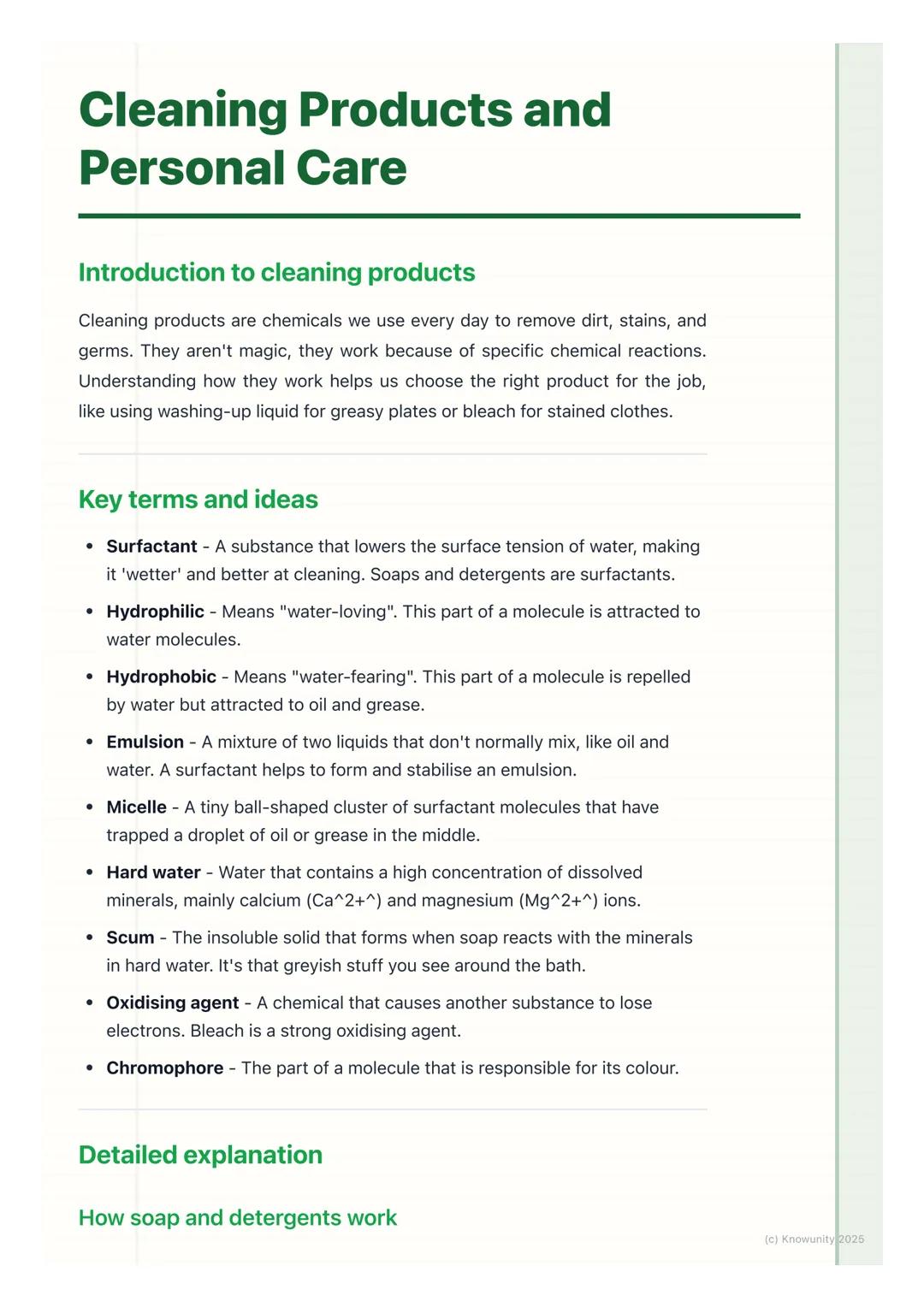
Introduction to Cleaning Products
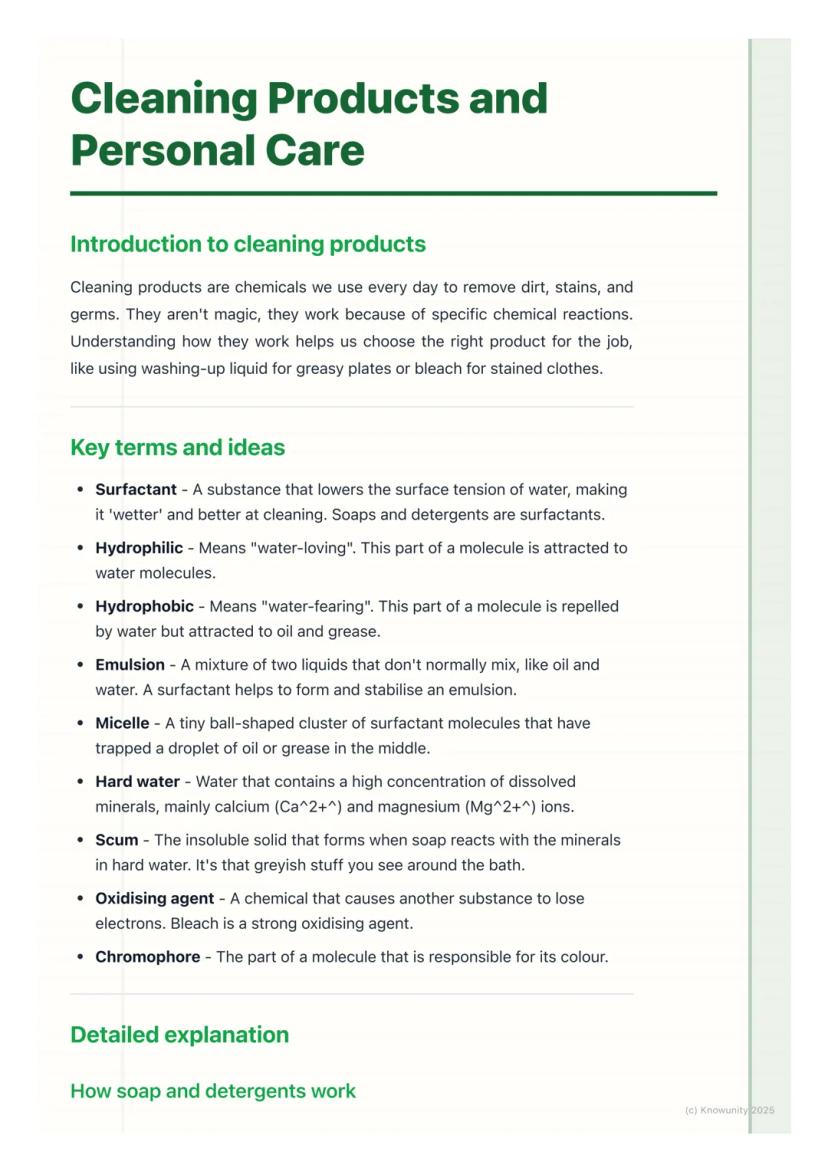
Cleaning products work because of specific chemical reactions, not magic tricks. Each type targets different kinds of mess - you wouldn't use bleach on grease or washing-up liquid on limescale.
The key to understanding cleaning is knowing about surfactants - substances that make water "wetter" and better at cleaning. These clever molecules have two very different ends that don't normally get along.
Important terms you'll need to know: hydrophilic , hydrophobic , emulsion (oil and water mixture), micelles (tiny soap bubbles that trap grease), hard water (water with lots of dissolved minerals), and chromophores (the parts of molecules that create colour).
Quick Tip: Think of surfactants as molecular matchmakers - they help water and grease get along when they normally hate each other!
2
of 6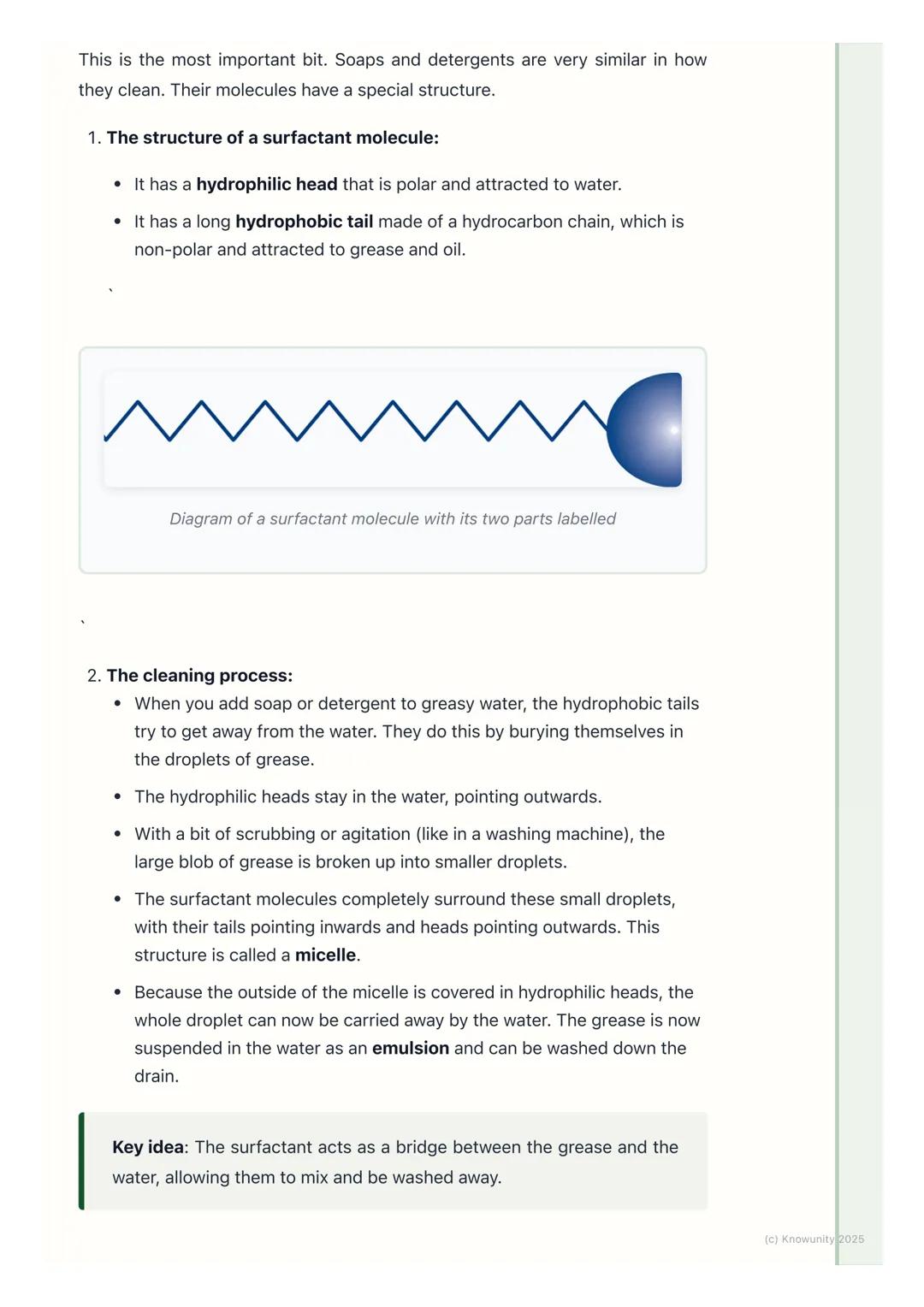
How Soap and Detergents Work
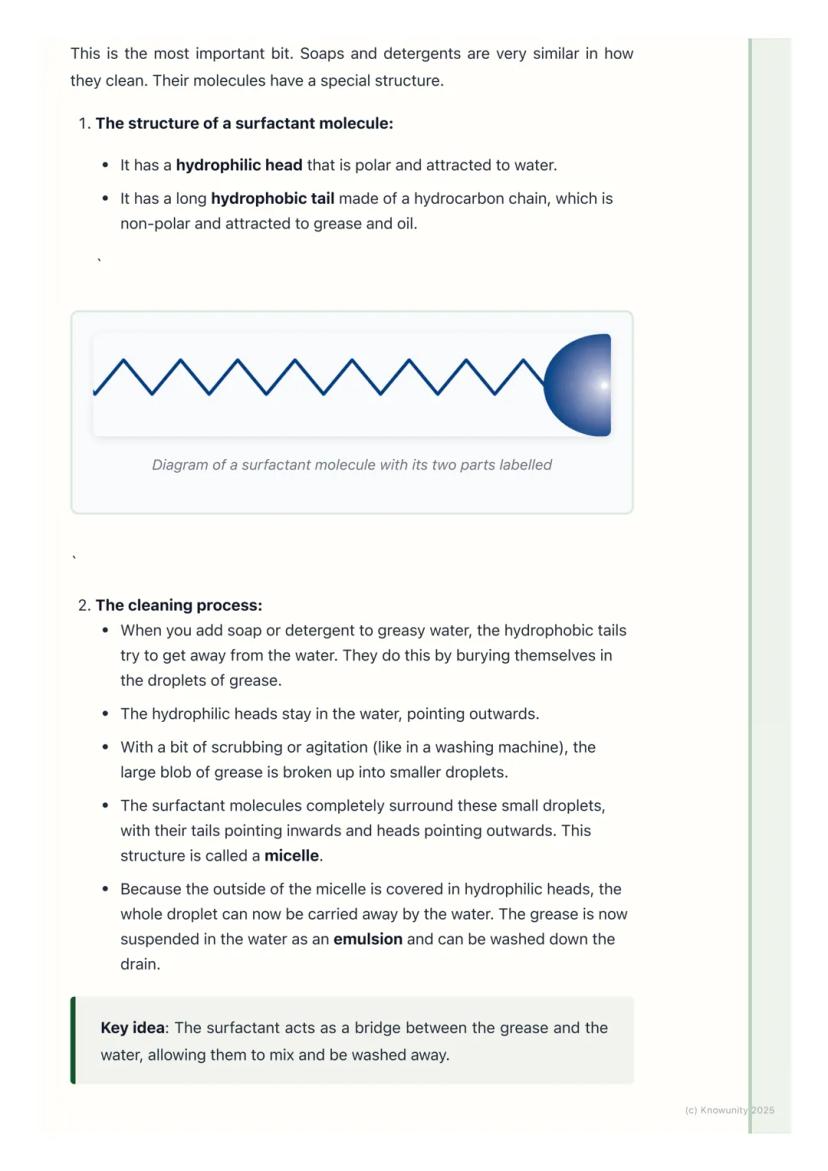
Here's the brilliant bit about surfactant molecules - they're like tiny molecular scissors with two completely different ends. One end (the hydrophilic head) loves water and is polar, while the other end (the hydrophobic tail) is a long hydrocarbon chain that's attracted to grease and oil.
When you add soap to greasy water, something amazing happens. The hydrophobic tails dive into the grease droplets to escape the water, while the hydrophilic heads stay pointing out into the water.
With a bit of scrubbing, large grease blobs break into smaller droplets that get completely surrounded by surfactant molecules - creating micelles. Because the outside of each micelle is covered in water-loving heads, the whole greasy mess can now be carried away by water as an emulsion.
Remember This: The surfactant acts like a bridge between grease and water, letting them mix and wash away together!
3
of 6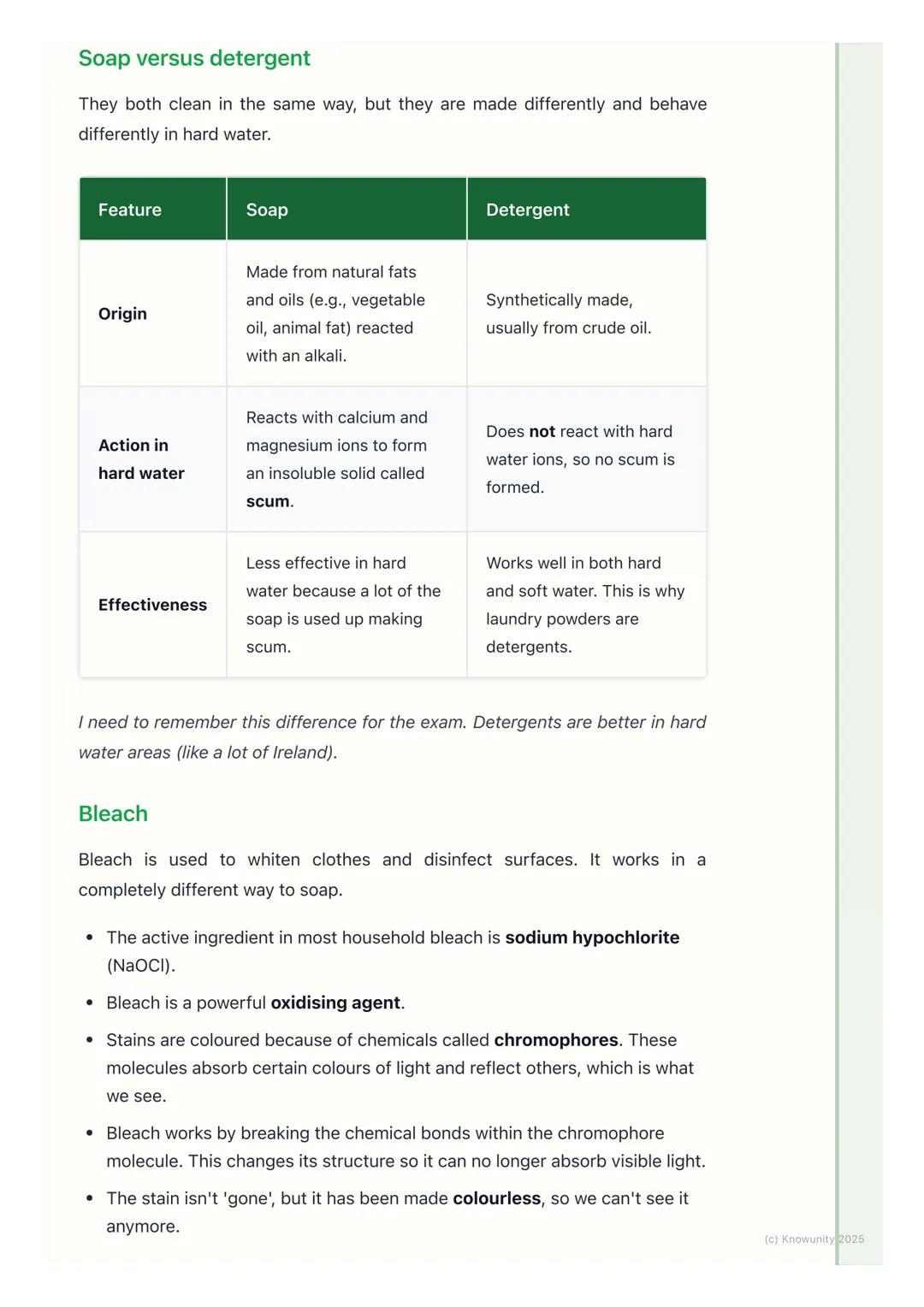
Soap vs Detergent
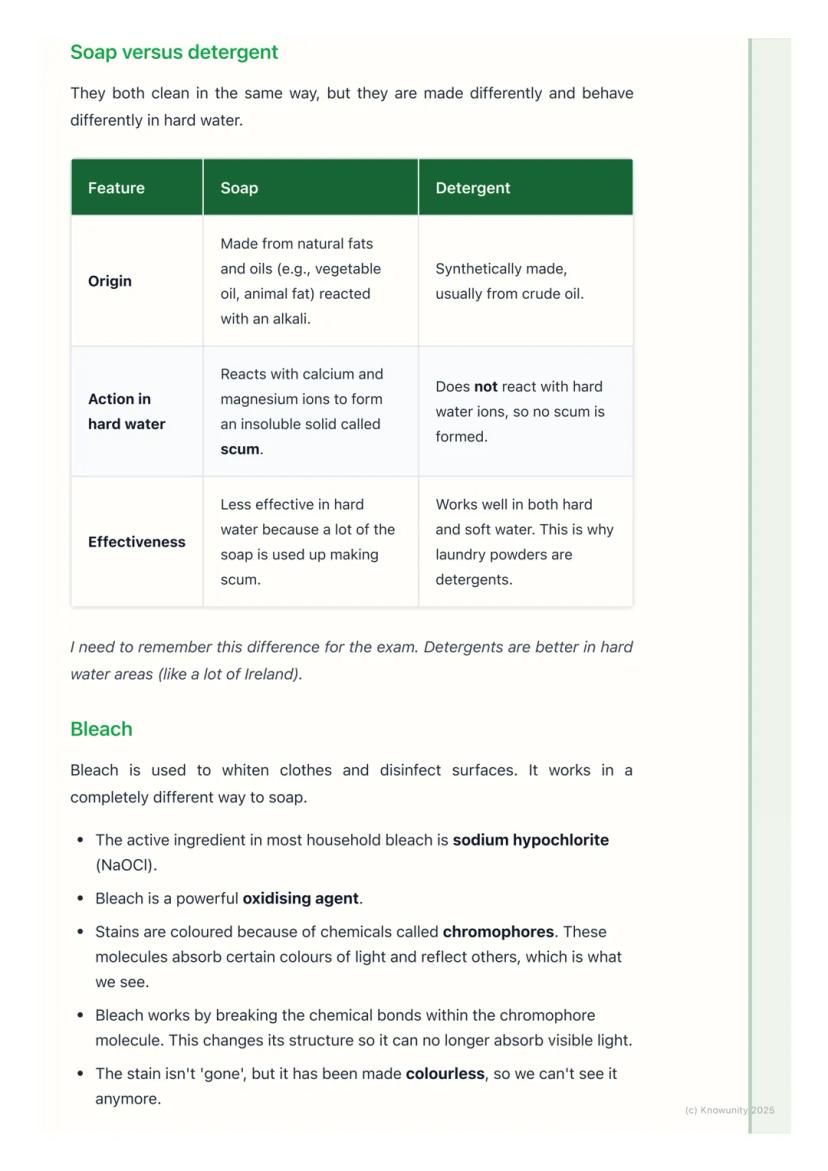
Both clean the same way, but they behave very differently in hard water - which is common in Ireland. Soap comes from natural fats and oils mixed with alkali, whilst detergent is synthetically made from crude oil.
The crucial difference happens in hard water. Soap reacts with calcium and magnesium ions to form scum - that greyish stuff around your bath. Much of your soap gets wasted making this insoluble mess instead of cleaning.
Detergents don't react with hard water minerals at all, so no scum forms. They work brilliantly in both hard and soft water, which is why your washing powder is a detergent, not soap.
Bleach works completely differently from soap. The active ingredient sodium hypochlorite is a powerful oxidising agent that breaks chemical bonds in chromophore molecules. It doesn't remove stains - it makes them colourless by changing their structure so they can't absorb visible light anymore.
Exam Essential: In hard water areas, detergents clean better than soap because they don't waste energy making scum!
4
of 6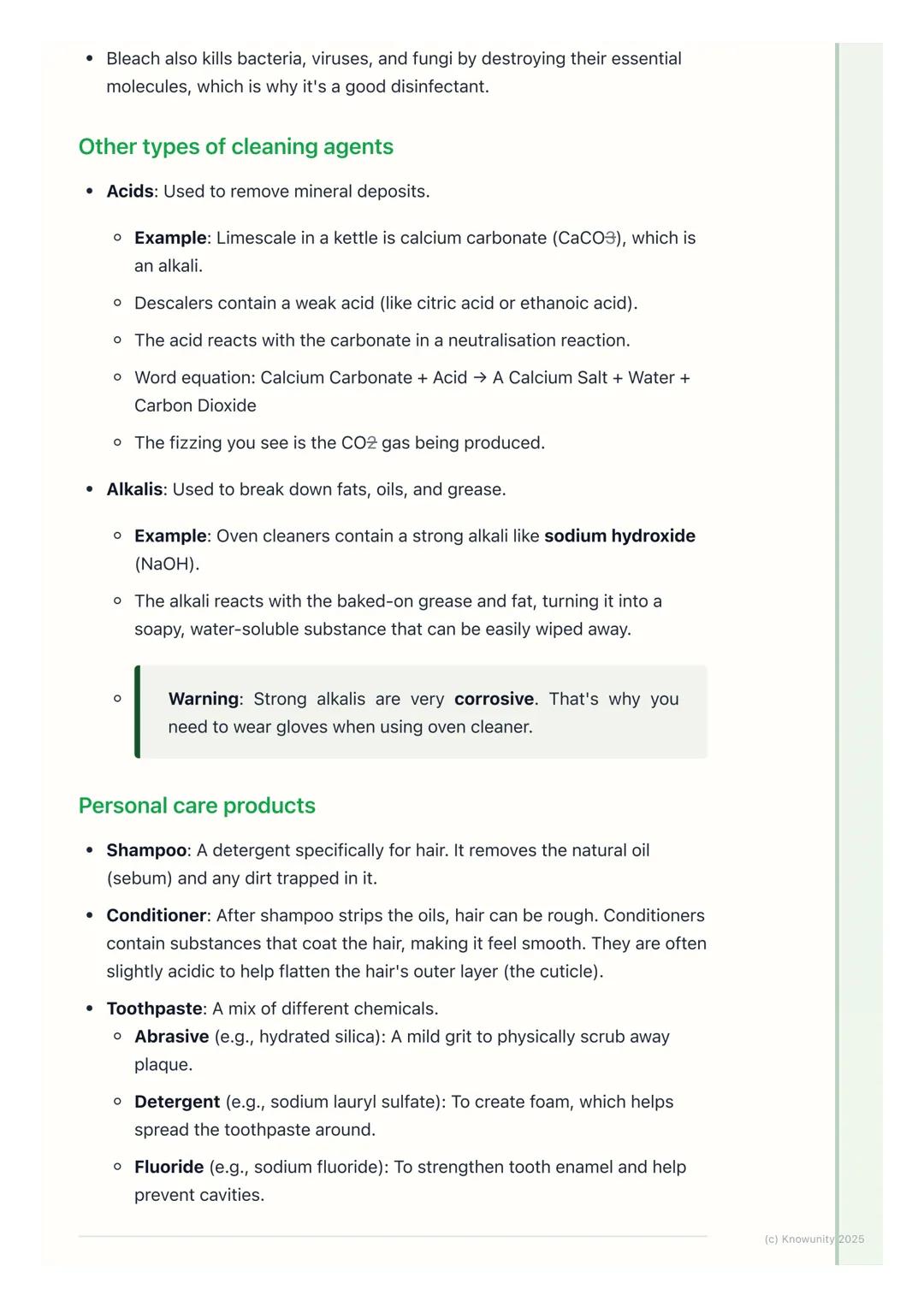
Other Cleaning Agents
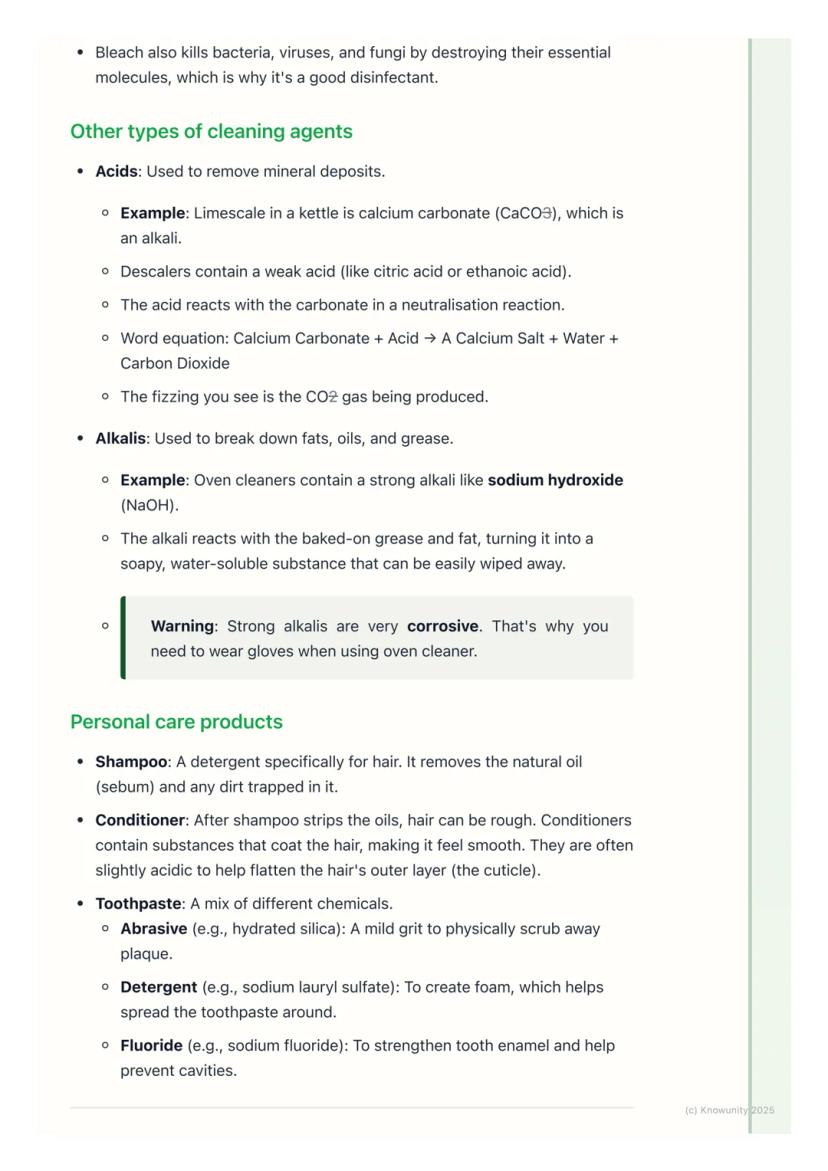
Acids tackle mineral deposits brilliantly. Limescale in your kettle is calcium carbonate (an alkali), so descalers contain weak acids like citric acid. The neutralisation reaction breaks down the limescale, producing carbon dioxide gas - that's the fizzing you see.
Alkalis destroy fats, oils, and grease. Oven cleaners contain strong alkali like sodium hydroxide that turns baked-on grease into soapy, water-soluble substances you can wipe away easily.
Personal care products use similar chemistry. Shampoo is basically detergent for hair that removes natural oils and trapped dirt. Conditioner coats hair with substances to make it smooth after shampoo strips the oils - it's often slightly acidic to flatten the hair's outer layer.
Toothpaste combines an abrasive (like hydrated silica) for physical scrubbing, detergent for foaming action, and fluoride to strengthen tooth enamel and prevent cavities.
Safety Alert: Strong alkalis like oven cleaner are seriously corrosive - always wear gloves and follow safety instructions!
5
of 6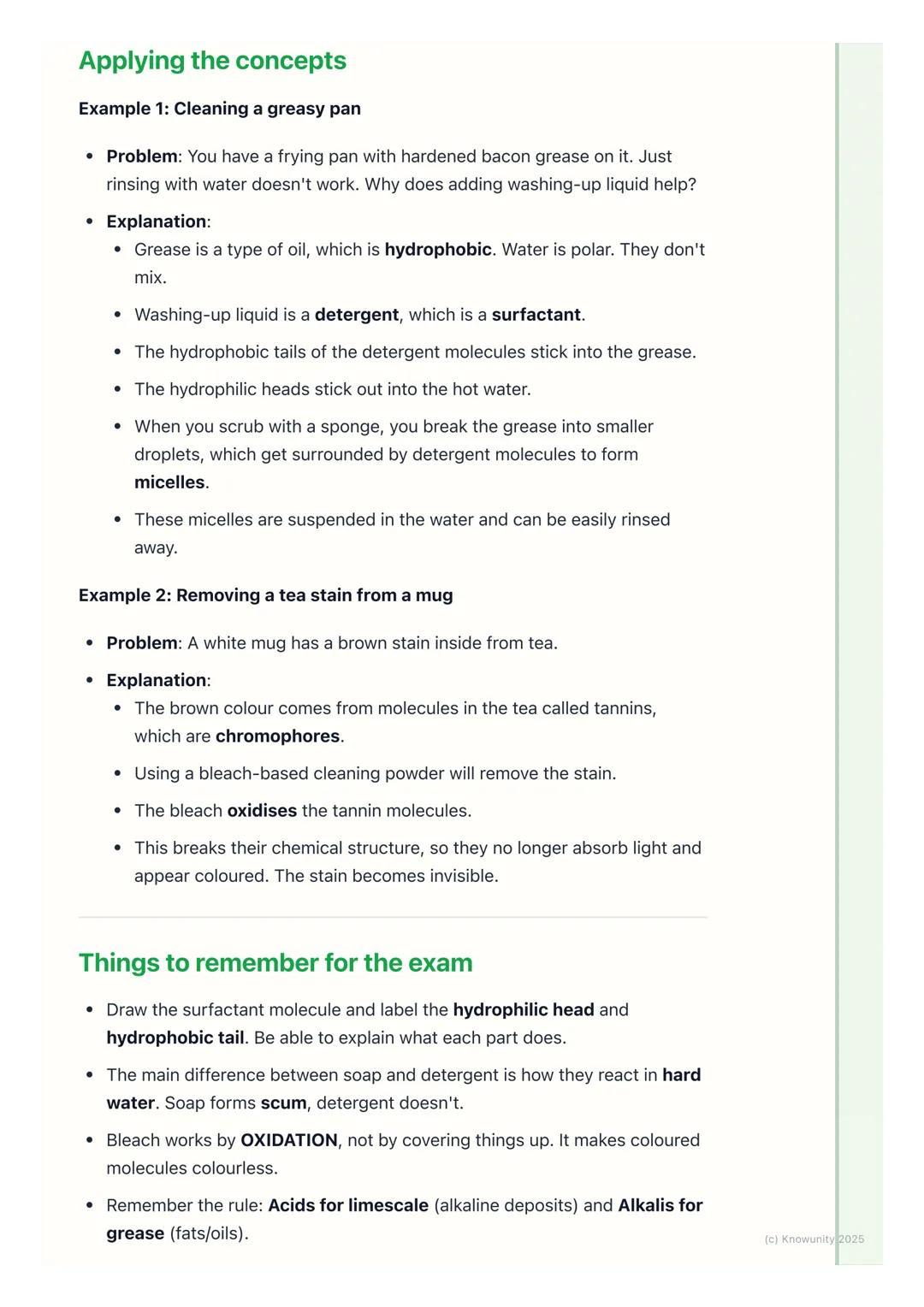
Real-World Applications
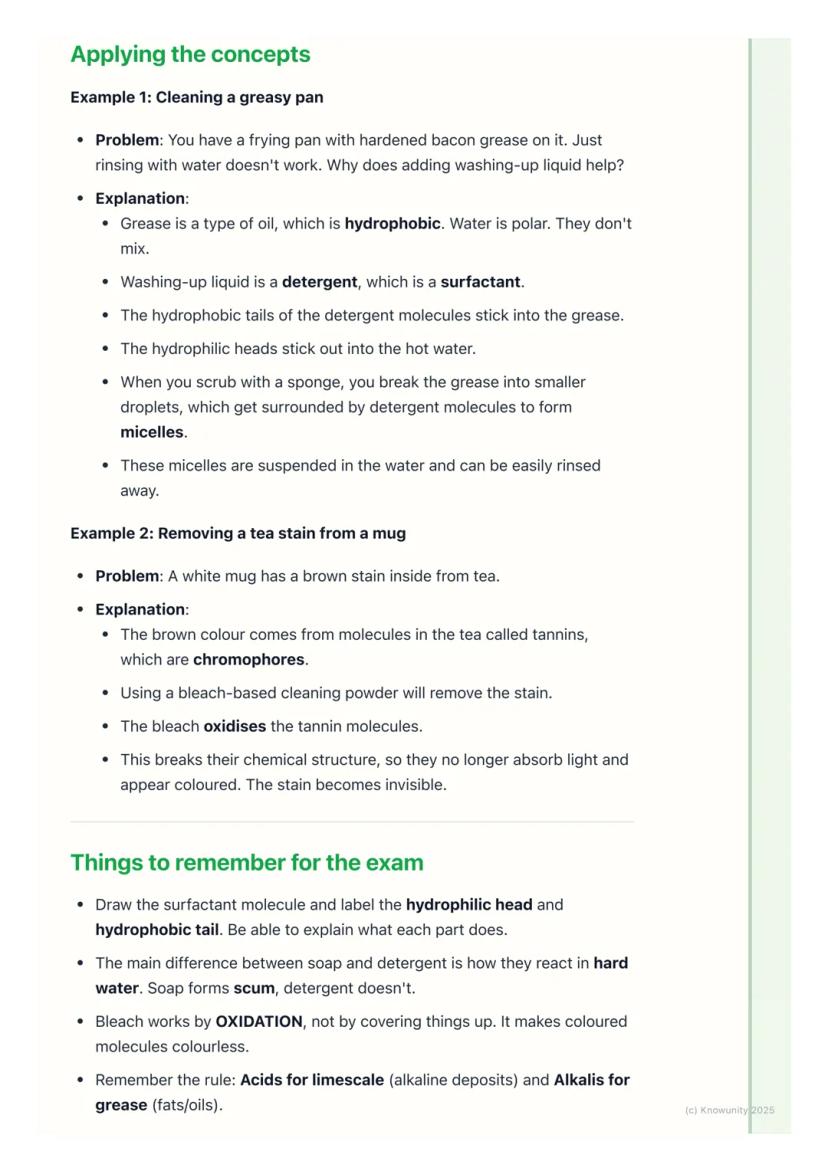
When you're cleaning a greasy frying pan, just water won't work because grease is hydrophobic and water is polar - they don't mix. Adding washing-up liquid changes everything because the detergent molecules act as bridges.
The hydrophobic tails stick into the grease whilst the hydrophilic heads point into the hot water. Scrubbing breaks the grease into smaller droplets that get surrounded by detergent molecules, forming micelles that can be rinsed away easily.
For tea stains on mugs, the brown colour comes from tannin molecules (chromophores) in tea. Bleach-based cleaning powder oxidises these molecules, breaking their structure so they can't absorb light and appear coloured anymore.
Remember the golden rule: acids for limescale (alkaline deposits) and alkalis for grease (fats and oils). Different chemistry problems need different chemical solutions.
Exam Success: Be able to draw a surfactant molecule with labelled hydrophilic head and hydrophobic tail - this diagram comes up regularly!
6
of 6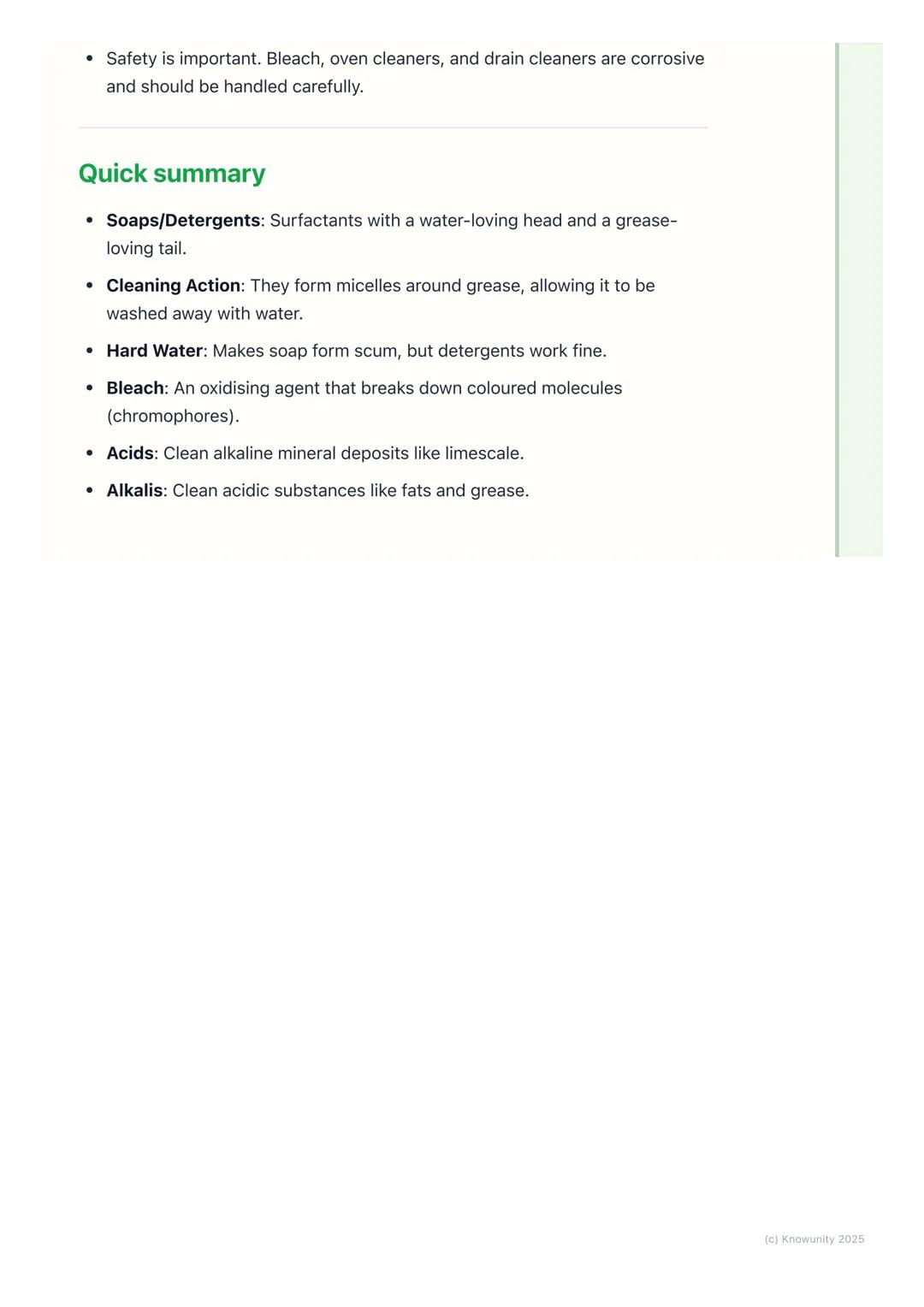
Key Points for Success
The main difference between soap and detergent is their behaviour in hard water - soap forms scum, detergent doesn't. This makes detergents much more effective in areas with mineral-rich water.
Bleach works by oxidation, not by covering things up. It permanently changes coloured molecules into colourless ones by breaking their chemical bonds. The stain molecules are still there, but they're invisible.
Safety matters with cleaning products. Bleach, oven cleaners, and drain cleaners contain corrosive substances that can seriously damage skin and eyes - always handle them carefully.
Quick revision summary: Surfactants have water-loving heads and grease-loving tails that form micelles to carry away dirt. Bleach oxidises chromophores to remove colour. Acids clean alkaline deposits whilst alkalis tackle greasy substances.
Final Tip: Understanding the 'why' behind cleaning chemistry makes the facts much easier to remember in exams!
Azt hittük, soha nem fogod megkérdezni...
Mi a Knowunity MI társ?
MI Társunk egy diákközpontú MI eszköz, amely többet nyújt puszta válaszoknál. Millió Knowunity erőforrásra épülve releváns információkat, személyre szabott tanulási terveket, kvízeket és tartalmat biztosít közvetlenül a chatben, alkalmazkodva az egyéni tanulási utadhoz.
Honnan tudom letölteni a Knowunity appot?
Az appot letöltheted a Google Play Store-ból és az Apple App Store-ból.
Tényleg ingyenes a Knowunity?
Pontosan! Élvezd az ingyenes hozzáférést a tanulási tartalmakhoz, kapcsolódj diáktársaiddal, és kapj azonnali segítséget – mind a kezed ügyében.
Legnépszerűbb tananyagok
9Nem találod amit keresel? Fedezz fel más tantárgyakat.
A diákok imádnak minket — és téged is fognak.
4.6/5App Store
4.7/5Google Play
Az alkalmazás nagyon könnyen használható és jól megtervezett. Mindent megtaláltam, amit eddig kerestem, és sokat tudtam tanulni a prezentációkból! Biztosan használni fogom az alkalmazást egy osztályfeladathoz! És persze inspirációként is nagyszerűen segít.
Stefan SiOS felhasználó
Ez az alkalmazás tényleg nagyszerű. Olyan sok tanulási jegyzet és segítség van benne [...]. Például a francia a problémás tantárgyam, és az alkalmazásban olyan sok segítség lehetőség van. Ennek az alkalmazásnak köszönhetően javult a franciám. Mindenkinek ajánlanám.
Samantha KlichAndroid felhasználó
Hű, tényleg lenyűgözött. Csak úgy kipróbáltam az alkalmazást, mert sokszor láttam reklámozva, és teljesen megdöbbentett. Ez az alkalmazás AZ A SEGÍTSÉG, amire az iskolában szükséged van, és mindenekelőtt olyan sok mindent kínál, mint például gyakorlatokat és összefoglalókat, amik nekem személyesen NAGYON hasznosak voltak.
AnnaiOS felhasználó
Chemistry12 megtekintések·Frissítve Jun 13, 2026·6 oldalCleaning Products and Personal Care Explained
Ever wonder why washing-up liquid actually works on greasy dishes, or how bleach makes stains disappear? The cleaning products you use every day aren't magic - they're clever chemistry in action, and understanding how they work will help you nail... Továbbiak megjelenítése
1
of 6Regisztrálj, hogy lásd a tartalmat. Teljesen ingyenes!
- Hozzáférés minden dokumentumhoz
- Javítsd a jegyeidet
- Csatlakozz diákok millióihoz
Introduction to Cleaning Products
Cleaning products work because of specific chemical reactions, not magic tricks. Each type targets different kinds of mess - you wouldn't use bleach on grease or washing-up liquid on limescale.
The key to understanding cleaning is knowing about surfactants - substances that make water "wetter" and better at cleaning. These clever molecules have two very different ends that don't normally get along.
Important terms you'll need to know: hydrophilic , hydrophobic , emulsion (oil and water mixture), micelles (tiny soap bubbles that trap grease), hard water (water with lots of dissolved minerals), and chromophores (the parts of molecules that create colour).
Quick Tip: Think of surfactants as molecular matchmakers - they help water and grease get along when they normally hate each other!
2
of 6Regisztrálj, hogy lásd a tartalmat. Teljesen ingyenes!
- Hozzáférés minden dokumentumhoz
- Javítsd a jegyeidet
- Csatlakozz diákok millióihoz
How Soap and Detergents Work
Here's the brilliant bit about surfactant molecules - they're like tiny molecular scissors with two completely different ends. One end (the hydrophilic head) loves water and is polar, while the other end (the hydrophobic tail) is a long hydrocarbon chain that's attracted to grease and oil.
When you add soap to greasy water, something amazing happens. The hydrophobic tails dive into the grease droplets to escape the water, while the hydrophilic heads stay pointing out into the water.
With a bit of scrubbing, large grease blobs break into smaller droplets that get completely surrounded by surfactant molecules - creating micelles. Because the outside of each micelle is covered in water-loving heads, the whole greasy mess can now be carried away by water as an emulsion.
Remember This: The surfactant acts like a bridge between grease and water, letting them mix and wash away together!
3
of 6Regisztrálj, hogy lásd a tartalmat. Teljesen ingyenes!
- Hozzáférés minden dokumentumhoz
- Javítsd a jegyeidet
- Csatlakozz diákok millióihoz
Soap vs Detergent
Both clean the same way, but they behave very differently in hard water - which is common in Ireland. Soap comes from natural fats and oils mixed with alkali, whilst detergent is synthetically made from crude oil.
The crucial difference happens in hard water. Soap reacts with calcium and magnesium ions to form scum - that greyish stuff around your bath. Much of your soap gets wasted making this insoluble mess instead of cleaning.
Detergents don't react with hard water minerals at all, so no scum forms. They work brilliantly in both hard and soft water, which is why your washing powder is a detergent, not soap.
Bleach works completely differently from soap. The active ingredient sodium hypochlorite is a powerful oxidising agent that breaks chemical bonds in chromophore molecules. It doesn't remove stains - it makes them colourless by changing their structure so they can't absorb visible light anymore.
Exam Essential: In hard water areas, detergents clean better than soap because they don't waste energy making scum!
4
of 6Regisztrálj, hogy lásd a tartalmat. Teljesen ingyenes!
- Hozzáférés minden dokumentumhoz
- Javítsd a jegyeidet
- Csatlakozz diákok millióihoz
Other Cleaning Agents
Acids tackle mineral deposits brilliantly. Limescale in your kettle is calcium carbonate (an alkali), so descalers contain weak acids like citric acid. The neutralisation reaction breaks down the limescale, producing carbon dioxide gas - that's the fizzing you see.
Alkalis destroy fats, oils, and grease. Oven cleaners contain strong alkali like sodium hydroxide that turns baked-on grease into soapy, water-soluble substances you can wipe away easily.
Personal care products use similar chemistry. Shampoo is basically detergent for hair that removes natural oils and trapped dirt. Conditioner coats hair with substances to make it smooth after shampoo strips the oils - it's often slightly acidic to flatten the hair's outer layer.
Toothpaste combines an abrasive (like hydrated silica) for physical scrubbing, detergent for foaming action, and fluoride to strengthen tooth enamel and prevent cavities.
Safety Alert: Strong alkalis like oven cleaner are seriously corrosive - always wear gloves and follow safety instructions!
5
of 6Regisztrálj, hogy lásd a tartalmat. Teljesen ingyenes!
- Hozzáférés minden dokumentumhoz
- Javítsd a jegyeidet
- Csatlakozz diákok millióihoz
Real-World Applications
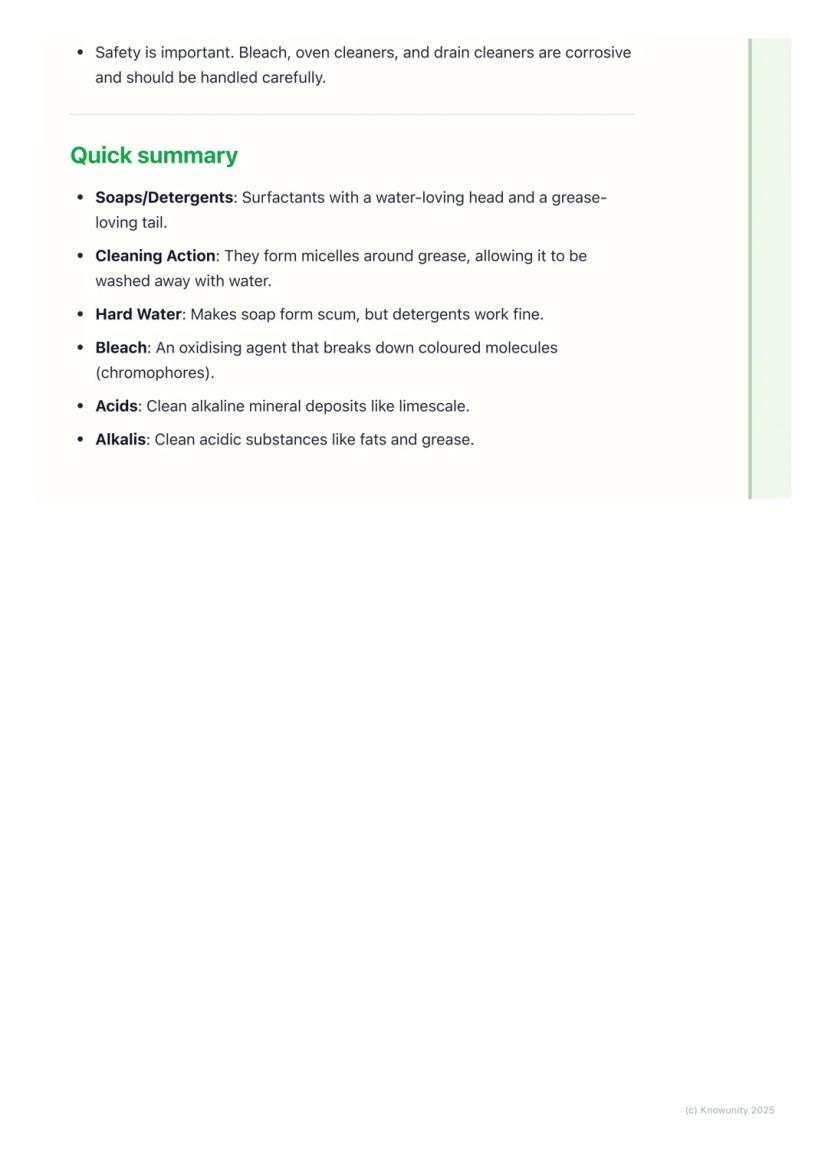
When you're cleaning a greasy frying pan, just water won't work because grease is hydrophobic and water is polar - they don't mix. Adding washing-up liquid changes everything because the detergent molecules act as bridges.
The hydrophobic tails stick into the grease whilst the hydrophilic heads point into the hot water. Scrubbing breaks the grease into smaller droplets that get surrounded by detergent molecules, forming micelles that can be rinsed away easily.
For tea stains on mugs, the brown colour comes from tannin molecules (chromophores) in tea. Bleach-based cleaning powder oxidises these molecules, breaking their structure so they can't absorb light and appear coloured anymore.
Remember the golden rule: acids for limescale (alkaline deposits) and alkalis for grease (fats and oils). Different chemistry problems need different chemical solutions.
Exam Success: Be able to draw a surfactant molecule with labelled hydrophilic head and hydrophobic tail - this diagram comes up regularly!
6
of 6Regisztrálj, hogy lásd a tartalmat. Teljesen ingyenes!
- Hozzáférés minden dokumentumhoz
- Javítsd a jegyeidet
- Csatlakozz diákok millióihoz
Key Points for Success
The main difference between soap and detergent is their behaviour in hard water - soap forms scum, detergent doesn't. This makes detergents much more effective in areas with mineral-rich water.
Bleach works by oxidation, not by covering things up. It permanently changes coloured molecules into colourless ones by breaking their chemical bonds. The stain molecules are still there, but they're invisible.
Safety matters with cleaning products. Bleach, oven cleaners, and drain cleaners contain corrosive substances that can seriously damage skin and eyes - always handle them carefully.
Quick revision summary: Surfactants have water-loving heads and grease-loving tails that form micelles to carry away dirt. Bleach oxidises chromophores to remove colour. Acids clean alkaline deposits whilst alkalis tackle greasy substances.
Final Tip: Understanding the 'why' behind cleaning chemistry makes the facts much easier to remember in exams!
Azt hittük, soha nem fogod megkérdezni...
Mi a Knowunity MI társ?
MI Társunk egy diákközpontú MI eszköz, amely többet nyújt puszta válaszoknál. Millió Knowunity erőforrásra épülve releváns információkat, személyre szabott tanulási terveket, kvízeket és tartalmat biztosít közvetlenül a chatben, alkalmazkodva az egyéni tanulási utadhoz.
Honnan tudom letölteni a Knowunity appot?
Az appot letöltheted a Google Play Store-ból és az Apple App Store-ból.
Tényleg ingyenes a Knowunity?
Pontosan! Élvezd az ingyenes hozzáférést a tanulási tartalmakhoz, kapcsolódj diáktársaiddal, és kapj azonnali segítséget – mind a kezed ügyében.
Legnépszerűbb tananyagok
9Nem találod amit keresel? Fedezz fel más tantárgyakat.
A diákok imádnak minket — és téged is fognak.
4.6/5App Store
4.7/5Google Play
Az alkalmazás nagyon könnyen használható és jól megtervezett. Mindent megtaláltam, amit eddig kerestem, és sokat tudtam tanulni a prezentációkból! Biztosan használni fogom az alkalmazást egy osztályfeladathoz! És persze inspirációként is nagyszerűen segít.
Stefan SiOS felhasználó
Ez az alkalmazás tényleg nagyszerű. Olyan sok tanulási jegyzet és segítség van benne [...]. Például a francia a problémás tantárgyam, és az alkalmazásban olyan sok segítség lehetőség van. Ennek az alkalmazásnak köszönhetően javult a franciám. Mindenkinek ajánlanám.
Samantha KlichAndroid felhasználó
Hű, tényleg lenyűgözött. Csak úgy kipróbáltam az alkalmazást, mert sokszor láttam reklámozva, és teljesen megdöbbentett. Ez az alkalmazás AZ A SEGÍTSÉG, amire az iskolában szükséged van, és mindenekelőtt olyan sok mindent kínál, mint például gyakorlatokat és összefoglalókat, amik nekem személyesen NAGYON hasznosak voltak.
AnnaiOS felhasználó